Log In Register

comparison grow: HPS vs Induction

  • Thread starter Thread starter calbunn
  • Start date Start date
  • Tagged users Tagged users None

comparison grow: HPS vs Induction

calbunn 276 Replies 66,760 Views
Page 3 of 14 · Replies 41–60 of 277
I'm glad to see that people are embracing the benefits of full spectrum lighting. I have switched my rooms to dual-arcs about a year ago.

I just wish that plasma and CMH options were available in 1000 watt versions...

Why plasma or CMH at such high wattages?

I've seen definite benefits with wide spectrum phosphors such as reduced wattage, reduced heat, longer lamp life, higher quality product, etc....with the biggest drawback as intial cost to purchase. But when you compare the cost p/gram and expense lamp change outs 2x a year with both the MH and HPS plus the added HID ventilation for cooling HID which the 420's don't need then the return of that intial investments can be expensed within 1-2 harvests.

So I won't consider any single lamp @ 1000 watts unless it yields better then a gram/watt allows full veg-bud from a single lamp source and I can get a year or more out of the lamp life. Not sure about the 1000 watt dual-arc lamps for full spectrum but sulphur plasma for PAR spectrums is strictly a veg UV band lamp and they run about $1,500.00 per light.

Here are week 5 pics of the IDA White Russian, Waikiki Queen and Sugar Baby all under the 420 series.

Happy Thanksgiving to All!
 

Attachments

  • IDS White Russian wk 5.JPG
    IDS White Russian wk 5.JPG
    104 KB · Views: 271
  • Sugar Baby wk 5.JPG
    Sugar Baby wk 5.JPG
    133.8 KB · Views: 264
  • week 5.jpg
    week 5.jpg
    56.6 KB · Views: 272
Yea i'm referring to 10-15k watt rooms. I understand why plasma lights won't reach 1k for a while and patent holders for CMH technology have no intention for releasing anything more than 400 watts.

I'll need to figure out some way to add supplement plasma lighting in my room. I believe the UV spectrum is something that's missing from indoor grows.
 
Yea i'm referring to 10-15k watt rooms. I understand why plasma lights won't reach 1k for a while and patent holders for CMH technology have no intention for releasing anything more than 400 watts.

I'll need to figure out some way to add supplement plasma lighting in my room. I believe the UV spectrum is something that's missing from indoor grows.

I agree it's a bandwidth missing in all HPS lamps and should be available at flower if you wish to create these bud densities. UVB at flower seems to force the plant to create more resin, oil and trichromes to protect itself from the UVB presence.

On veg I'm now seeing 1-2" growth per day on an 18/6 cycle. For me I'm happy with that and I'm not looking to supplement the UV with a higher wattage source that doesn't cover as large of an area.
 
The spectral emissions in the peak carotenoid ranges of 400-520 pick up spectrums that have been lower or missing in the MH bandwidth making a case for these widespectrum blends.

This strain is an F1 Skunk x Haze, 9-10wk flower period. The pics are in the middle of week 7. This started as cuttings that were taken from a very sickly mother at the end of July. There were 9 cuttings taken, with 6 surviving. The cuttings were put under T12 fluorescents (45W x 4) until rooted firmly and pushing new growth, approx 14-20 days. 3 were then placed under the inda-gro 420 for 14 days of 18/6 veg.

The new growth in this time under the inda-gro was explosive and vigorous. Lights were then turned back to 12/12, while the other 3 were saved as mothers and left under the fluories for 18/6. The mothers get cut back every 14-17 days and cutting are taken every 6 weeks. Mothers get put into the flowering area after 3-4 cycles. The goal for the future is to get a few Inda-Gro Pro200PAR's for mothering/cuttings so that the plants can be acclimated to these blends from the onset.
 

Attachments

  • IMG_0177.JPG
    IMG_0177.JPG
    91.1 KB · Views: 173
  • IMG_0179.JPG
    IMG_0179.JPG
    86.2 KB · Views: 173
  • IMG_0180.JPG
    IMG_0180.JPG
    87.4 KB · Views: 170
  • IMG_0183.JPG
    IMG_0183.JPG
    85 KB · Views: 171
Missing Wavelengths

I found this to be a worthwhile read on Carotenoids and how they function as an 'accessory pigment' in a plants development.

Carotenoids absorb wavelengths that traditionally are missing or unstable within HID lamp spectrums but in sunlight or with lamps that provide these 400-530nm spectrums it allows more of that energy to be absorbed which chlorophyll A/B do not effectively absorb but the presence of these wavelengths will contribute to overall plant development.

I found it particularily interesting, section 3, at how similar the leaf structure is to human skin.


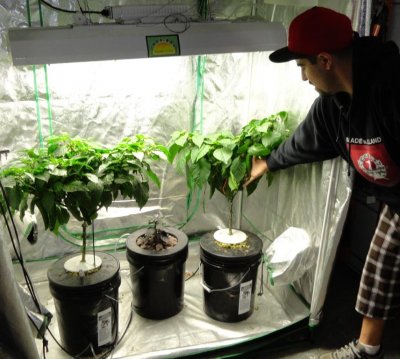
This isn't my grow but I thought the 8 week peppers were worth showing as these plants were brought up from veg thru fruit completely utilizing a single widespectrum lamp blend and not one problem leaf in the entire tent.
 

Attachments

  • 8.1.JPG
    8.1.JPG
    94.4 KB · Views: 180
  • 8.2.JPG
    8.2.JPG
    130.9 KB · Views: 173
Light Rail Grow

I've got my light rail covering about 20' x 12' with two fixtures.
 

Attachments

  • IMG_6422.JPG
    IMG_6422.JPG
    83.4 KB · Views: 272
  • IMG_6425.JPG
    IMG_6425.JPG
    85.6 KB · Views: 268
  • IMG_6426.jpg
    IMG_6426.jpg
    90.7 KB · Views: 292
  • IMG_6427.JPG
    IMG_6427.JPG
    83.8 KB · Views: 269
  • IMG_6429.jpg
    IMG_6429.jpg
    121.2 KB · Views: 273
  • IMG_6419.jpg
    IMG_6419.jpg
    82.4 KB · Views: 273
what strain and how far along is that last bud shot?
IT is impressive for such coverage.
 
what strain and how far along is that last bud shot?
IT is impressive for such coverage.
Thanks it is impressive results for only two 420 watt lights being used from veg on. That's the White Russian at week 6. She's very healthy with better budding on the bottom branches since this setup.

Knowledge is Power
 
12x20 is huge and I would expect that 800w would betotally outclassed in that much space, even with a mover.
That is a nice white Russian if it still has 2-3 more weeks to fill out, it looks pretty nice already.
 
12x20 is huge and I would expect that 800w would betotally outclassed in that much space, even with a mover.
That is a nice white Russian if it still has 2-3 more weeks to fill out, it looks pretty nice already.
I completely agree! The inside of these lights is highly reflective so I definitely see more light making the canopy. Look closely at the pictures and you'll see the plants in the reflectors they're like in a mirror.

What's also remarkable is that the same WR plants on the outer edge of the HPS grow 10ft away have actually turned towards the inda-gro's so even the lower intensity horizontal distribution levels are having a positive effect.
 
How's the drying coming along for that mid-nov harvest?
 
the latest harvest was on Thanksgiving which was the Barney's LSD which got to 5 ft. wet weight average @ 380g per plant compared to my 1000 hps which usually wetts @ 270g for this strain. I'm giving this one 30 days for dry/cure.

less wattage, less heat, less stretching, top to bottom there was better bud initiation and development with no infestation means a happy Calbunn :clapping
 
So before you got over half a lb per with two 1k hps on a mover in 12x20? I'm pretty interested in these induction lamps, and have read evrything you and the other five guys have written on the subject, on every forum, just wanna make sure I'm making the comparisons correctly..
 
Oh, and do they kill borg or something? What exactly do you mean by no infestations?
 
HE is posting wet weights, which I never really understand people bothering to measure.

Dry weight is 10-20% of wet, so you are looking at 2-3zs per plant across a 12x20 space I think.


Calbunn can perhaps reveal dry weights and comparisons once he completes his cure.
 
Interesting and informative thread, guys. Thanks for the level-headed discussion - it's a relief to see these conversations not result in posturing and head butts.

Anyway, I'm particularly interested in the UV component to these lights. It makes sense that it's useful for plants to some degree, seeing as how they y'know evolved by growing under the sun. Funny how people conveniently forget that mimicking nature as closely as possible is probably what we should all be shooting for, at least at first.

I have a few not-very-scientific questions for you, Calbunn. How has your electrical bill responded to these lights as compared to others you've used? And how much heat do they throw, also in comparison? How close can you hold your hand to it? Not asking for specific measurements (unless of course you have them already written down ;D ), just wondering if throwing a 200w lamp into my 6x3x3 tent would cook plants or create a big glowing Bust Me sign for the Po. Stealth is one of my top considerations; visually, heat signature-wise, and spiking electric bill-wise as well.
 
I don't want to mimic nature. I want to push the plants to reasonable and healthy limits, while giving them a high performance diet of everything they need to perform to a high athletic standard. Health, overall quality, yield, medicinal effects. And I want to do this via the most effective means (light, nutes, environment, etc). Does this lamp belong in my armamentarium is the question.

And by effective I mean evidence-based, peer reviewed. Other than mfg marketing literature, anecdotal accounts are all we have to work with so far and the basic currency of these forums). Extraordinary claims require extraordinary evidence (quoting Carl Sagan, but really a truism). I'm looking for enough evidence to justify the expense of doing a proper trial myself, haven't found it yet.
 
I don't get the wet weight thing either. His setup doesnt sound conducive to pulling conclusive data (movers, rotating plants in and out, etc). Calbunn, are you running an interval harvest?

(edit) Wait a minute, so that means you're pulling around 2oz from a 5ft plant, average? Sounds pretty space-inefficient, is that just how it goes with these?
 
EC - Agreed on all counts.

What I was trying to say re: referring to nature (sorry if you took that as a dig - didn't mean it as one) was that looking at what the sun provides in as broad a way as possible seems to me to be a sensible place to start the journey towards perfecting how we light our plants. A light that radiates on all the same bands as the sun as viewed from within our atmosphere will probably be more effective than a light which has significant gaps, in other words. Granted this probably won't be possible until we get a cold fusion generator in every house and a chicken in every pot, or something (not holding my breath), but I'm just trying to use an extreme example.

As for getting solid stats of the actual outputs of all these various lights, I think that everyone can agree on that. But like you're saying, for the time being it becomes difficult for any one person to verify the claims if the companies even provide info in the first place. Maybe we should form a consumer reports for mmj - has anyone done that in even a small way? Seems like an idea whose time has come.

Toward that end, what are the important pieces of information when it comes to rating lights? I'm pretty ignorant when it comes to this stuff, but it seems that PAR, spectral bands produced, electrical draw, and BTUs radiated are all worth mentioning. I'd love some help with making a comprehensive list of questions which I can ask light manufacturers in the future, if you wouldn't mind helping me put one together. If it doesn't already exist somewhere, that is...
 
Oh, and do they kill borg or something? What exactly do you mean by no infestations?

No I haven't put them against incoming cyborgs yet. Vampire yes but borgs no.

What I was saying was that indirectly the plants overall health is better as a result of the lamps low heat signatures and less stress on the plant makes for a healthier more robust plant that can better defend itself from predators and or some airborne pathogens that I avoided in this grow.

I'm not saying that these lamps will completely eliminate infestation. I just avoided it and I believe the overall environment helps contribute to that defense mechanism.
 
Page 3 of 14 · Replies 41–60 of 277
Back
Top Bottom