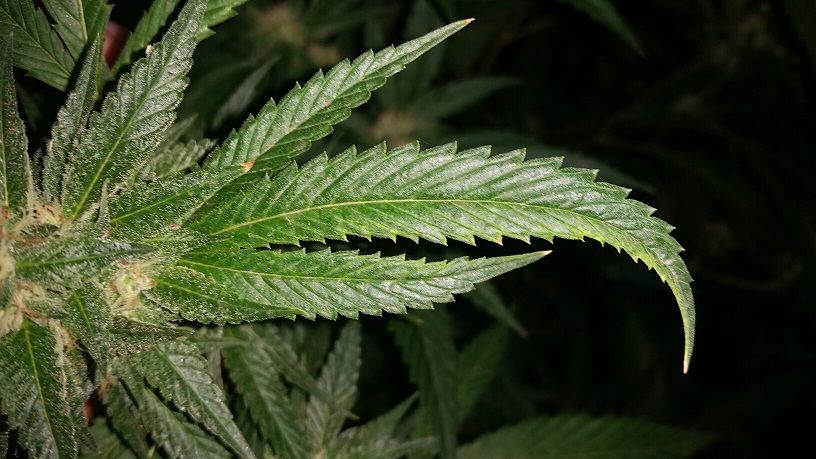
Kelp meal top dress and done. Make sure your pH is good and you aren't overwatering.
Leaf twists and distortions...potassium.
Your plant is plowing through carbon right now.
Carbon, hydrogen, and oxygen constitute 96% of a plant’s dry weight. Source leaves are the primary sites
of C reduction and the main organs exporting reduced C to growing sinks. It is well known that in almost
all species, sugars, starch, and amino acids accumulate in leaves during the daytime and export of assim-
ilates derived from these reserves occurs both concurrently with photosynthesis and subsequently during
night periods [1–5]. Our overall knowledge of translocation processes has been derived from diverse ex-
perimental approaches [6–11]. For example, imaging techniques, which include light, electron, and fluo-
rescence microscopy using dyes or proteins, provide valuable qualitative data on intercellular connections
and export [12–16]. Generally, these imaging techniques are destructive. However, procedures using iso-
topes of carbon (e.g., mass isotopes, 13C, and radioisotopes, 11C and 14C) to study export can be both
quantitative and noninvasive [7,17–19]. Phloem sap exudation from cut sieve tubes or from aphid stylec-
tomy has provided a practical means of sampling mobile assimilates [20]. Collection of apoplastic fluids
[21–22] and measurements of pH and membrane potential [23] further demonstrate the physiological and
biochemical interactions that operate intercellularly as sugars are loaded or unloaded from the phloem.
More recently, molecular techniques have led to characterization of sugar transporters [24] and the engi-
neering of transgenic plants that can be designed to provide important information regarding the role of
specific export processes in the leaves [11,25].
Most researchers who have studied translocation [6,5,26–29] acknowledge that it is very difficult to
quantify simultaneously (1) C assimilation by the leaf, (2) C recycling within the leaf, (3) temporary C
storage within the leaf, and (4) immediate C efflux rate via the phloem. It is even more complex to relate
any of these leaf processes to daily export patterns and relative growth rates (RGRs) at the whole plant
level [30].
One of our interests has been to examine the importance of product removal from the leaf in pro-
cesses such as C recycling in that organ specifically during periods of active photosynthesis and pho-
torespiration [18,31–34]. By knowing what is happening quantitatively to export concurrently with CO2
fixation, we are better able to evaluate concepts such as feedback inhibition of photosynthesis and quan-
tify intercellular movements of metabolites that link long-distance export to sinks and the primary
metabolism of the leaf (i.e., photosynthesis).