
Log In Register

New to LED LIGHTS ALL HELP WELCOMED

  • Thread starter Thread starter diereckeddank
  • Start date Start date
  • Tagged users Tagged users None

New to LED LIGHTS ALL HELP WELCOMED

diereckeddank 22 Replies 2,273 Views
Page 1 of 2 · Replies 1–20 of 23
D

diereckeddank

Posts
31
Reactions
18
Joined
Feb 11, 2025
Points
8
Hello there, first time poster, long time grower under hps.
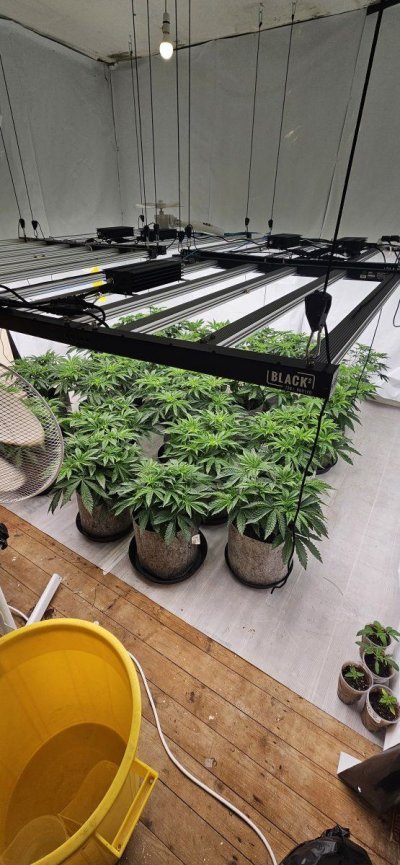
What ppfd are you guys running under mid veg ? These gals are 4 weeks from when I opened the seed pack, and I know for sure I freaked them out 2 weeks ago by busting up to 75 percent light at 50cm when they were a quarter of the size they are now, but after having to adapt my pot choice due to my wet to dry cycle being way to long, I'm wondering if the light green new leaves and yellowing tips is nitrogen deficiency rather than to much light due to me not being able to feed until they had dried out . Have rectified the wet to dry time now to 48 hours. Girls are all topped, tied down and in 16l fabric pots but what I also need to take into account is the fact the smaller ones width wise aren't showing the yellowing tips, just the monsters. That's screaming nitrogen deficiency to me as they weren't depleting the soil so quickly. Any ideas much appreciated. Also, I'm loving the new lights not had this much thick consistent growth under hps before and I've been going for 10 years . But just a bit of a learning curve. Also, I'm going to flip now as I don't think I can really go any wider and just want to use this run as a practise run but I'm sure this is going to fill up every square inch nice and evenly.
Also adding calmag at half strength every feed after a few people said beneficial due to the power of leds

Thankyou guys
 

Attachments
  • 20250213_193151.mp4
    111.1 MB
  • new-to-led-lights-all-help-welcomed.jpg
    new-to-led-lights-all-help-welcomed.jpg
    164.7 KB · Views: 3
  • new-to-led-lights-all-help-welcomed-2.jpg
    new-to-led-lights-all-help-welcomed-2.jpg
    226.8 KB · Views: 3
Last edited:
I see edge curl, taco-ing, and interveinal yellowing, all of which say "too much light" to me. Over-lighting and nutrient deficiencies are related. The light is the accelerator pedal, the nutes are the gas in the tank, and the roots are the carbuerator or fuel injector. The hotter you run your lights, the more demand there is for nutrients. The interveinal yellowing is likely your lights outrunning the magnesium available to the plants. Magnesium is the central atom in a chlorophyll molecule. Not enough = less green. It might be that there isn't enough Mg in the pots, but it also might be that you've reached the roots' capacity for uptake. If those were mine, I'd move the light higher and turn it down.
 
I see edge curl, taco-ing, and interveinal yellowing, all of which say "too much light" to me. Over-lighting and nutrient deficiencies are related. The light is the accelerator pedal, the nutes are the gas in the tank, and the roots are the carbuerator or fuel injector. The hotter you run your lights, the more demand there is for nutrients. The interveinal yellowing is likely your lights outrunning the magnesium available to the plants. Magnesium is the central atom in a chlorophyll molecule. Not enough = less green. It might be that there isn't enough Mg in the pots, but it also might be that you've reached the roots' capacity for uptake. If those were mine, I'd move the light higher and turn it down.
Brilliant info, I think i definitely pushed them into deficiency with not being used to the wet and dry times for a fortnight in solid plastic pots with the room at 26. Ordinarily I'd be feeding under hps every 2 days, but was only managing every 4 days so same age plants were getting half the nutes. So now that I'm flipping to 12 12 and I'm under about 450ppfd , should I allow the plants to stretch into the light and find a slightly higher ppfd as the total daily light has been cut by 50 percent ?
Also, do you reckon I should up my calmag , current using it at half ratio

Cheers buddy
 
Last edited:
The first thing I'd do is move your lights higher and turn them down, and watch the plants to see if they're enjoying the new light level. There are lots of ways to grow. I'll just tell you what I do. I don't flip sick plants. If they were mine, I'd veg as long as I need to to get them healthy, then flip. If that meant removing plants to make enough room for the stretch, I'd do it. (I've done it.) Without knowing what the full ratio of calmag is, it's tough to say if half is enough. In soil, I start calmag at 50 ppms in week three of seedling, and bump it up another 50 ppms any time I see symptoms on new growth. How much I end up giving seems to be strain (and even pheno) dependent. Some cultivars love light. Some don't. I put calmag in every non-feed watering after S3, until the fourth week of flower, when I switch to magnesium sulfate.
 
The first thing I'd do is move your lights higher and turn them down, and watch the plants to see if they're enjoying the new light level. There are lots of ways to grow. I'll just tell you what I do. I don't flip sick plants. If they were mine, I'd veg as long as I need to to get them healthy, then flip. If that meant removing plants to make enough room for the stretch, I'd do it. (I've done it.) Without knowing what the full ratio of calmag is, it's tough to say if half is enough. In soil, I start calmag at 50 ppms in week three of seedling, and bump it up another 50 ppms any time I see symptoms on new growth. How much I end up giving seems to be strain (and even pheno) dependent. Some cultivars love light. Some don't. I put calmag in every non-feed watering after S3, until the fourth week of flower, when I switch to magnesium sulfate.
I certainly can't wait to do a run with cuts I know , il get there I'm sure , not enough time to veg for longer really so just have to hope the few affected pirk up over transition . Also sitting pondering last night if the leaves that are light effected were the under canopies I'd revealed during first round of lst that had never recieved that amount of light . Maybe I've rushed ,basing things on my experience of hps . Oh well, we live and learn !
Il be starting a journal on these though as 15 of the 19 are a very special strain that not many know about, I can't find a journal or pics anywhere but ran them before. They're called Wet Cherries by Offensive Selections. Tropicana cookies x pink ladies. My christ there were some absolute stunners in the last couple of packs, but also alot of variation in phenos, so this will be my last hunt with these as they get hard work in flower .
Thankyou for your input champ 🏆
 
I see edge curl, taco-ing, and interveinal yellowing, all of which say "too much light" to me. Over-lighting and nutrient deficiencies are related. The light is the accelerator pedal, the nutes are the gas in the tank, and the roots are the carbuerator or fuel injector. The hotter you run your lights, the more demand there is for nutrients. The interveinal yellowing is likely your lights outrunning the magnesium available to the plants. Magnesium is the central atom in a chlorophyll molecule. Not enough = less green. It might be that there isn't enough Mg in the pots, but it also might be that you've reached the roots' capacity for uptake. If those were mine, I'd move the light higher and turn it down.
 

Attachments

  • bob.jpg
    bob.jpg
    127.1 KB · Views: 3
I can't not , no other option sadly or il be cancelling holidays .
However, it's been 3 days since that last video, they've had a super nice few days of feed and are looking spectacular compared, will update tomorrow or the next day 🏆
 
Hang it as high in the tent as possible. You don’t need to get them that close. Start at 40% when the plants are praying right before lights out then increase the intensity by 10% I like to be about 70% when I flip to flower.
 
Hang it as high in the tent as possible. You don’t need to get them that close. Start at 40% when the plants are praying right before lights out then increase the intensity by 10% I like to be about 70% when I flip to flower.
Theyre dual ballasts, so at maximum one light one ballast 4ft x 4ft area is 720w, or I can double up and crank 960 . When they were 12 days from sprout I upped to 75 percent for 3 days without realising just how much power it was at 50 cm . But I'm not sitting at 400pfd and going to continue to measure and monitor , but in sure it was what I done the other weak as ppfd seems to be what everyone's suggesting, around 400 . At 50 percent . Just a mistake as under hps I would of ordinarily lowered the lights then as wouldn't want stretch, I underestimated the strength of them and and clearly paying for it now . I'm still very impressed with growth rate and the node intervals even with my mistakes so far . Thankyou mate please keep an eye and any info appreciated 👍
 
Hang it as high in the tent as possible. You don’t need to get them that close. Start at 40% when the plants are praying right before lights out then increase the intensity by 10% I like to be about 70% when I flip to flower.
I'm at 400ppfd at 60cm height now . Surely if I put it higher I just need to raise the power to achieve the 400 ppdf ? Any less is surely to little for plants this size ? From what I've read and watched
 
I'm at 400ppfd at 60cm height now . Surely if I put it higher I just need to raise the power to achieve the 400 ppdf ? Any less is surely to little for plants this size ? From what I've read and watched
I don’t measure light. Completely unnecessary.
 

Attachments

  • IMG_3380.jpeg
    IMG_3380.jpeg
    238.2 KB · Views: 4
I don’t measure light. Completely unnecessary.
Really ? Why ? Surely taking the guesswork and waiting times out of just observing your plants to see if they're happy and having stuff logged would only help in speeding up growth ? Like, surely there are optimum intensities for best rates of growth ?
Genuine question
 
Really ? Why ? Surely taking the guesswork and waiting times out of just observing your plants to see if they're happy and having stuff logged would only help in speeding up growth ? Like, surely there are optimum intensities for best rates of growth ?
Genuine question
Sure there are best intensity’s. What are they? Does every plant want the same amount? By watching what the plants want you can make a better judgement call than what a reading shows.
 
Really ? Why ? Surely taking the guesswork and waiting times out of just observing your plants to see if they're happy and having stuff logged would only help in speeding up growth ? Like, surely there are optimum intensities for best rates of growth ?
Genuine question
like @Natep i also quit measuring light.

since i grow from seed, light needs are too variable. if i grew from clone, maybe. but even then id know what they need from the first run.

plus i grow for myself and family. i dont need to chase maximum efficiency. its a noble goal, but when plants are being pushed hard, the smaller dumb mistakes can have more impact.

ive had a lot of practice making dumb mistakes and im getting good at them, so i follow the adage to not let perfect become the enemy of good enough.
 
Like, surely there are optimum intensities for best rates of growth ?
Genuine question
Per plant and at a particular time, sure. The trick is, how do we determine what those optimum intensities are? A plant with kushy genetics whose ancestors evolved at 35° north will have a very different appetite for light than some equatorial heatseeker. Not to mention all the hybrids in between. Unless they're growing your genetics, someone who tells you how many ppfd is "right" for your plants at your stage is guessing. The best light meter any of us owns is the plant.

If you're monocropping one genotype from clones over and over, then a PAR meter is great for recording what was too much, what was too little, and what was just right at different stages for those plants. Then we can use that information next time to dial in the lights. But that's based on what that plant shows us. Meters don't know what our gardens look like, and if the genetics are different, the light needs are likely to change, too.
 
Last edited:
Sure there are best intensity’s. What are they? Does every plant want the same amount? By watching what the plants want you can make a better judgement call than what a reading shows.
Makes sense
 
Per plant and at a particular time, sure. The trick is, how do we determine what those optimum intensities are? A plant with kushy genetics whose ancestors evolved at 35° north will have a very different appetite for light than some equatorial heatseeker. Not to mention all the hybrids in between. Unless they're growing your genetics, someone who tells you how many ppfd is "right" for your plants at your stage is guessing. The best light meter any of us owns is the plant.

If you're monocropping one genotype from clones over and over, then a PAR meter is great for recording what was too much, what was too little, and what was just right at different stages for those plants. Then we can use that information next time to dial in the lights. But that's based on what that plant shows us. Meters don't know what our gardens look like, and if the genetics are different, the light needs are likely to change, too.
Makes sense. Well, it looks like my adventure begins now 👍👍
 
Per plant and at a particular time, sure. The trick is, how do we determine what those optimum intensities are? A plant with kushy genetics whose ancestors evolved at 35° north will have a very different appetite for light than some equatorial heatseeker. Not to mention all the hybrids in between. Unless they're growing your genetics, someone who tells you how many ppfd is "right" for your plants at your stage is guessing. The best light meter any of us owns is the plant.

If you're monocropping one genotype from clones over and over, then a PAR meter is great for recording what was too much, what was too little, and what was just right at different stages for those plants. Then we can use that information next time to dial in the lights. But that's based on what that plant shows us. Meters don't know what our gardens look like, and if the genetics are different, the light needs are likely to change, too.
When the plant does want more light in a week or what have you , am I better to let the plant stretch up into the light and not move fixture, or to keep raising the light but increase the power ? Thankyou
 
When the plant does want more light in a week or what have you , am I better to let the plant stretch up into the light and not move fixture, or to keep raising the light but increase the power ? Thankyou
My lights live at the top of my tents, so that when the intensity on the tops looks good, they put as much light into the lower canopy as possible. I don't move my fixtures. But to answer your question, having your light higher at a higher dimmer setting makes a deeper canopy.
 
Page 1 of 2 · Replies 1–20 of 23
Back
Top Bottom