
Log In Register

pH value changes when water is in motion -- Please enlighten me!

  • Thread starter Thread starter Nerdlicht
  • Start date Start date
  • Tagged users Tagged users None

pH value changes when water is in motion -- Please enlighten me!

Nerdlicht 7 Replies 1,691 Views
Page 1 of 1 · Replies 1–8 of 8
1
Nerdlicht

Nerdlicht

Posts
32
Reactions
27
Joined
Apr 10, 2024
Points
18
Hello everyone! :)

I have a ~50L water tank, opaque with a cover, in which a circulation pump is installed. I also have a device for measuring pH, EC, and temperature.

I noticed during the calibration of the pH sensor that the pH value changes depending on whether I hold it still in my calibration fluid or move it around (when it is moved, the pH value increases). Since the sensor's manual clearly stated that I should move it evenly in the fluid, I calibrated the sensor accordingly. This was relatively difficult because it took a long time for the value to stop rising.

Now I have the same phenomenon in my water tank with the circulation pump: when the water is still, the pH value changes very little. As soon as the circulation pump is turned on and the water moves, the pH value rises.

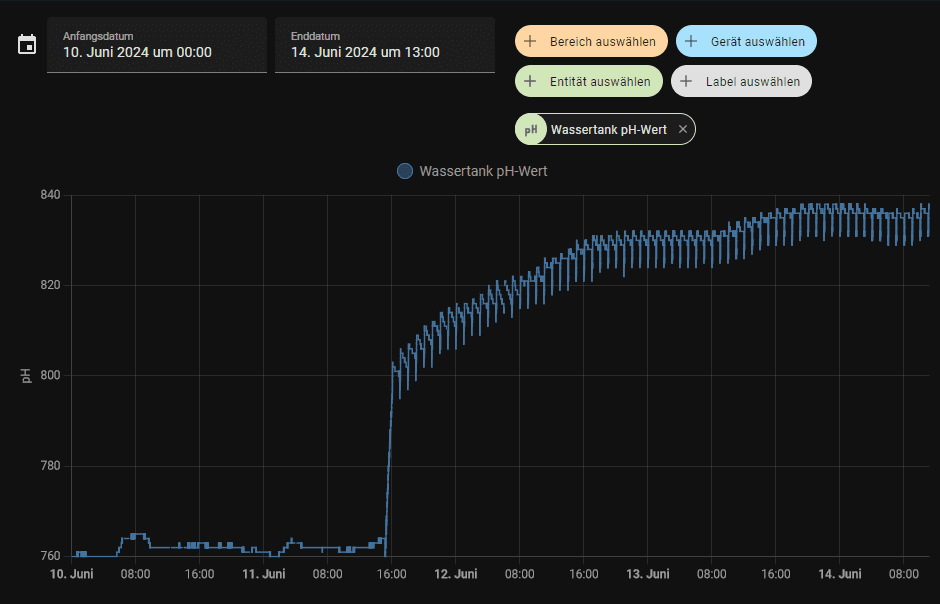
Here is a graph showing the pH value when the pump was off for a longer period. Then I turned it on for about 60 minutes and subsequently turned it on for 5 minutes every 60 minutes over several days.

If I were to stop turning it on regularly for one or more days, the pH value would drop again and stabilize somewhere.

So my question is: what is happening here? Did I do something wrong? Is my measuring device defective? Is this normal? Which value should I rely on?


Ph value changes when water is in motion    please enlighten me
 
I can verify this occurring with several stationary monitors i use. Adjust the hydraulics and the sensors accuracy changes. I've seen several brands have this happen. With orp also. Could be the unit itself just not able to read as accurate with a current. Or its the opposite and its reading a bit better with a swirl. Play with readings taken from calibration fluid so you can be sure the ph of a solution and see where it reads the most accurately then recreate that level of flow over your sensor.
 
Normal / Measuring Device / Beyond Performance Capability / Null / Water Quality / pH Scale Management

Even the best lab equipment will show Variance in readings when there is movement(static/non-static), this is why we use "acceptable range" or "safe zone" measurements for certain applications, In this application, pH in Nutrient Solutions, this is manageable.

*"It is desirable, even advantageous for your plants to have nutrient solutions that move up and down the pH scale within the the safe zone", this insures uptake of nutrients that are more/less available along the pH scale. Your job in "Managing your Data" will be to pH your Solutions aware of the movement, to "Your Own acceptable Safe Range", this will be different for all of Us, based on Water Quality per Geo-Location.

@Zill is right on this "too much data", or "Information Overload", and our ability to analyze, filter, support and manage the Data.

@Nerdlicht keep at it, its just weed, post pics of them Plants soon, I love seeing Plants that are so Loved and Cared for! lol

In Management / Engineering, students are taught from the get go, "the Problems and Issues will always exist", how we Manage them is the Key. (this applies to all real life scenarios as well)
 
Chopper!! It’s Friday! Have a great weekend!

And if it makes sense have wonderful Fathers Day!

Z.
 
The meters struggle with clean water. Once you have filtered down to 0ppm it gets harder to read ph. This is why they measure very clean water in mega ohms.
 
I can verify this occurring with several stationary monitors i use. Adjust the hydraulics and the sensors accuracy changes. I've seen several brands have this happen. With orp also. Could be the unit itself just not able to read as accurate with a current. Or its the opposite and its reading a bit better with a swirl. Play with readings taken from calibration fluid so you can be sure the ph of a solution and see where it reads the most accurately then recreate that level of flow over your sensor.

Okay, just to make sure I understand correctly... we can rule out that the pH value actually changes with the movement of the water (except through the resulting change in temperature, which probably shouldn't be too significant)? Then this would mean that if the instructions say to perform the calibration in moving water, the 'correct' pH value can only be read later in still water, because this effect was practically 'factored in' during the calibration in moving water. Or am I making a mistake in my thinking?

Then it would also make sense that the instructions explicitly stated to move the sensor in the calibration solution during calibration. πŸ€”

Nerd,

If you left the system running would the pH values level off, settle in?

I deactivated the automation for the flow pump on the day I wrote here. In this screenshot, you can see how the pH value has been slowly dropping since then. The movement in the water should have come to a complete stop after a few hours, so the pH value should have returned to its initial value much faster. Really strange...

1718634082985


Normal / Measuring Device / Beyond Performance Capability / Null / Water Quality / pH Scale Management

Even the best lab equipment will show Variance in readings when there is movement(static/non-static), this is why we use "acceptable range" or "safe zone" measurements for certain applications, In this application, pH in Nutrient Solutions, this is manageable.

*"It is desirable, even advantageous for your plants to have nutrient solutions that move up and down the pH scale within the the safe zone", this insures uptake of nutrients that are more/less available along the pH scale. Your job in "Managing your Data" will be to pH your Solutions aware of the movement, to "Your Own acceptable Safe Range", this will be different for all of Us, based on Water Quality per Geo-Location.

Yes, I absolutely understand what you mean!

This is my very first grow, and I still have to learn which values I need to take seriously. What I've gathered so far is that the pH value plays a very important role. Everyone always talks about whether their plants have too much or too little of something, but it seems to me that the pH value needs to be right first before worrying about nutrients. That's my understanding. And regarding 'my own acceptable safe range,' my pH values are unfortunately not within that range at all. Here, I specifically asked about the values in my water tank... additionally, I also read the pH, EC, and temperature separately from each substrate of every plant in real-time. Look at this... I'm far from the 'acceptable safe range'..

1718634807079


Look at the pH value of Blue Dream. Without me changing anything (except that the light went out and the temperature dropped), it dropped from 7.3 to 4.3 overnight. WTF? πŸ˜…


Once in while we may generate more data than we need.
@Zill is right on this "too much data", or "Information Overload", and our ability to analyze, filter, support and manage the Data.

Are you saying that using a FLIR camera to measure the leaf surface temperature in real-time and incorporating this value into the VPD calculation is somehow overkill? Should I also not build an individual scale for each plant that measures to the third decimal place and feed this value into my automation in real-time so that I can track how much water has been used since the last watering? 😁

@Nerdlicht keep at it, its just weed, post pics of them Plants soon, I love seeing Plants that are so Loved and Cared for! lol

This was the past week. The Green Crack looks pretty good... unfortunately, the other two do not. So far, no one has been able to tell me what it could be. I have already added some ammonium sulfate because I thought it might be sulfur. That didn't help much... then I tried nitrogen (with Blue Dream, the one on the right). For the one in the middle, I just added a bit more of the stuff I used to mix the soil. It's a type of fertilizer that you can use to make your own 'living soil.' It's relatively well-known in Germany, probably not in the US. It's called FLO, https://www.florganics.de/shop/flo-5liter-bware/

 
Page 1 of 1 · Replies 1–8 of 8
1
Back
Top Bottom