Thank you Tags for the good info and Great graphs.
I see what you mean by having little gain when going for the 90CRI over the 80CRI. Although, it looks like over half of the loss for going for CRI90 is outside the range of photosynthetically usable radiation (below 630nm).
Do you mind explaining where my reasoning is off. Here is what's going through my head.
The reason I believed that CRI90 was superior to CRI80 is because the ratio of usable red:blue light is closer to 1 in CRI 80 vs. CRI 90.
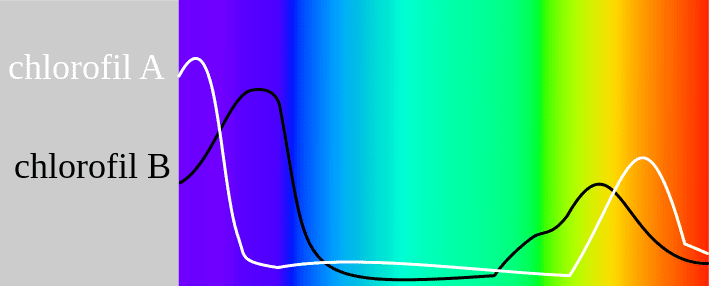
I believe this is good because plant light absorbance of red and blue is close to 1:1
So, I suppose that is the point. The low level of blue-light would be the rate limiting step. In 80CRI and 90CRI the difference in blue output is negligible.
In short, my guess is that anything far above the highest levels of blue radiation is limited because both are needed for a complete photosynthesis cycle.
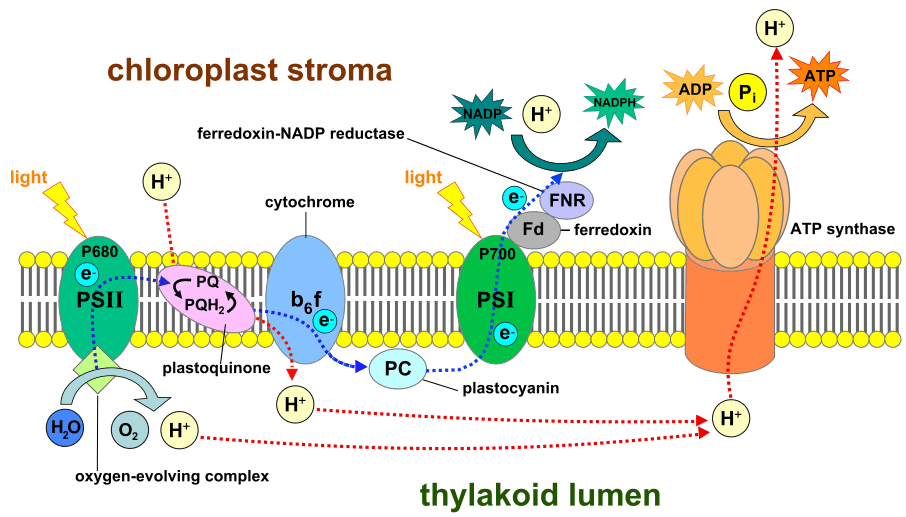
But now, I just read that PSI and PSII have maxima for absorbance around 680nm and 700nm. So, I suppose I was wrong and red:blue is not best at 1:1.
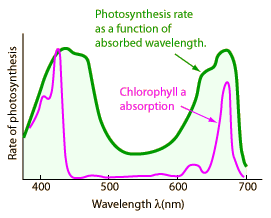
But then I look at this graph and think, no, a ratio closer to 1:1 is beter.
in fact the image makes me think that heavy blue could be good!
I don't see the advantage of heavy red. In general I think it's all about improving your rate limiting step.
Granted, I am a beginner. And the images I shared is not species specific. However, I am familiar with science/bio/physics (basically two B.S. in both subjects) so, i want to understand whats going on so I can know the lamp I piece together is good. Plus it's fun learning all of this information :)
But yea, CRI90 seems to be closer to 1:1 for R:B color output, based on the normalized graph from their website.
Anyways, I was having trouble finding CRI90 chips so it'll probably have to be CRI80. Even so, I want to understand this.