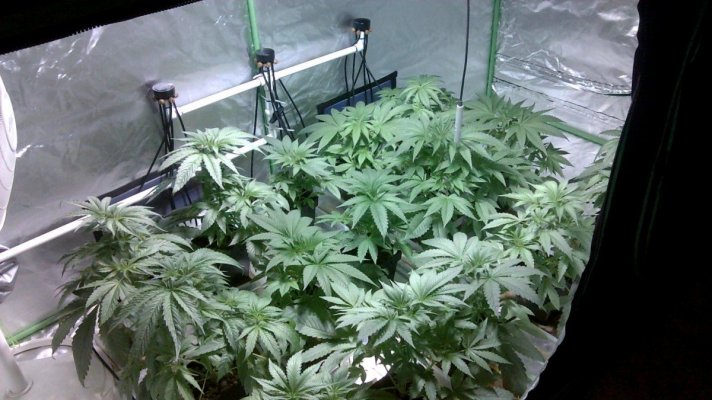
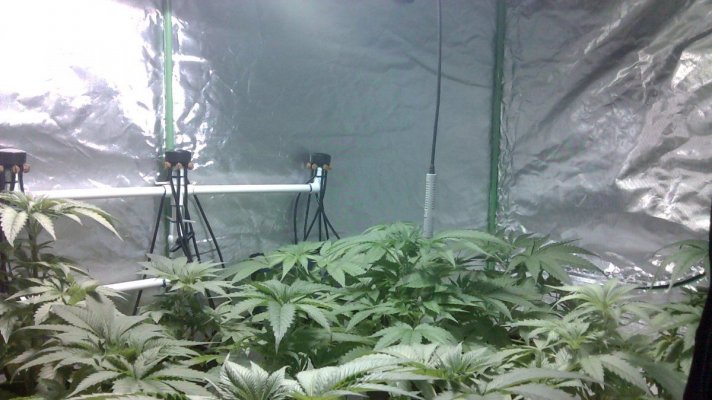
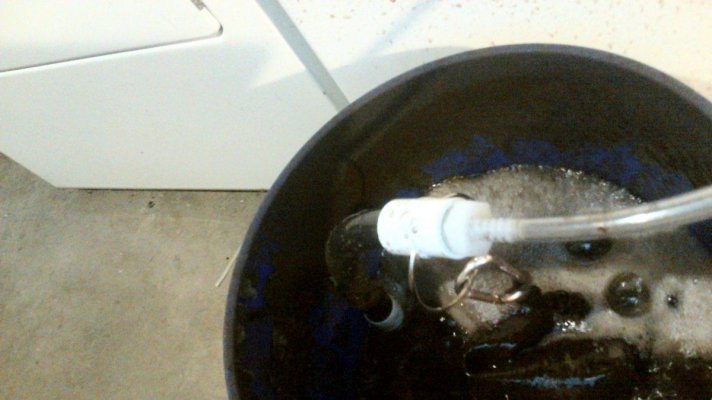
I read this article in Urban Garden Magazine, thought I would share since its about the UC,
The Water Room
Is your back aching from lugging endless sacks of soil, coco or other growth media in and out of your indoor garden? Then check out our latest blueprint, aptly named “The Water Room.” The idea is to grow monster tomato plants directly in a nutrient solution using a cutting-edge, modular Deep Water Culture (DWC) system called The Under Current™. But the liquid theme doesn’t end there. Water is also used to cool the garden using an ingenious chiller-based system created by Hydro Innovations.
Everest catches up with Dan and Stephen, the co-designers of this blueprint, to find out what logic exists beyond all this liquid!
GROWING IN WATER
Everest: Hi Dan. Let’s start by looking at the systems themselves. Am I right in thinking each 16 pot system requires both an air pump and a water pump?
Dan: That’s right, Everest. The inline water pump powers the negative solution displacement, which drives the Sub Current Culture (SCC) method. The linear, high efficiency air pumps provide the active aeration which supercharges the nutrient uptake.
Everest: So it runs 24/7 – even during the night cycle?
Dan: In properly aerated and balanced nutrient solution, plant roots can stay submerged 24/7, even through the dark cycle. Plants continue to metabolize nutrients and exchange gases in the dark, so keeping the solution moving aids in these processes. And remember, no timers for pumps means no worries!
Everest: How much solution is in each module?
Dan: We recommend an operating volume of approximately six gallons per module. That makes 100 gallons +/- in a 16XL (6 x 17 modules). A very small volume of solution is held in each joint (conduit) between the modules as well.
Everest: Is it the same for the bloom cycle?
Dan: We advise growers to drop the operating level to about four gallons per module during the fruit and flowering cycle. This helps ensure ample atmospheric oxygen uptake by the non submerged roots within the module. This oxygen exposure aids in proper fruit set and essential oil production as the plants mature. This technique can also mimic “drought conditions,” which triggers the plant to produce more oils as a means of reducing transpiration rates.
Everest: What about nutrient top-up?
Dan: The return module (epicenter) comes equipped with a high quality float valve built in for easy auto top-off. Each system also includes a bulkhead adapter for plumbing straight to your reservoir.
Everest: What about developing this set-up further with an auto-dosing system?
Dan: This system would work perfectly with an auto-doser like the Intellidose from AM. In this case you would plumb the Under Current (UC) float valve directly to a pure water source and let the Intellidose do the rest. Of course, you’ll need to set the doser to your specs, but then it’s on like Donkey Kong. The likelihood of a zero dump out run increases exponentially when a doser is used.
Everest: What EC should the top off res be balanced to?
Dan: When operated properly, top off should be balanced the same as the solution in the system. Traditionally hydro growers have been instructed to top off with half strength or pure water to avoid nutrient toxicity, but because the UC runs best with half strength nutes there is less of a chance of salt build-up. Ideally the solution in the system should stay balanced even as the plants use the nutrient and water. As a rule of thumb, if the nutrient EC/TDS rises as the solution is depleted you are likely running your levels too high to begin with. Conversely, if your EC/TDS drops it indicates you’ve started too low. Ultimately, as solution levels drop in the system the EC/TDS should stay stable; this is a good indicator that you’re dialed in. This EC/TDS stability will translate into improved plant health and greater pH stability to boot.
Everest: What if I experience drift in my nutes?
Dan: Correct it with your top off solutions. For example: a system started at 500ppm but has crept to 625ppm as the solution level has decreased. That’s a 25% increase, which can be easily offset by a top off res balanced at 25% below the initial 500ppm. This results in a top off res balanced at 375ppm to compensate. Ideally solution strength should stay constant as the plants consume it. This is a good indicator that minerals and water are being used at equal proportions.
Everest: What solution temperatures are optimal?
Dan: The system operates well anywhere from 65-80°F. We recommend maintaining a temperature between 68-72°F. This is a happy medium between optimum dissolved oxygen capacity and not chilling the nutrient solution so much that it slows the plant’s metabolism. If necessary, the water chiller can be easily adapted to the return pump.
Everest: Besides high water temps, what else can reduce dissolved oxygen levels in the system?
Dan: Elevated levels of dissolved solids can displace dissolved oxygen as they compete for real estate in the nutrient solution. So cool, half strength nutes are a perfect environment for high dissolved oxygen levels.
Everest: What dissolved oxygen levels should growers aim for in the UC?
Dan: We’ve tested on average +/- 9ppm of D.O. in solution. Water temps and quality will influence levels. As a point of reference, Dr. Elaine Ingham recommends no less than 6ppm to brew actively aerated teas.
Everest: You claim nutrient solution can last several weeks in the UC, but what about nutrient schedules that change by week?
Dan: Given that we encourage zero nutrient change outs, this does complicate things a bit. Best technique is to dilute any primary supplement into the top off reservoir.
Everest: How do you veg for the system?
Dan: Quad Tops are now available for the UC which allow up to four juvenile plants to be grown in each bucket. You can transplant our 5.5” heavy duty net pots right into your blooming UC rig. Other systems that veg well for the system include the GH Aeroflo2, AmHydro’s N.F.T., or transplant straight out of any aero cloner. Veg times in the UC are notoriously quick so start your fruiting cycles early to avoid overgrown madness. WE MEAN IT!
Everest: What grow media works best in the net pots?
Dan: Any non-wicking inert grow media tends to work best. Expanded clay pellets, growstones, silica stones, lava rock, sure to grow … to name a few. When using a wicking media like rockwool be sure to adjust the solution level to a point where it is not in contact with the media.
Everest: How much longer will nutrient stay viable vs. traditional ebb ‘n’ flow set-ups?
Dan: Time frames vary but typical change outs in E/F are about 7-10 days. In the UC, change outs should be necessary no sooner then 21-28 days. Many variables influence this time frame, so adjust your time frame to best meet your needs. Change nutes once they destabilize or become murky.
Everest: Is it a pain to clean in between crops?
Dan: Disassembly is not necessary. A bottle brush, green pad, biogreen and some elbow grease is all you need.