Captspaulding
Supporter
What’s the matter? Don’t like clowns? 🤡
- Posts
- 26,157
- Reactions
- 101,367
- Joined
- Mar 23, 2021
- Points
- 638
I try to spread the love man! Hand delivered by a certified nut job!That's being a good friend there!!!


121,203 growers, practical cultivation threads, real grow diaries, and community advice.
Create account → Already a member? Log inFollow along with the video below to see how to install our site as a web app on your home screen.
Note: This feature may not be available in some browsers.
I try to spread the love man! Hand delivered by a certified nut job!That's being a good friend there!!!
When will then be now? Soon…..Ya man! It's like trying to watch molasses chop a plant down

Doc one thing you have wrong. Trichomes go from clear to cloudy(milky). Keep growing growmieLucky you, never hurts to experiment, and we never stop learning.
Good luck with your harvest, looks like it could be a good toke.
Harvest should happen when pistils have gone super brown/copper, and curly like a pig's tail, and trichomes have gone almost clear...might need a good magnifying glass for that...apologies if I'm trying to teach you how to suck eggs, haven't read your previous posts...

I'm doing the same thing... my old grow partner and best friend/like a bro.... im dedicating half of my harvests to him for a bit... he lost his mom and is in a huge financial pickle...I try to spread the love man! Hand delivered by a certified nut job!

My bad, I is getting old.Doc one thing you have wrong. Trichomes go from clear to cloudy(milky). Keep growing growmie


Gotta keep my eye on it. I don't want 420 to roll by without some celebration of sortsCapt, Just hit 400 pages! and you're rolling up on 8k posts! busy guy

chatGPT's response to this; TMYKI don't see how a indoor light can burn seedlings so easily though when I've heard of no problem with that with sunlight (which is much more powerful than an LED). but, whatever.


I 2nd that emotion.chatGPT's response to this; TMYK
While it's true that the sun is significantly more powerful than any indoor grow light, indoor grow lights can still be too powerful for plants due to differences in how they deliver light and the controlled environment of indoor growing. Here are some key factors to consider:
For these reasons, indoor growers need to carefully manage the intensity, spectrum, distance, and duration of light to avoid light burn and other forms of stress. When properly managed, indoor grow lights can provide the right conditions for vigorous plant growth. While the sun is indeed more powerful, its natural variability and the ability of outdoor plants to adapt make it less likely to cause the same issues associated with overly powerful indoor lights.
- Intensity and Proximity: Indoor grow lights, such as high-intensity discharge (HID) or high-powered LED lights, can deliver a very high intensity of light at a close proximity to the plants. The sun's intensity is diffused over a vast area, and plants can adjust to varying light levels by moving, shading, and changing the angle of their leaves. Indoor plants, in contrast, are often exposed to light sources that are much closer and more intense, which can lead to light burn, especially if the light is too close to the plants.
- Light Spectrum: Indoor grow lights can be tuned to specific light spectrums that may not perfectly mimic natural sunlight. Certain spectrums of light, such as ultraviolet (UV) and infrared (IR), can be concentrated in indoor lights and may be more intense than what plants typically receive from the sun.
- Controlled Environment: Indoor growers maintain a controlled environment with set light schedules, which may include longer photoperiods during the vegetative growth stage. This extended exposure to artificial light can lead to light stress if not properly managed.
- Temperature Control: Indoor grow lights often produce heat, and if not managed, this heat can accumulate quickly in an enclosed space. High temperatures can exacerbate light stress, leading to issues like light burn and wilting.
- Plant Genetics and Adaptation: Some indoor grow lights are exceptionally powerful and are designed for specific purposes like flowering or fruiting stages. Not all plants can adapt to or efficiently use the full intensity of these lights.
- Duration: The sun has natural cycles, including dawn, dusk, and seasonal variations. Indoor lights, especially if left on 24/7, can lead to overexposure.

looks fine seen many like it, just as 3 cotyledons is all.Keep in mind, they only just emerged a few hours ago so there's very little to take pics of; but I did my best
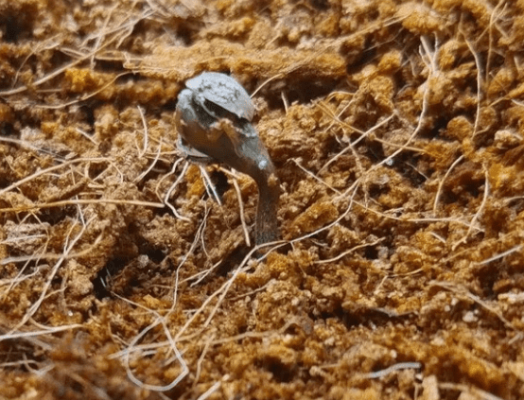
maybe just let the shell fall off on its own, most times they just grow out of it.so, all 4 seedlings are above ground although for one, the seed shell won't come off; I helped another get theirs off last night and she's thriving today because of it but this one, the seed is pretty large so I'd be afraid to mess with it.
The ones with their leaves out though, this morning I noticed they were all curled down just a bit, and the three leaved mutant's 3rd leaf is still quite curled and suffering from the bleached spot. I read online this can be a symptom of too much light, so I turned the light down to 30% power (300w viparspectra xs3000, around 30 inches away).
I'll hope this fixes it, it was on 40% power overnight.
I don't see how a indoor light can burn seedlings so easily though when I've heard of no problem with that with sunlight (which is much more powerful than an LED). but, whatever.
yeah, looks healthier today too after being out of the ground a few more hours.looks fine seen many like it, just as 3 cotyledons is all.
they all have them bud no need to worry.yeah, looks healthier today too after being out of the ground a few more hours.View attachment 2057138
It seems healthy either way so It's not crucial I know, but my seedlings have much more noticeable little white hairs all over the stems and leaves than other pictures I've seen. I mixed mycorrhizae with the seeds from germination, and then into their hole. Is it possible the abundance of white hairs could be due to them being hyphae or have I just not seen enough pics of seedlings to have noticed
View attachment 2057139
This is another pic where the hairs are very pronounced, on another plant
at least your not getting this ..yeah, looks healthier today too after being out of the ground a few more hours.View attachment 2057138
It seems healthy either way so It's not crucial I know, but my seedlings have much more noticeable little white hairs all over the stems and leaves than other pictures I've seen. I mixed mycorrhizae with the seeds from germination, and then into their hole. Is it possible the abundance of white hairs could be due to them being hyphae or have I just not seen enough pics of seedlings to have noticed
View attachment 2057139
This is another pic where the hairs are very pronounced, on another plant
at least your not getting this ..
At that point wouldnt the only option be to just cut the "sac" open a bit really carefully with a razorblade or something?

It's like baby hairthey all have them bud no need to worry.
kindaIt's like baby hair