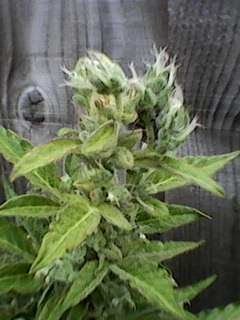
This is an incredibly widespread bit of not "misinformation" but misleading information. Cannabis, due to the abnormal amount of genetic stewardship by humans and the genetic potential of the plant in the first place (for example, name ANY other plant with half the secondary metabolites and I guarantee it is a medicinal plant of the highest order of cash crops...), has a large spread for what pollen comes out looking like and subsequently behaves like. You can also still get stupid dank dripping trichomes on dense nugs in pollinated flower. Thats gonna be your sauce, not the seeding, that dictates that.
The simple truth is that cannabis pollen is as varied as the plants themselves. I am a bit of a hobbyist in the palynological space, and I maintain a database of pollen sample metrics. This all started over a cannabis start up asking me to design a chemical surface which would unlock a qualitative indicator when exposed to cannabis pollen (like a color change), a few dozen of us couldn't do it without genetic testing in real time. The MVP ended up being an open sourced imaging model, trained in house mostly on the incredible variety of OTHER things at this exact scale that would be false positives (mold, dust, yeast, other non cannabis pollen, etc.). The core of the issue is two fold... all pollen's properties are essentially driven by either genetics firstly or the current moisture content of the pollen second. Genetically you get a huge range of sizes for cannabis pollen. Some strains have pollen that will not disperse more than a few inches from the nana, and if anywhere they'll fall to the ground like an anvil. Some pollen is naturally more dry, and smaller, and will be wind dispersed. If you logically think of the driver for that, you get the drive of naturalized cannabis to reproduce...so in theory, we should be seeing less wind-dispersed pollen on average.
until real science is done genetically, I can provide anecdotes like: by the time your average pollen is dry enough to be a true airborne risk, viability is near the floor....or that a simple misting of your plant would be enough to stop any further pollination. And IME, the closer to landraces you are the more airborne the pollen is...
Just to circle back to the original post, about "vast distance". I used to parrot that a lot until I got into chucking and started working with pollen regularly. Really though, if you sit down and think about it you realize it is one of those 'sounds right' things that makes no logical sense. Given the sheer magnitude of hemp farming at giga-scale in the US, Canada, many European countries, and so on....if this were true about pollen, we'd all be forced underground into hermetically sealed rooms for sensi....and that just is not the truth. In fact, I'll work with pollen in a perpetual flow with all three flowering tents at premium pollen receiving time, with the tents open if I feel like it, and have never once had a single pollination accident just by a basic understanding of cannabis pollen
At the end of the day, some of the realest and dankest cultivators out there with decades doing this/families with centuries completely exclusively growing cannabis, many...and I mean many...of these folks think it is perfectly natural for her to throw a naner late. A good rule of thumb is, if she is throwing them after the window to self pollinate, that is natural. If she has the chance of pollinating herself for real, that is likely stress/doodoo genetics/both.