
cpurola
Supporter
- Posts
- 4,363
- Reactions
- 21,227
- Joined
- Jul 17, 2021
- Points
- 263
And now, for something completely different..... LOLEvery thread I poke in too....arguments
Perhaps its time for a break

121,231 growers, practical cultivation threads, real grow diaries, and community advice.
Create account → Already a member? Log inFollow along with the video below to see how to install our site as a web app on your home screen.
Note: This feature may not be available in some browsers.
And now, for something completely different..... LOLEvery thread I poke in too....arguments
Perhaps its time for a break


Don't you dare..... LOLThanks Cpurrrr! I don’t wear them either! I used to all the time! Got tired of banging my melon on low hanging objects hidden by the bill! Decided it was less painful to just get a haircut and shit can the caps! Now, to start dwelling on some retaliation!


Dr. Mattson is a well respected plant physiologist and of course students did the grunt work but Mattson signed off on it. This isn't slooch science. Methodology was very sound.For example were these students experienced growers and experienced with autoflowers? Did they only have 3 control and 3 variable plants?
This is simply the truthOne old automotive reference comes to mind! Too many heads under the hood, no good!
Especially when everyone is adjusting the dwell angle...I know you know...let's see who else does.One old automotive reference comes to mind! Too many heads under the hood, no good!
Timing is everything..Especially when everyone is adjusting the dwell angle...I know you know...let's see who else does.
Be my guest, please.Glad we moved on from points and condensers. Can we go back to grow subjects now? Lol

Bright light will interfere with photosynthesis. In particular, gas exchange. It is not recommended to increase the brightness if the temperature and humidity cannot be controlled. It is optimal to find average values in the root zone that will allow you to work in any conditions. This way, the plant will not suffer from temperatures ranging from -4°C to +50°C, and humidity will not play a crucial role. This is a transformable environment where a balance is achieved.Be my guest, please.
Oh, wait, that's MY cue. LOL
I believe I may have given my plants a case of mild LED burn.
They have been on level 4 for a few days and after being fed properly looked pretty good.
This afternoon I needed to check the light's power with a meter and turned it up to 10 for all of 20 mins. Now I'm noticing the top most leaves on one plant are much lighter than they were, and there are brown spots where there weren't before.
Another DUH moment. : /

does it look like this?Be my guest, please.
Oh, wait, that's MY cue. LOL
I believe I may have given my plants a case of mild LED burn.
They have been on level 4 for a few days and after being fed properly looked pretty good.
This afternoon I needed to check the light's power with a meter and turned it up to 10 for all of 20 mins. Now I'm noticing the top most leaves on one plant are much lighter than they were, and there are brown spots where there weren't before.
Another DUH moment. : /
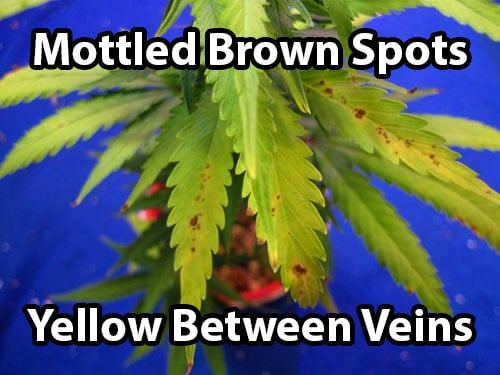
 www.growweedeasy.com
maybe this?Be my guest, please.
Oh, wait, that's MY cue. LOL
I believe I may have given my plants a case of mild LED burn.
They have been on level 4 for a few days and after being fed properly looked pretty good.
This afternoon I needed to check the light's power with a meter and turned it up to 10 for all of 20 mins. Now I'm noticing the top most leaves on one plant are much lighter than they were, and there are brown spots where there weren't before.
Another DUH moment. : /
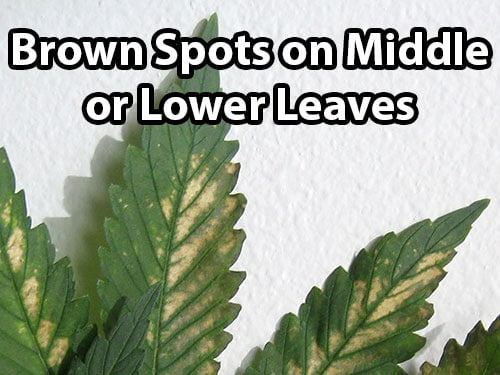 www.growweedeasy.com
Yes, as a matter of fact it does.does it look like this?
How to fix Cannabis Manganese Deficiency (Mn) Pics & Symptoms
Manganese deficiency can cause cannabis leaves to become yellow in between the veins, with mottled brown spots on the affected leaves. Learn how to treat it!
there you go. heres the link with many problems and fixes.Yes, as a matter of fact it does.View attachment 2572461
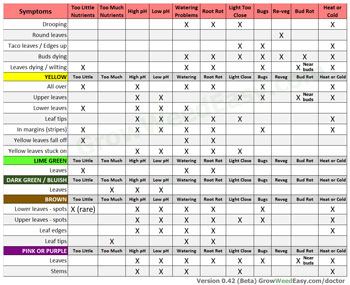 www.growweedeasy.com
I also think that we should pay attention to the basic interactions. Nitrogen-potassium. Because we can calculate all the ratios based on the nitrogen level. Potassium acts as a balance for nitrogen absorption. When it's cold outside, it's preferable to choose a 1:1 ratio that matches the growing season. However, in indoor conditions, the opposite is true. Controlling the amount of rainfall is crucial. This means that we can provide you with maximum doses of sulfur and potassium. It's a bit confusing. But the relationship is as follows: temperature - solubility - concentration. Temperature is nitrogen, and the higher the temperature, the more potassium is required. Sulfur solubility is temperature, and the higher the temperature, the less potassium is required. Concentration is calcium, and the hotter it is, the less total salt is required, including calcium. However, it is always important to rely on nitrogen-potassium. It can be confusing, which is why I always recommend testing my solution.Yes, as a matter of fact it does.
Stupid phone made it yellow, but the leaf is very pale yellow.
View attachment 2572461
 With any amount of light.
 In this case, the following ratio will be crucial. The colder it is, the less light is required. The hotter it is, the more light is required. However, in cold weather, there is a risk of over-illumination and excessive watering. However, this does not occur in a home environment.It may be cold in the tundra, but there is little precipitation, so I think it works even in the tundra.
 Excessive watering can also have a negative impact in conditions of high humidity. However, we can control it in our homes. And water less often than usual.
Thank you, I will try to understand all that tomorrow. When I'm not so floaty. LOLI also think that we should pay attention to the basic interactions. Nitrogen-potassium. Because we can calculate all the ratios based on the nitrogen level. Potassium acts as a balance for nitrogen absorption. When it's cold outside, it's preferable to choose a 1:1 ratio that matches the growing season. However, in indoor conditions, the opposite is true. Controlling the amount of rainfall is crucial. This means that we can provide you with maximum doses of sulfur and potassium. It's a bit confusing. But the relationship is as follows: temperature - solubility - concentration. Temperature is nitrogen, and the higher the temperature, the more potassium is required. Sulfur solubility is temperature, and the higher the temperature, the less potassium is required. Concentration is calcium, and the hotter it is, the less total salt is required, including calcium. However, it is always important to rely on nitrogen-potassium. It can be confusing, which is why I always recommend testing my solution.

 as much as people like to think u need a phd to grow weed it’s really not that complicated air water food simples the simpler you keep it the less u mess with em the better they grow I reckon u should try coco/perlite for indoor easy peasy feed n watch em grow way less trouble than soil I reckon no over watering problems it’s just easy In saying that they looking way better @cpurola hope your enjoying the process cause that’s what it’s all about growing is fun
Yes, this is true, but you'll agree that it's convenient to control only the watering schedule. This applies to both hot and cold weather. However, if you feel that watering is too infrequent during cold weather, you can reduce the amount of sulfur and potassium. Similarly, if you find that watering is too frequent during hot weather, you can reduce the amount of calcium. This is simply a matter of convenience.To many cooks in the kitchen spoil the broth

