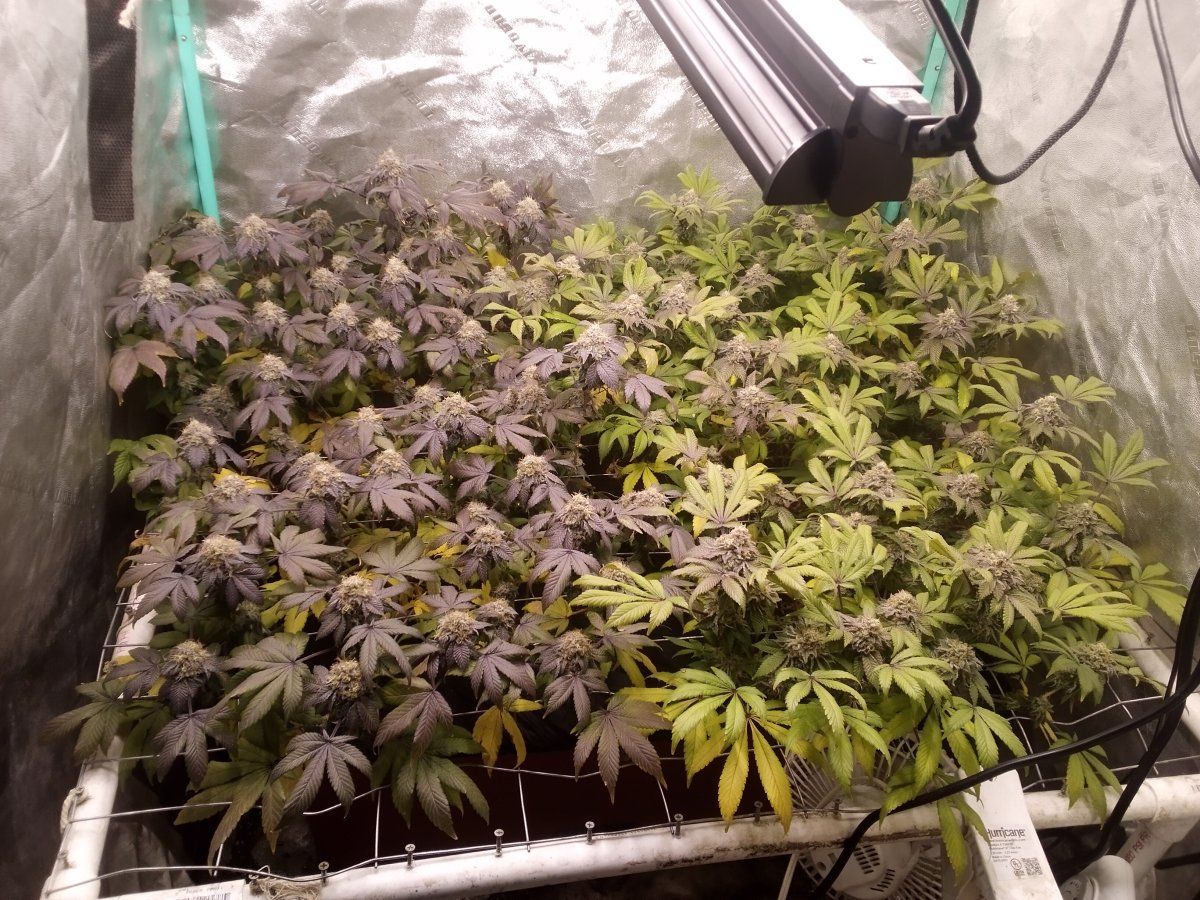
Howdy! Plants look like a nice canopy there! What I believe you've got going on is too much nutrients. Let me explain. Plants turn red from anthocyanins in the plant. Its triggers are cold weather, general plant stress and phosphorus uptake issues (could be either deficiency or lockout).
So we then have to look at visual clues on the plant. Phosphorus is a mobile nutrient. That means the plant will borrow nutrients from one spot and move them to another part of the plant where they're needed, for instance to focus on bud development.
Plants will take their mobile nutrients from the oldest leaves first, so if it's a deficiency you would be looking for those leaves to turn red or lose color toward the bottom of the plant.
As we can see from yours, it's further up on the top. This suggests a nutrient excess is causing a lockout, and they're not flowing to those middle leaves like they should. The usual culprit is what we call salt accumulation and what it means is there is just a high concentration of nutrients either throughout the soil, or sitting in pockets within the soil (aka channeling).
So your correction is going to be, next time you water, you want to give it a really good, very slow and very thorough watering so that the nutrients can get diluted down and you can break up any channeling going on. Presuming you're in 5 gallon pots, wait until about a quart of water has passed out the bottom, and it should take you about 30 minutes time doing pouring increments to get there. Any quicker and you're working too fast. So after about a quart flows out, collect some of it and test it with an EC pen, make a note of the number. Do another pour and collect it and take that reading. Compare the two and check if the second reading is higher or lower than the first. If it's higher, keep pouring until you see it fall. If it's lower but still a high number, pour until it comes down to a safe level.
So why did this happen to your plant, or rather how could it be prevented? The problem is you probably had lots of vegging nutrients in the soil and you started with the flowering nutes. When you're flipping, you want to reset the soil a little, give it a good heavy watering to push the excess vegging nutes out so you can load in your flowering nutes in and not having them compete for uptake.
The plant on the right is showing a similar problem but it probably doesn't have the genetics that triggers purple. So it has the exact same problematic fade going on but looks differently.