Log In Register

240v Duplex Receptacle

  • Thread starter Thread starter DjangoNugs
  • Start date Start date
  • Tagged users Tagged users None

240v Duplex Receptacle

DjangoNugs 38 Replies 8,311 Views
Page 2 of 2 · Replies 21–39 of 39
According to my math..your 15 amp circuit (15 amp plugs) can handle a total of roughly 10 fixtures. The 12 gauge wire is fine as long as the run of all wires doesn't exceed 50 feet total or you will suffer a voltage drop. Your weakest point in the whole system is the 15 amp receptacles..the wire and breaker are fine if under 5o feet total. So you must abide by the limit of your receptacles.
lol scratch that..that's late night math. It's closer to 8 fixtures with 15 amp receptacles to be safe..but if these were pig-tailed that number could abide by the breaker/wire. Which is closer to 11 fixtures. Under-rated wire is more likely to fail a circuit before an undersized plug..but that is the question. "can a 15 amp 240v receptacle handle 20 amps of draw being daisy-chained?" If they were 120v the neutrals would be shared is the big difference.
I agree @fishwhistle let's get @hiboy in on this opinion.
 
Yeah im not knockin what you did at all im just saying no way thats code or even close here,Im no electrician but ive been a general for along time.
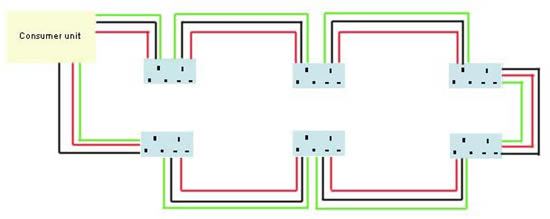
This is how they do it in theUK,its known as a ring main but its much different than the way you have them run and not code here,not sure why.

''Run the power to the first socket, then from there to the second, then to the third, then back to the supply. If you just daisy-chain the sockets in series the 1st run of cable will carry the cumulative load of all the equipment. On a ring-main it's balanced and you're effectively doubling the cross-section of the cable (not quite but good enough).''
ring_main.jpg

I have seen it done the way your doing it in small home shops with multiple machines but the difference is they never run more than one machine/receptacle at a time on that circuit,I think pigtailing is the best option for what we do in a growroom.
 
Last edited:
15 amp outlets on a 20 amp breaker wont fly here in pa.you must use 15 amp breaker with 15 amp outlets,wire ect.alot of guys think hey ill just increase my breaker to 20 or 30 amps and im good but all that does is cook shit like ballasts and oulets instead of tripping breakers.gen lighting is always run on 15 amp for that reason.20 amp is reserved for wells,refridge,ect and is usually run with no extra outlets or runs attached. i did that shit for years when i was younger,im sure a few codes have changed but the principals of electricity has not lol.i would not run more than 12 or 13 amps on that 220v daisy chain,and even then those individual lights are not really protected with the breaker being 20amp.but if its new tech the leds should be fine since they dont have that start up draw of a hid setup.
 
I've been digging around Mike Holt's site and I haven't found a definitive answer. The NEC isn't written for a 240V household. The critical factor is the through-current capacity of the receptacles but I haven't found a spec from the manufacturers.

I'm probably jaded from working with industrial 440V 3-phase but I don't see great hazard moving from 120 to 240VAC.

The actual load on my circuit could be (4 x 330W) + (5 x 325W) + (4 x 165W) = 3605W
3840W is the 80%
 
OK, so I am definitely in violation of the NEC:

210.6 Branch-Circuit Voltage Limitations. The nominal voltage of branch circuits shall not exceed the values permitted by 210.6(A) through (E).
(A) Occupancy Limitation. In dwelling units and guest rooms or guest suites of hotels, motels, and similar occupancies, the voltage shall not exceed 120 volts, nominal, between conductors that supply the terminals of the following:
(1) Luminaires
(2) Cord-and-plug-connected loads 1440 volt-amperes, nominal, or less or less than 1⁄4 hp
 
I've been digging around Mike Holt's site and I haven't found a definitive answer. The NEC isn't written for a 240V household. The critical factor is the through-current capacity of the receptacles but I haven't found a spec from the manufacturers.

I'm probably jaded from working with industrial 440V 3-phase but I don't see great hazard moving from 120 to 240VAC.

The actual load on my circuit could be (4 x 330W) + (5 x 325W) + (4 x 165W) = 3605W
3840W is the 80%
looks good with what you have for power draw,even f they all fired up at the same time .
 
The NEC notes that for lights using a ballast, loads should be calculated using the specified current, not power.
In other words..actual amp readings vs wattage rating? If so it makes sense, since most ballast powered lighting has high ramp-up loads..we're talking 30%-40% sometimes at peak for old magnetic types.
I think you could benefit from one of those guardian devices that give amp readings in real time. It's nice to know you are conscientious about your loads and err on the side of caution. I would be curious how each receptacle is varying in voltage under load..as in comparing beginning..middle and end of run. Alot of us are doing clandestine type installs..but we should try and stay congruent with code as much as possible..it sounds like you're doing what you think is safe. It's a definite streamlined and more affordable to do it this way..but aslo a bit more dangerous.What we don't want are less observant folk replicating an otherwise threatening situation.
 
Yeah what I'm setting up is just like @seaslug for the most part. I don't think I'm daisy chaining them though. There's a different 12awg cable running to each receptacle. Maybe it is daisy chaining. Not quite up to speed on the terminology. I pretty much made a light timer out of two intermatic timers and 8 duplex 240v receptacles and one single one. 5 on one circuit, 4 on the other. Took account for the continuous load. I was just over 80% so I made two circuits with two timers instead of all on one. It was still way cheaper than getting a timer but took a couple weeks worth of r & d to be comfortable enough to do it lol. Y'all answered my final question (hopefully), now it's time to finish putting up the show. It's been a Long time coming.
 
So reading through this thread again I'm second guessing something. If I have the circuit running through a 40a intermatic timer to the receptacles, do I have them on a breaker that equals the total load the circuit will be carrying (just under 30a) or a 15a breaker to match the receptacles?
 
Natural, I hope you are not suggesting leaving a Kill-a-Watt plugged in. The instructions specifically forbid it and I've seen stoner photos of the results from not reading.

A specific example of a luminaire with ballast (driver) is Lumigrow Pro 325. The advertised and measured power is 325W. The sticker next to the IEC receptacle says 5 / 2.5 amps depending on 120V or 240V. That equals 600VA.

A Mike Holt forum post had an electrician working in Saudi Arabia where the household standard is 240V but they were contracted to work per the NEC. The concensus was that this is absurd, the NEC doesn't allow for 240V to replace 120V in a dwelling. The electrician had his superiors redefine the specifications. Someone in the Phillipines said their code modified NEC to allow 240V as the normal voltage in a dwelling.
 
Natural, I hope you are not suggesting leaving a Kill-a-Watt plugged in. The instructions specifically forbid it and I've seen stoner photos of the results from not reading.

A specific example of a luminaire with ballast (driver) is Lumigrow Pro 325. The advertised and measured power is 325W. The sticker next to the IEC receptacle says 5 / 2.5 amps depending on 120V or 240V. That equals 600VA.

A Mike Holt forum post had an electrician working in Saudi Arabia where the household standard is 240V but they were contracted to work per the NEC. The concensus was that this is absurd, the NEC doesn't allow for 240V to replace 120V in a dwelling. The electrician had his superiors redefine the specifications. Someone in the Phillipines said their code modified NEC to allow 240V as the normal voltage in a dwelling.

No..but good you bring it up..just curious how much actual draw your led's use to power up. As far as looking for answers according to the NEC..you're not going to find any. 240v power in Europe and the like have a well designed system to balance loads and decrease chances for fault. Fish and basseye are on the money..what you have set up is illegal in the eyes of the NEC. Your chances of continued success are going to depend on your awareness of load..voltage drop..and equipment longevity.
 
Yeah what I'm setting up is just like @seaslug for the most part. I don't think I'm daisy chaining them though. There's a different 12awg cable running to each receptacle. Maybe it is daisy chaining. Not quite up to speed on the terminology. I pretty much made a light timer out of two intermatic timers and 8 duplex 240v receptacles and one single one. 5 on one circuit, 4 on the other. Took account for the continuous load. I was just over 80% so I made two circuits with two timers instead of all on one. It was still way cheaper than getting a timer but took a couple weeks worth of r & d to be comfortable enough to do it lol. Y'all answered my final question (hopefully), now it's time to finish putting up the show. It's been a Long time coming.

So reading through this thread again I'm second guessing something. If I have the circuit running through a 40a intermatic timer to the receptacles, do I have them on a breaker that equals the total load the circuit will be carrying (just under 30a) or a 15a breaker to match the receptacles?


So..when we say daisy chain, we mean that we are running receptacles in a series..much like speakers and low voltage led landscape lighting aka 12v equipment. So receptacles would be wired one after the other instead of making home runs for each receptacle back to the power center. This is what we are grumbling about and is not legal in the US.
If you have 15 amp receptacles and you do not exceed 80% of 15 amps per receptacle you will be just fine. We need to pay attention to the total length of all runs of wiring and the breaker has to match the load. So you would not run a 20 amp breaker with 15 amp (14g) wire as your breaker will allow a load greater than the wire can handle. We always run bigger gauge wire for higher loads and longer runs to avoid over-heating (resistance) and voltage drops.
 
15 amp plugs no problem on 20 amp circuit.
No problem Daisy chaining 240 v outlets just don't exceed the draw of 16 amps. Definitely pigtail them.
Hb
 
I'd need a digital o'scope to tell you what the actual inrush current is. Switching power supplies are a capacitive load.

Mean Well has started publishing "Max no. of PSUs" on a circuit breaker. The 320W HLG-320H series has an inrush current of: COLD START 70A(t =1010 s measured at 50% I ) at 230VAC
 
15 amp plugs no problem on 20 amp circuit.
No problem Daisy chaining 240 v outlets just don't exceed the draw of 16 amps. Definitely pigtail them.
Hb
Do you recommend pigtailing 120V receptacles?
 
Pigtailing is required per NEC? I can't find it, only for multiwire branch circuits:
[Mike Holt forum]
"11-17-14, 03:16 AM#79hurk27
user-offline.png
Moderator

quote_icon.png
Originally Posted by Cletis
This thread actually has nothing to do with backstabbing devices (although I think it should be banned), it's about using a receptacle as a pass through source. this thread has been skewed a bit..."

Yes it has but the truth of that matter is that all 15 and 20 amp receptacles are UL listed for 20 amps pass through and as long as two or more receptacles are on a circuit the code allows a 15 amp receptacle on a 20 amp circuit, a duplex receptacle is two receptacles by the definition in the NEC article 100.

The only time code does not allow you to use the receptacle or any device for that matter is where a multi-wire branch circuit is run into and out of the receptacle box and this is because of the neutral not the current carrying capacity of the pass-through (see 300.13(B), EGC's also can not be passed through a receptacle or switch for the same reason as if the device is removed it will leave other devices without a EGC or fault path (See 250.148(B) ).

Like I said before this is a design choice not a safety problem, and again like I said we don't need the NEC designing how we are allowed to run our wires as long as it is not a safety issue as like was said as long as other parts of the NEC are followed the issue of a screw or back-stab connection going bad will not be an issue safety wise."
 
It's code I've been called on it before
Or at least my local a city inspector said it was so I didn't question it but I really don't care to look it up you can do that and have fun no matter what I would be pigtail everything
 
Last edited:
Page 2 of 2 · Replies 21–39 of 39
Back
Top Bottom