T
TestTime
- Posts
- 424
- Reactions
- 280
- Joined
- Feb 7, 2025
- Points
- 63
No problem.Yo bro, "Nervous Nelly" back at you again with some numbers.
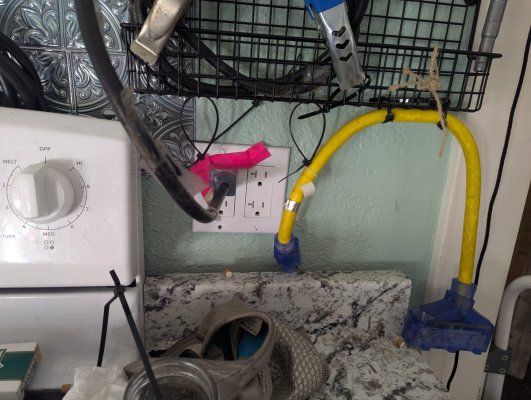
I haven't seen a picture of a single 20A receptacle in your posts.View attachment 2520310
If you are indeed running 3,000W of light, that alone requires two 20A circuits to remain within safety margins—and that's not counting any other pumps, fans, ACs, etc.
If you have an electrician who supposedly "put you in a bunch of high-amperage circuits" and is looking over your shoulder as you have stated, it may be time to consider replacing them, perhaps with a monkey, as that would probably give you better results…
The pics show standard 15A receptacles (NEMA 5-15R), consumer power strips, daisy-chaining, and a lot of load points. If you're actually running ~3,000 W of lights (and more for fans, pumps, etc.) on 120 V, the math and safety aren’t on your side.
The hard numbers (no drama, just physics)
Heat: 3,000 W = ~10,200 BTU/h added to the room before fans, drivers, dehu, etc.
- Watts → Amps: 3,000 W ÷ 120 V = 25 A.
- NEC 80% rule for continuous loads (3+ hrs):
- 15A circuit safe continuous load ≈ 12 A → ~1,440 W max.
- 20A circuit safe continuous load ≈ 16 A → ~1,920 W max.
- So 3,000 W at 120 V requires at least two separate 20A circuits (and that’s just the lights, no fans/dehue/controls). Realistically: 2×20A + one extra circuit or a 240 V circuit.
What the photos suggest (risk flags)
- 5-15 recepts (straight slots) = 15A circuits. A 20A recept would show a T-slot (5-20R) or you’d see a 240 V recept (6-20R/6-30R) for higher amp 240 V.
- Daisy-chained power strips and light-duty cords = common fire starters (I²R heating at plug blades, cheap MOVs, no strain relief).
- Cords through the air, coiled, under load → hot spots.
- Wet area + electrical (fabric pots with algae) → GFCI strongly recommended.View attachment 2520324
If you actually want it safe
- Map the circuits: Flip breakers and label which outlets die. Don’t mix high-draw gear on the same branch.
- Measure the draw: A clamp meter on each branch or a Kill-A-Watt on each light driver.
- Prefer 240 V if drivers allow (most do 100–277 V). Same watts at 240 V = half the current, less plug/cord heating. Use a proper 6-20R/6-30R and a 20–30A PDU, 12 AWG or better.
- No daisy-chains. Mount a single rated PDU to a non-combustible surface; add GFCI near water.
- Strain relief/cable management: No hanging by plugs; no cords under tension; no coils.
This is the last I'll say about this. Please don't burn your house down.
Always willing to prove safety.
Here you go.