Log In Register

Info on Diesel generators please.

  • Thread starter Thread starter juggernaut
  • Start date Start date
  • Tagged users Tagged users None

Info on Diesel generators please.

juggernaut 15 Replies 10,146 Views
Page 1 of 1 · Replies 1–16 of 16
1
juggernaut

juggernaut

Posts
1,250
Reactions
1,271
Joined
Nov 28, 2011
Points
163
Hey I'm moving out to the country and I am lucky enough to have a large aluminum barn that will hold around 20 lights.
My plan is to run a greenhouse as well and the barn would be responsible for the clone, veg and mothers. I would obviously have a flower room there but the needs of suppling the greenhouse in the summer has to be done thru the garage. I would like 2 cycles from the greenhouse using light depravation and this would allow me to run some sativas living in Canada.

My problem is I have only done a 4000w grow max and being a med patient Using that much power wasn't a problem but with around 20 lights I will def need another source of power.

So I am looking at a diesel generator. However to me that would raise a big red flag to a grow operation.
So I'm looking at size,brands,How much diesel a day.
If the generator is running enough power to run 20 lights then i will add or remove lights as needed to match thegenerator.
What should I say it is for?
How would i bring in fuel?

How should i pay for it(obviouslly monthly if i get popped)

My goal is to open up a dispensary or coffee shop depending on our gov'ts ruling on the med marijuana laws.

I would actually love to fly to cali/colorado, amsterdam or anywhere where I could see a large operation running at speed but a little tough with the secrecy of the marijuana laws.

Not the fat ex-hooker and ex/biker from american weed though.

Right now I basically give a 1k light to a 4x4 space which is 62.5 watts a ft2. Plenty of light but with some strains I can do 3k in a 40ft2 area for 75 watts a square foot.

Any help is appreciated my friends
 
First let me say I hate growing with diesel generators but if you are mechanically inclined, like to change oil and filters, like loud rumbling noises, like spilling diesel on your clothes and enjoy worrying that your power source could die at any moment then diesel generators are for you.

It is doable tho. MQ is a good brand I know, I think CAT might be pretty good too and I'm sure there are others just do your research so you do not end up with piece of junk. If I remember right they are rated kind of like breakers so a 20 kw would handle a load of sixteen kw. so you probably need a 35 or 40 kw. Ideally you would get two of the same model for when one breaks down. Fuel consumption varies depending upon load but will be more economical if you don't get one that is too over-sized. I don't know what the laws are for Canad regarding fuel consumption but in the California you can only haul a limited amount; 100 gallons maybe at a time. Best to get some huge storage tanks and have it delivered.

Have you considered gas generators? I think natural gas prices are very low now.

Also you will probably want to build a sound deadening structure and get special mufflers for it, they are very loud; whisper watt my ass.
 
Would I need a gas fitter to hook up the natural gas gererator.
 
Generac makes a propane gas generator. They are all pieces of shit. I am not aware of any gennies' that run on natural gas.

All generators are loud and obnoxious, IMO.

Depending where you live, why not invest in solar power? Scoop up some quality panels, a top-end controller (Outback Co)and some deep cycle batteries (Trojan). A monkey can set it up. A 10k Honda gennie' would be a good back-up for power.
 
i never thought of solar as yet to be worth the cost.

To run 10k in lights what would I need and what cost am i looking at?
 
Your going to need a really big generator.

Most Generators are not designed to run for more then 12-24 hours straight, and you will burn it out quickly. If the 20 lights(1K watts?) your talking about are running 18/6 not 12/12 your going to need a 30K generator most likely so it can easily handle the power output, You also have to tack on fans etc.

Now on the other hand, Solar is a lot better of a choice. It can cost 30K$ to get your entire house down, but holy hell never paying for power is worth it, you can also get a solar hot-water system.

Chobble
 
Most Generators are not designed to run for more then 12-24 hours straight, and you will burn it out quickly.

There are many industrial generators like Multiquips, ect designed to run continuously. Many large scale growers in the U.S. and Canada use them.

Would I need a gas fitter to hook up the natural gas gererator.

Not sure what that is? Is that a tool or some sort of mechanic JK?

I don't have experience with gas generators but I know they are a bit quieter and less polluting and I know natural gas prices are way down. If I was in your shows I would look at all your options including win and solar but a small diesel gen may be your best bet. They certainly make natural gas generators; propane is just natural gas with a scent agent for safety.

If you down size your kilowatt needs it would be much more manageable, you could get a newer, quieter, better gen set that uses less fuel. Much easier to transport. Look at MQ's webste for fuel consumption and noise level data. I think a 15 KW or 20 KW would be good. You can veg a great number of plants with ten k on light movers. Vegging does not require nearly as much electricity per sq ft. as flower.

PM me if you want, I do consulting and tours; I only charge $1500 per hour.

Remember your goal is to grow weed not operate a power plant.
 
i never thought of solar as yet to be worth the cost.

To run 10k in lights what would I need and what cost am i looking at?

I will take a wild guess and say $15k would sun-power you up...that's with you doing the install...maybe even less. It's quite easy as I did my own setup. An Outback Controller (the best IMO) runs about $1000, PV array panels will run approx $6-8k, batteries $3k and all the other little goodies (wiring, switches, breakers, etc) maybe$1k.
 
Also remember that some ballasts don't play well with generators. Make sure you get the right ones...
 
You need a primary generator meaning it is rated for continuous use. You will be running a minimum of 18 hrs for probably 6 weeks veg then 12 hours for 10 weeks (most strains) burning 2-4 gallons of diesel an hour. Do the math. It's not going to be cheap to run that generator for 16 weeks for a crop. Just say it burned 4 gal hr. X 18 hrs = 72 gallons a day x 7 days = 504 gallons a week x 6 weeks veg =3024 gallons......you get the point. Well shit I like math I will keep going so 10 week flower is 840 hrs x 4 gallons diesel = 3360 + 3024 =6384 gallons of diesel × $3.00 = $19125 fuck even if you used half that amount your talkin a 10 rack on top of nutes lighting medium pots etc etc, not to Merion the logistics of purchasing and moving and fueling that gennie. Not saying it can't be done.....but your average dude will not be cut out for that kinda dedication.
 
Solar panels ftmfw! With the cost of a quality diesel gen (see gold rush TV show $$$$), you could easily outfit quite a few panels on the roof to supply power.
 
Solar is the long term solution. Plus if it's on your home/property you could get a home loan and write it off
 
i never thought of solar as yet to be worth the cost.

To run 10k in lights what would I need and what cost am i looking at?
Now you are talking. Wattage needed would be around 5-10kw for a facility
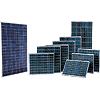
solar panels ->
Photovoltaic Modules aka Solar Panels, Solar Electric Panels or PV Modules
solarpanels.jpg

PV Modules
PV modules are known as solar panels or solar electric panels. We'll be using the terms interchangeably throughout this article although "PV Module" is the more technically correct terminology.

Solar panels provide electricity from sunlight. They are typically made of silicon crystal slices called cells, glass, a polymer backing, and aluminum framing. Solar panels can vary in type, size, shape, and color. In most cases the “size” of a PV module refers to the panel’s rated output wattage or electricity generating potential. Solar panels also have voltage ratings. Those with of 12 or 24 Volts are generally preferred for off-grid systems with battery banks. Other solar panels come in less common nominal voltages such as 18, 42, and even 60 Volts. These modules are typically used in grid-tied applications to accommodate the working of grid-tied inverters. Solar panels can be used alone or combined into arrays by wiring them in or in to achieve the needed . The price of most large residential or commercial PV modules can range between $2.20 and $3.40 per rated watt.
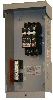
a Combiner ->
Combiner Box
100_MNPV3.jpg

Midnight PV3 Combiner Box
A combiner box is an often-overlooked, yet essential part of most solar electric systems. The combiner box is an electrical enclosure which allows multiple of solar panels to be combined in parallel. For example, if you want to wire together two 12 Volt panels for your 12 Volt system, you will wire each panel’s output directly to terminals inside the combiner box. From the combiner box you can then run just one positive and one negative wire (in appropriate conduit) to the next system component, the charge controller. The combiner box will also house series string fuses or circuit breakers. These boxes are usually outdoor-rated, and meant for placement right next to the array or solar panels. Combiner boxes usually cost between $80 and $140 USD.
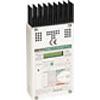
a Controller->
Solar Charge Controllers
100_c40.jpg

C40 Charge Controller
Every solar electric system with batteries should have a solar charge controller. A charge controller regulates the amount of current the PV modules feed into a battery bank. Their main function is to prevent overcharging of the batteries, but charge controllers also block battery bank current from leaking back into the photovoltaic array at night or on cloudy days, draining the battery bank.

The two main types are PWM (Pulse Width Modulated) and MPPT ( Tracking). PWM technology is older and more commonly used on smaller solar arrays. Choose a PWM charge controller that is the same as your solar array and battery bank. The controller must also have enough capacity (in rated Amps) to handle the total current of the solar array safely. MPPT charge controllers can track the maximum power point of a solar array and deliver 10-25% more power than a PWM controller could do for the same array. They do this by converting excess voltage into usable current. Another feature of MPPT charge controllers is their ability to accept higher voltage from the solar array for output to a lower voltage battery bank. Charge controllers typically cost between $50 and $750 depending on size, type and features.
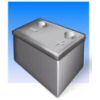
batteries->
Batteries for Solar Electric Systems
100_deep_cycle_batteries.jpg

Deep Cycle Battery
Batteries chemically store electrical energy in renewable energy systems. They come in several voltages, but the most common varieties are 6 Volt and 12 Volt. The three types of batteries that are most common to RE systems are:

Flooded lead-acid batteries are the most cost-effective variety. They require maintenance that involves monitoring voltage, adding water, and occasional . Additionally, FLA batteries vent hydrogen under heavy charging so they must be stored in a ventilated enclosure. Because of the maintenance issues of FLAs, some people prefer sealed batteries, which don’t require maintenance. Since they are sealed, they do not require watering, nor do they typically vent any gasses. AGM batteries cost more and are more sensitive to overcharging than FLAs. Gel Cell batteries are similar to AGMs in that they are also sealed and therefore do not require maintenance, but tend to be the most expensive of the three types. The useful life of all battery types is measured in rather than units of time. is directly related to number of charge cycles possible: the deeper you drain batteries each time you use them, the fewer charge cycles you will get from them. Sealed batteries tend not to last as long as flooded batteries. Well-maintained FLAs can last as long as ten years, with sealed batteries lasting closer to five years. Other factors to keep in mind are that some of these batteries weigh over 200 pounds and, depending upon capacity, can cost anywhere from $20 to $1200 each. So, given the maintenance issues, weight and expense, consider your energy storage needs very carefully. Planning for five days of battery storage for your system may not be your best option!
an inverter->
Solar Inverters
Solectria_Panel.jpg

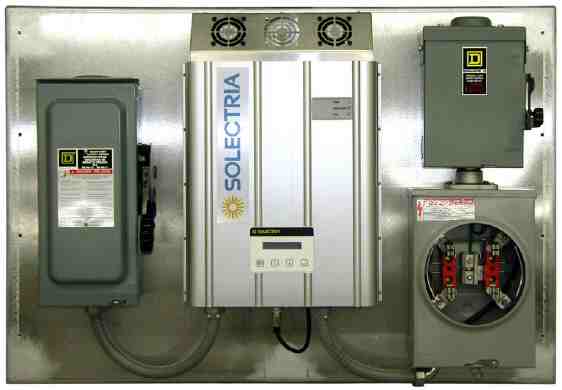
Solectria Inverter on a Prewired Power Panel
An inverter takes (DC) from batteries and turns it into (AC) which is used to run most common electrical loads. There are two main classes of inverters, or grid-capable and , standalone units.

Off-grid inverters require batteries for storage. Straight grid-tied inverters don’t use batteries and grid-capable inverters can work either with or without batteries depending on system design. There is a wide range of available inverter features suited to differing system needs and situations. Some inverters have integrated AC chargers so that they can use AC power from the grid to charge the batteries during periods of low sun. Inverters with integrated AC chargers can also be used in conjunction with fossil fuel-based generators for battery charging or running very large loads. Off-grid inverters meant for whole-home usage must have appropriate conduit boxes and accessories that enclose all live wiring. Usually, whole-home inverters are rated to produce 2,000 Watts continuous power or more. Off-grid inverters come in two flavors: those producing current and those producing current. Some appliances (compressors or other inductive loads) and many sensitive electronics (cordless battery chargers, computers, stereos, etc.) will not function properly on modified sine wave power. Off-grid inverters can cost anywhere between $100 to $3,000 depending on size and type.

A straight grid-tied inverter connects directly to the utility grid without the use of batteries. With these inverters, when the grid goes down the PV system also goes down to protect service linemen from injury due to unexpected “live” lines during outages. A grid-capable inverter can both connect to the grid and use batteries, which allows for the possibility of back-up power during outages. Grid-connected inverters also generally produce 2,000 Watts or more and cost about $2,000 to $4,000.
a disconnect switch->
DC and AC Disconnects
SquareDBox_100.jpg
100_XANDC175.JPG

Disconnects
No () code-compliant system can live without disconnects! The DC and AC disconnects of a PV system are manual switches that are capable of cutting off power to and from the inverter. Some inverters have disconnects with switches integrated into their structure. Other systems use an integrated power panel to support the inverter(s) and their associated disconnects in an organized arrangement. In still other cases, you will need to purchase the appropriate disconnects separately to work with an inverter. The disconnects are used by service personnel or authorized persons (fire/police/electric workers) to stop power from a renewable energy system reaching the inverter. (Don't forget that there are capacitors in most inverters that can hold a lethal charge for up to several minutes after incoming current is cut off! Consult the inverter manual for safe access times.) Disconnection prevents the current being produced from going beyond the disconnect point to a downed utility grid or damaged component. Homeowners or authorized personnel can use disconnects to de-energize a system for maintenance or service. Disconnects can range in cost from $100 to $300.

 
Your talking serious $ for a decent system to run 10k. Batteries are the weak link in off grid systems. You really don't want to discharge them more than 50% - 25% is better and pretty much the standard. Batteries are expensive. You are going to want a 48volt system more efficient, more batteries $ longer life ( smaller wire ) longer distance. For a complete system for only 10 KWH a day was around 25 grand. That was everything. Which is one 1000 watt light for 10 hours. Just saying. 12 x 250 watt panels, 24 x 2 volt batteries, 4000 watt inverter, mounts, wiring, ect. https://www.bluepacificsolar.com/outback-radian/outback-radian-8850w-solar-kit.html
Just an example and this is without all the wire, batteries , panel, mounting, ect. This system is still a little small for your needs. Batteries alone $$$$$. Now a grid tied system is more doable. No batteries needed.
 
Page 1 of 1 · Replies 1–16 of 16
1
Back
Top Bottom