Cheers for the replies. Coco is 70/30 Coco perlite mix (buffered).
Bottom of pots we're still quite wet last night, but felt like they needed watering further up, I just gave them a litre. Went light on the a+b nutes (20%) but added some calmag and some epson salts, ec was 1.6 (start of week 5), pH was 5.9.
Worth noting that problem with brown patches on upper leaves hasn't really got any worse over last 4-5 days. I'll keep adding the calmag to every water and a little epson salts once a week.
I read Aquamans watering guide, it suggested watering quite frequently though, but my work/home life makes that difficult, watering once a day or every two days (what I've been doing) is much more practical.
To be honest this has become a bit of side issue (although still important to get sorted) since the discovery of spider mites. Trying to get those pricks under control or it's game over anyway.
Sprayed See ya Mite (couldn't find the stuff OldManGrower recommended) but hasn't been effective. Last night out up 10 sachets of predator mites and ordered a pot of the more aggressive predator mite, so hoping they'll do their job, but they have mixed reviews.
Nice plants dextr0!
Thanks man I trying really hard to get this right. I got tired of having leaves die off and watch plants that I knew would be beautiful preform ok. To think I just needed
calmag. It’s really humbling experience to me.
The reason frequent irrigation is
wanted:
What Happens to the Water and the Salt?
When you add nutrient solution to the coco, you are adding both water and salts. To understand how EC changes between fertigation events, it is important to consider what happens to each. Remember, plants do not absorb nutrient solution “through a straw” or “like a sponge”. Water and salts (fertilizers) are taken up by the plant separately. Under normal conditions, water is removed about four times faster than salts are absorbed. As a result, the EC of the nutrient solution in the media will rise between fertigation events.
Where Does the Water Go?
The Plant: Plants absorb water through osmosis leaving increased concentrations of salt in the nutrient solution in the coco. Plants also absorb nutrients and thus lower the quantity of salts in the solution. However, they remove the water much faster than they remove the salts. The vast majority of this water moves through the plant and is lost through transpiration.
The water that goes to the plant raises the EC of the nutrient solution in the coco.
Evaporation: As water sits in the pot suspended in the coco between fertigation events it is constantly evaporating. The water that is lost to evaporation causes EC in the remaining nutrient solution to increase.
Evaporation raises the EC of the nutrient solution in the coco.
Because of transpiration and evaporation, the EC in the coco is lowest immediately following a fertigation and “Peak EC” occurs just prior to the next fertigation event. The fertigation events themselves are responsible for lowering the EC in the coco. It may seem counter-intuitive to lower the level of salts by adding nutrient solution, but the process occurs through run-off.
The Run-off: As fresh nutrient solution is added to the coco it pushes out old nutrient solution which had been suspended in the coco. The run-off is not the same water that you are adding in the top. Run-off is higher EC than inflow because it has been sitting in the coco and subjected to the forces of transpiration and evaporation. Run-off carries salts out of the coco. Following each fertigation, the nutrient solution in the coco is closer to the inflow EC.
Run-off lowers EC by flushing excess salts.
Water is removed through transpiration and evaporation, whereas salt is only removed via run-off. As a result,
frequent fertigation with adequate run-off is essential to manage EC and get the best results from your coco grow!
The Effects of Incorrect EC on Cannabis Plants
What Happens when EC is Too HIGH
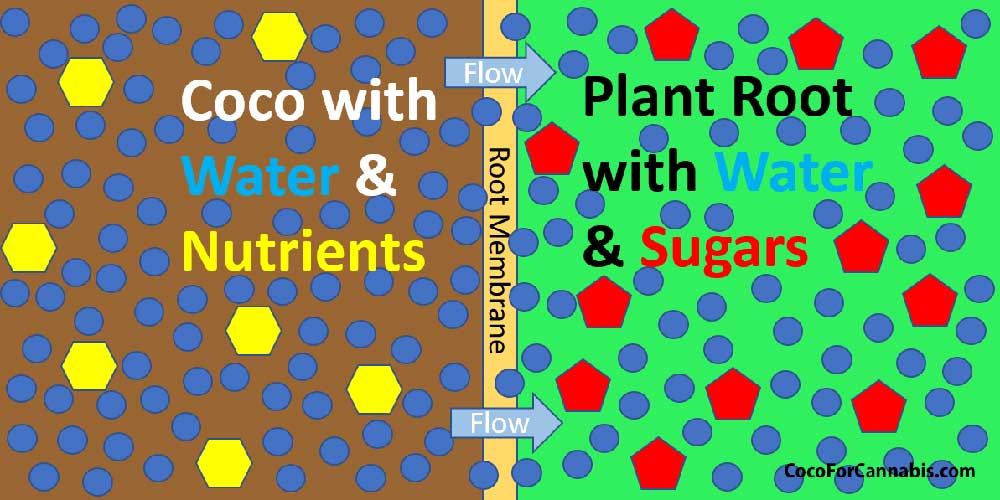
Plants receive water via osmosis across the membranes in their roots. Water moves through root membranes in the direction of higher concentration. In order for the roots to get water, the concentration of sugars within the roots must be higher than the concentration of salts in the nutrient solution. Plants are adapted to adjust to the osmotic gradient and produce sugars in their roots which raise the concentration and encourage water to enter the roots. However, high EC nutrient solution can easily overwhelm the plant’s ability to raise the concentration of sugars in her roots.
High EC Causes “Nute Burn”: If the EC of the nutrient solution is higher than the plant can handle she will start to struggle to get water. In fact, if the EC gets too high, osmosis can flow in the opposite direction and water is literally pulled out of your plant. This struggle for water and “reverse osmosis” is what causes all of the symptoms that are known as “nute burn” or “fertilizer burn”: wilting, burned tips, crispy dry leaves, leaf curling, slow growth, and eventual plant death.
If you are experiencing even minor signs of nute burn, that indicates that your plant is struggling to pull water against a too high EC. Rather than helping growth by “giving lots of food” you are hindering it by starving the plant of water. “Burn” symptoms should be met with remedial actions. See our tutorial, “
How to Manage Run-off EC”.
What Happens when EC is Too LOW
When the EC of the nutrient solution is too low, plants drink too much water and produce fewer sugars. This is because the concentration of sugars within their roots is in response to the EC of the nutrient solution. When the EC of the nutrient solution is low, plants may initially take in too much water because the concentration of sugars in their roots is higher than the concentration of salts in the nutrient solution. Drinking this extra water does not mean they are taking in additional nutrients. Plants take in water through osmosis and nutrients through separate diffusion and transport processes. Low EC exposes the risk of under-fertilizing because there is necessarily less fertilizer in the water. However, under-fertilizing is only one of the concerns. Plants produce sugars and other good things when EC is correct. They must do this to pull water into the plant through osmosis.
If EC is low, plants produce less of the “good stuff”.
What Happens when EC is Not Stable
When EC is constantly fluctuating, the plants are constantly working to adjust. To receive water through osmosis, plants need to adjust the concentration of sugars within their roots. When the EC of the nutrient solution is lower than they are prepared for, they take in too much water and have to lower the concentration of sugars in their roots. Conversely, when the EC of the nutrient solution is higher than they are prepared for, they cannot take in sufficient water and have to direct their energy into producing sugars to raise the concentration in their roots. When the EC goes up suddenly, plants can suffer burn even at relatively low ECs because the roots are prepared for even lower.
The common practice of interval flushing in coco with one watering of nutrient solution and one watering of "plain", "pHed", or "
CalMag" water should not be practiced because it results in unstable root zone EC and forces plants to constantly adjust.
Keeping plants healthy and happy requires delivering a nutrient solution with a consistent EC at each fertigation event.
Learn how EC, PPM & TDS affect plants. Understand osmosis (how the plant absorbs water) and why it is critical to measure EC/PPM when you fertigate.

www.cocoforcannabis.com