Aqua Man
- Posts
- 26,479
- Reactions
- 59,693
- Joined
- Jun 12, 2018
- Points
- 638
Yes citric acid is a fairly weak acidI use lime or lemon when absolutely necessary! It works but will not last 2-3 days must water right away

121,252 growers, practical cultivation threads, real grow diaries, and community advice.
Create account → Already a member? Log inFollow along with the video below to see how to install our site as a web app on your home screen.
Note: This feature may not be available in some browsers.
Yes citric acid is a fairly weak acidI use lime or lemon when absolutely necessary! It works but will not last 2-3 days must water right away


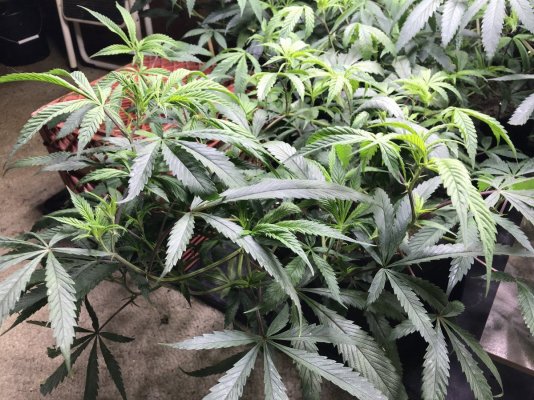
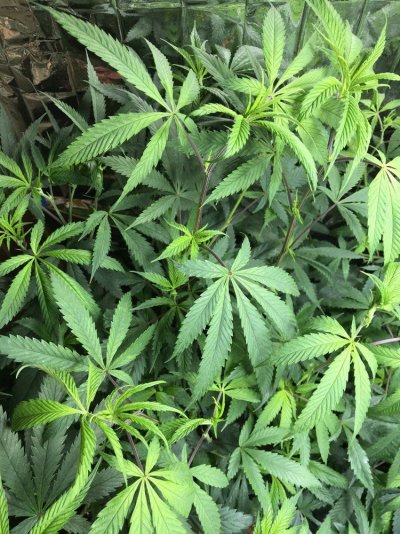


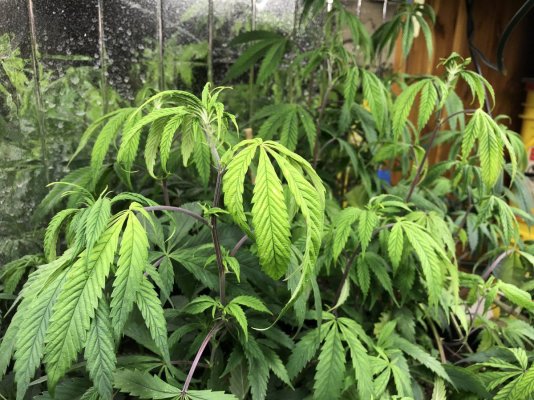
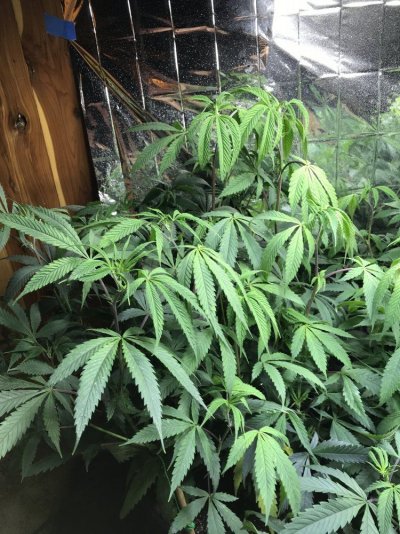
Low temps slow nutrient uptake and transport. The IR from hid will help warm the leaves as well as the warmer Tampa are likely the difference. 5k is ok for veg I think 4k would be a bit more ideal but definitely not the cause of your issues.Temperature is part of my problem. Today I’m struggling to get daytime temperatures above 65F. Nighttime is around 53 or 54 F. I broke down and put a space heater on low nearby...
I’ve got a plant I moved into the flowering room 2 days ago under dual 400w hps lamps and is already visibly perkier and happier. It’s a lot warmer in there in general I’d say. It’s more enclosed.
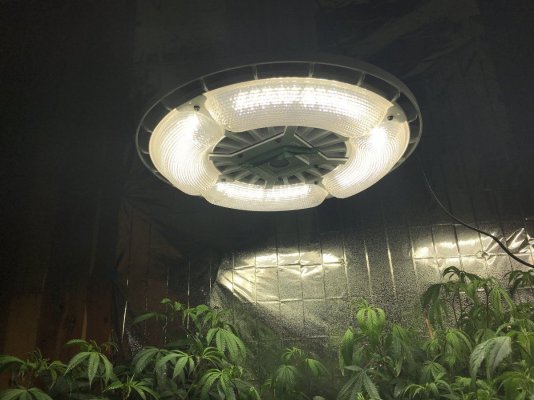
Also I still contend these huge led fixtures aren’t quite right. 5K color temp is all I can gather from the specs...dunno what they look like under a spectrograph. I might need to supplement with something...but the price I got them for was too dumb not to. 24,000 lumens each. 170 watts. Rated for moist environment use. I got two for $150


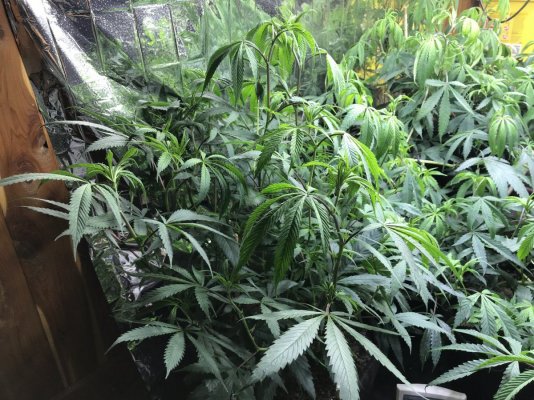


Those temps are looking much better and so are the plants. Its looking like over watering may have been the issue but temps probably compounded the issueMr. impatient here. I’m seeing improvement with increased temperatures for 36 hours.
I’m gonna MAKE SURE my pots dry out before watering again.
I’d love to solve this without adding any more nutes.

I use HID myself, but I feel that LED's produce a "harder" light that usually has most of it's spectrum in a few narrow bands. I think this makes the plants use more nutrients than HID lighting, but I have never tested it out. It's my opinion that HID lighting, MH and HPS, are more natural to plants due to the wider distribution of their spectrum, but I am not saying that one is better than the other, just different.Jimster how do you feel the LED affects the calcium and magnesium uptake and mobility ? I’m thinking it’s even magnified more for auto flowers? But I def think the light affects the need and the uptake . What’s ur thoughts ?

Love this open minded answer! Both sources have a purpose for sure good or bad for have chosen led to fit my grow II use HID myself, but I feel that LED's produce a "harder" light that usually has most of it's spectrum in a few narrow bands. I think this makes the plants use more nutrients than HID lighting, but I have never tested it out. It's my opinion that HID lighting, MH and HPS, are more natural to plants due to the wider distribution of their spectrum, but I am not saying that one is better than the other, just different.
This could all be bullshit, but I am just relating my take on things. I think LEDs are slightly harder on plants and perhaps that is why they seem to respond to nutrients differently. FWIW, the old common wisdom that HPS is best for flowering has taken a few hits recently, with a few studies showing tha increased blue light during flowering increases the production of THC. LEDs often have a lot more blue in them than a straight HPS bulb, so maybe the extra blue in the LEDs affects the plant differently than just HPS. Plants also seem to grow differently under LEDs than HID lighting as well, so there could be more than 1 factor that would explain the different nutrient needs.
No I’m interested for sure on any opinion. I. The end I really want to get my calcium and magnesium correct in the auto flowers! I even have trouble with phos. Sometimes.I don't think so. The number of photons hitting the leave can change the processes at saturation yes and lead to photorespiration. Increased photosynthesis will definitely lead to the need for more nutrients. I have enough knowledge on this just to make me dangerous without a full understanding on a cellular level I should probably not comment.
I feel it has to do with the green spectrum of light that led provides more of. But that's as far as I go lolNo I’m interested for sure on any opinion. I. The end I really want to get my calcium and magnesium correct in the auto flowers! I even have trouble with phos. Sometimes.
I know the grow super fast but it’s hard to get enufff cal to em without fuckin up ! Pardon my French
I just know it’s something ! Lol and it’s a fine line between awsome! And shitty! But I’m gettin dialed it’s just slowI feel it has to do with the green spectrum of light that led provides more of. But that's as far as I go lol

I use HID myself, but I feel that LED's produce a "harder" light that usually has most of it's spectrum in a few narrow bands. I think this makes the plants use more nutrients than HID lighting, but I have never tested it out. It's my opinion that HID lighting, MH and HPS, are more natural to plants due to the wider distribution of their spectrum, but I am not saying that one is better than the other, just different.
This could all be bullshit, but I am just relating my take on things. I think LEDs are slightly harder on plants and perhaps that is why they seem to respond to nutrients differently. FWIW, the old common wisdom that HPS is best for flowering has taken a few hits recently, with a few studies showing tha increased blue light during flowering increases the production of THC. LEDs often have a lot more blue in them than a straight HPS bulb, so maybe the extra blue in the LEDs affects the plant differently than just HPS. Plants also seem to grow differently under LEDs than HID lighting as well, so there could be more than 1 factor that would explain the different nutrient needs.
Love this open minded answer! Both sources have a purpose for sure good or bad for have chosen led to fit my grow I
Working on higher end lights which after much investigation def a factor! I am def not an expert so all spectrum aside intensity is the most contributing factor in my opinion. But I believe that some led can be placed so close that the light does get a chance to disperse? Meaning it may hitting a leaf at full intensity the size of let’s say a pencil . This may cause some immobile nutes to change molecular structure and attach to mobile nutrients and become neutral or un unusable. ? These are questions I have? Is it possible? Or am I out there
Thanx for clearing that up ! I think I understand now and agree!@Jimster, you actually have it backwards. HID lighting tends to operate with a more narrow spectrum. The first rule of lighting, white light is the presence of all wavelengths of light and black is the complete lack of light. So when we look at the LED units that appear very white that is because they include all wavelengths giving it a full (or broad) spectrum. HPS are very orange (though technically still white) and offer light predominantly in a narrow range, diminishing or leaving out much of the other wavelengths. MH leans the other way, more towards the blue wavelengths and reduced amounts of orange and red wavelengths.
Different photosynthetic reactions occur under the various wavelengths, and some wavelengths that we once tried to remove have proven to have uses in photosynthesis and other chemical reactions within the plants. While I have not looked too deeply into specific studies it would seem that under a full spectrum light more internal processes within the plant take place, thus needing more nutrients to drive those reactions. When we limit the available wavelengths some of those processes will cease, and the plants will not need as many nutrients to keep them alive and productive.
You are WAY out there. Immobile nutrients do not ever become mobile. Immobile nutrients are not immobile because of their chemical composition but how they are used within the plant. Calcium is immobile because it is imparted into the cell walls of the plant, and if I am remembering correctly is used in the pumping mechanisms that move mobile nutrients through the plant. But once the calcium is in a cell it is never going to move from that cell. Mobile nutrients, such as Nitrogen, can be moved from one plant cell to the next once taken in by the plant; it is not fixed to the cell it currently resides in. So no light or additive or chemical is going to change that.
I both agree and disagree. If you look at the spectra of a god quality HID bulb, say Eye Blue Hortilux, the spectrumis pretty flat, meaning that all frequencies/colors are about the same. HPS is a lot more selective in it's output, simply because of the sodium properties. LED light, especially the newer ones, are a LOT better than just a few years ago, when you have very specific frequencies of light, based on the diode's band-gap properties, etc. Blue light was the holy grail for LED technology, and it made the use of LEDs much more reliable with the inclusions of many other combined frequencies.For these reasons, I both agree about LEDs (especially the newer gens that provide a much broader spectrum than earlier models. HIDs can be the same, depending on the gas fill and the manufacturer. When I grow, I try to provide both the blues of a MH and the reds of a HPS, more HPS during flowering. The MH bulbs I use typically have an enhanced red component and I have used them alone for flowering, but I see an advantage to HPS and MH during flowering.@Jimster, you actually have it backwards. HID lighting tends to operate with a more narrow spectrum. The first rule of lighting, white light is the presence of all wavelengths of light and black is the complete lack of light. So when we look at the LED units that appear very white that is because they include all wavelengths giving it a full (or broad) spectrum. HPS are very orange (though technically still white) and offer light predominantly in a narrow range, diminishing or leaving out much of the other wavelengths. MH leans the other way, more towards the blue wavelengths and reduced amounts of orange and red wavelengths.