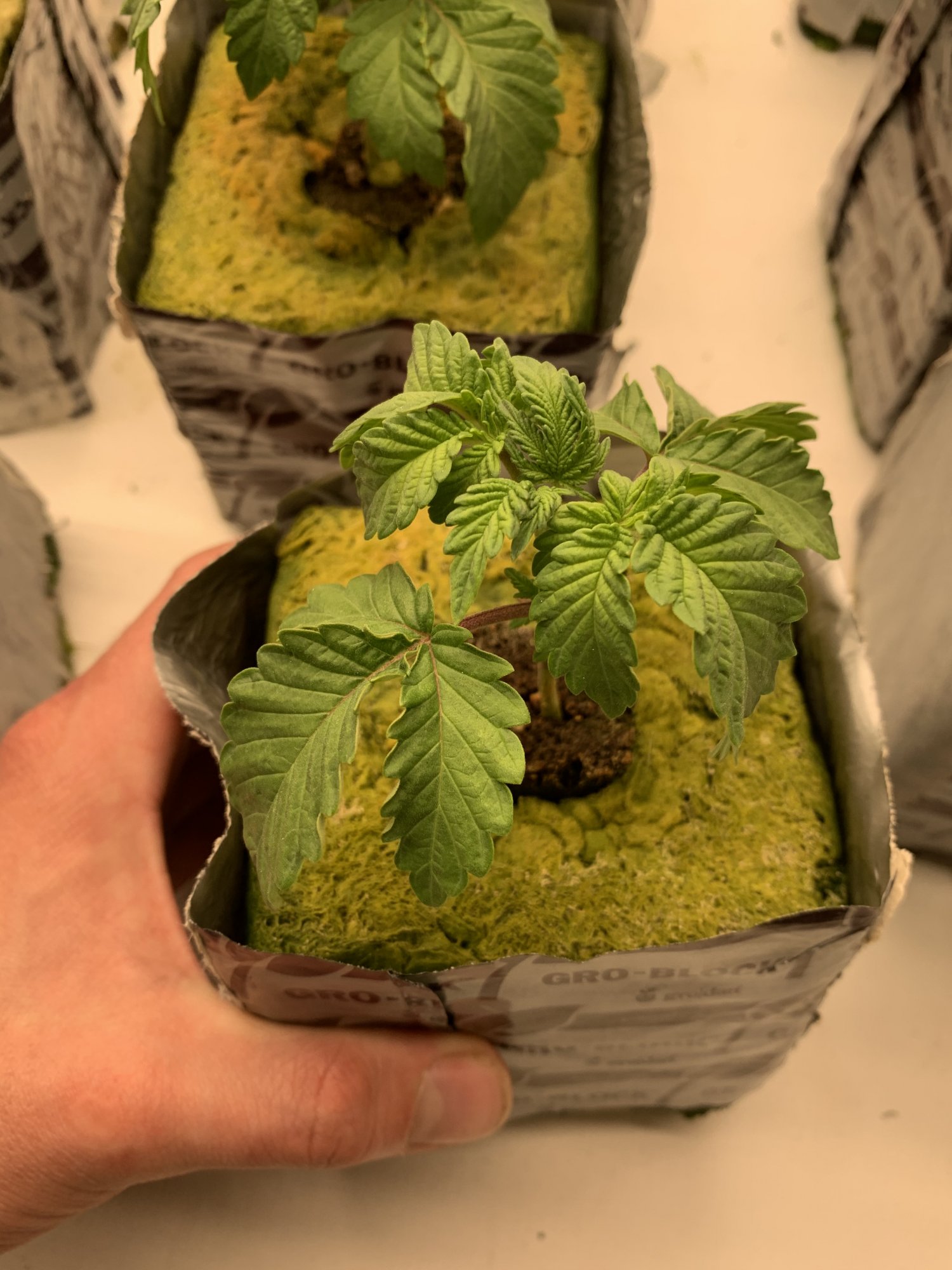
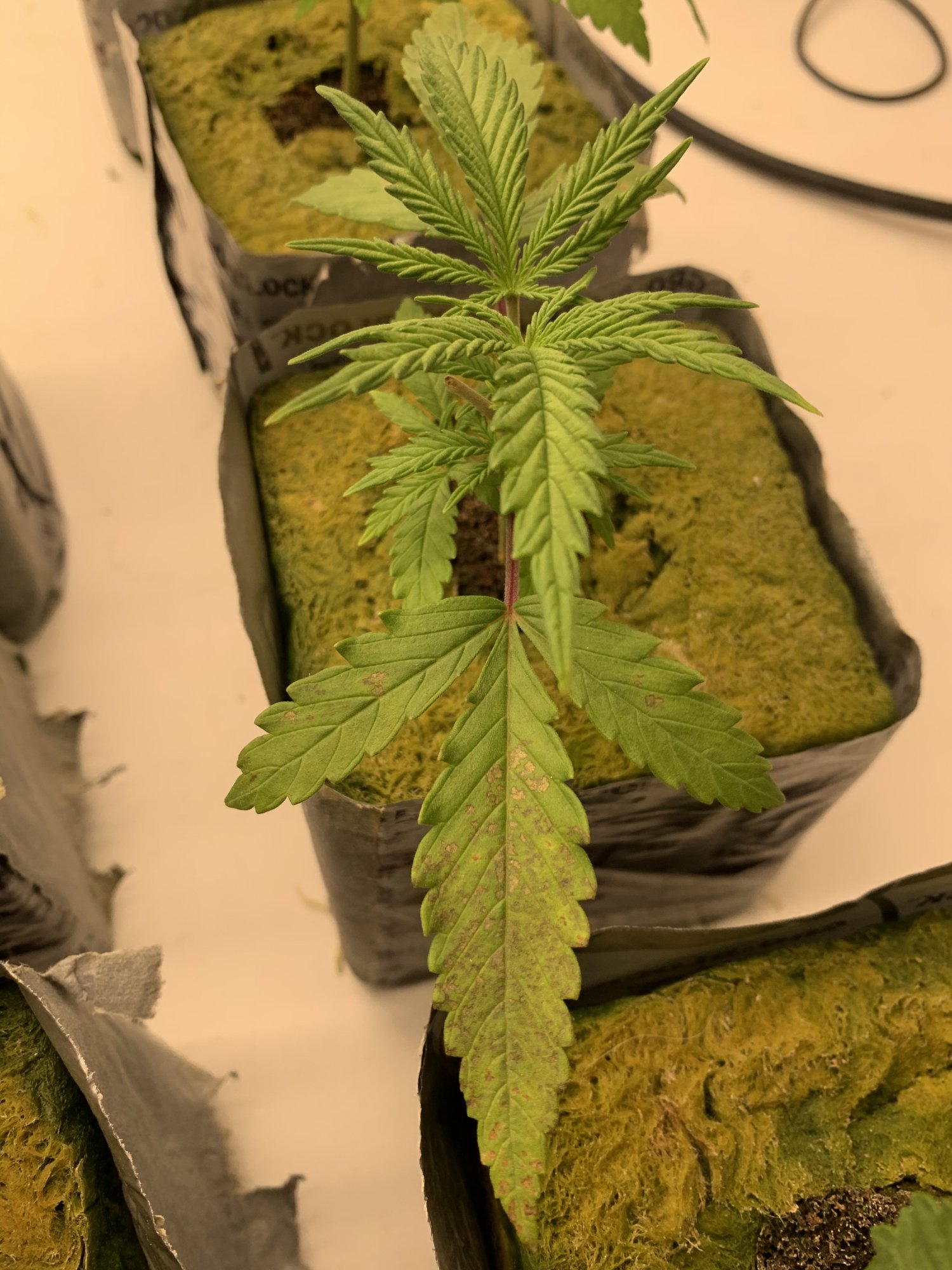
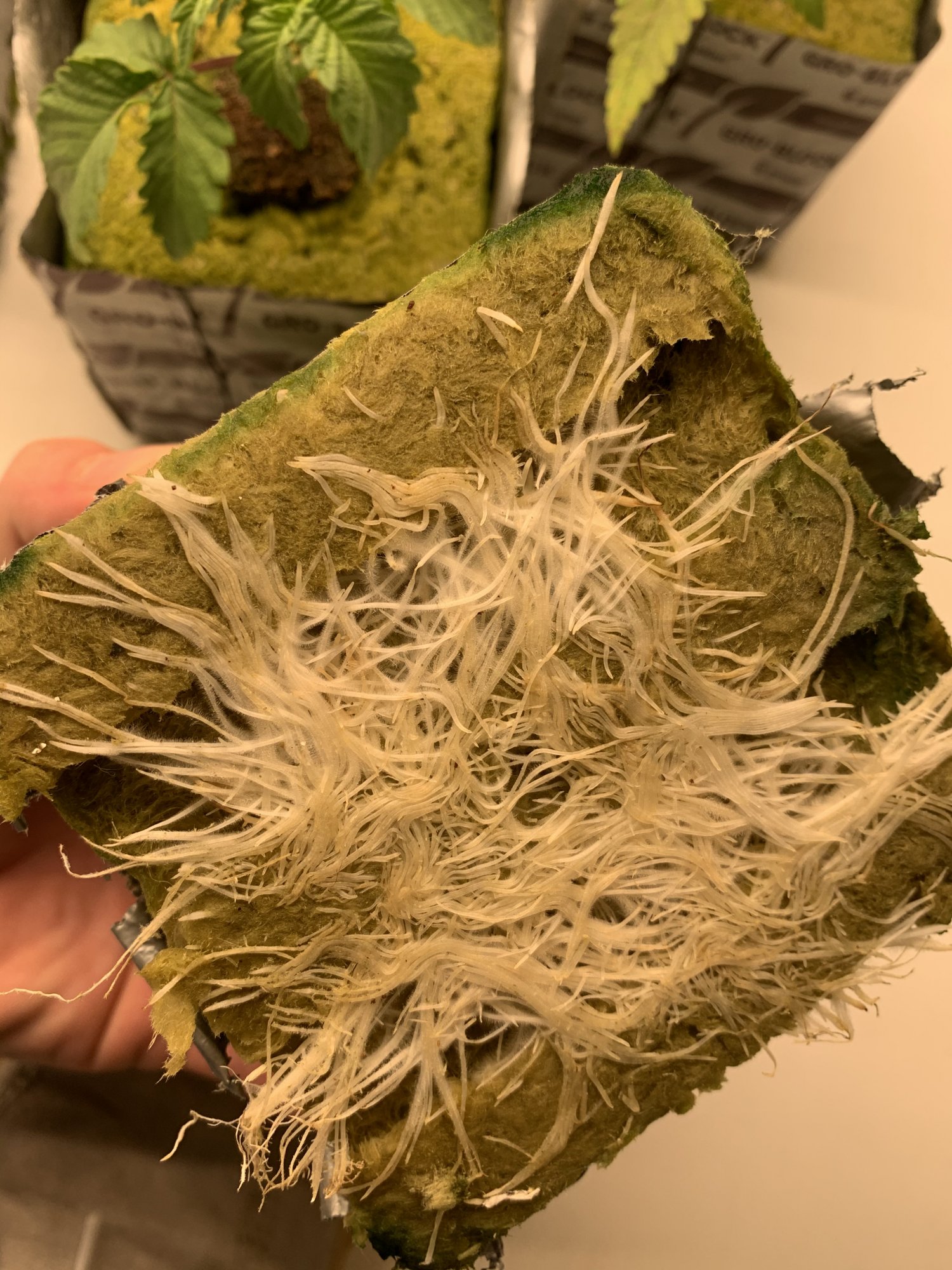
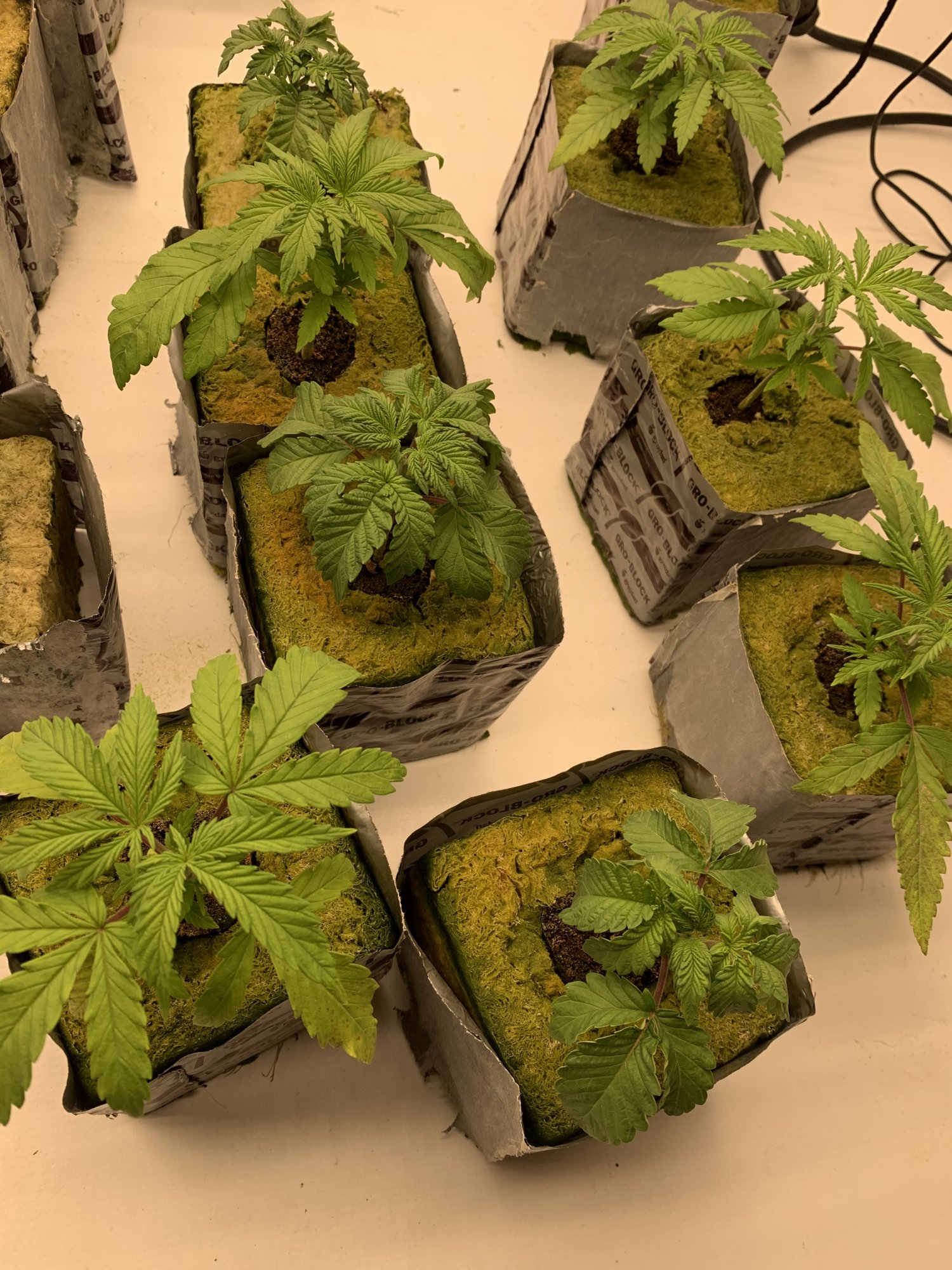
This might help out.
Remember the Moisture Gradient
Rockwool propagation cubes and slabs are designed to be used together to minimize root disturbance. Excellent moisture holding capacity and good aeration of the root zone are features of rockwool substrates. Irrigation of rockwool is a little different to other solid substrates because of the way the material is manufactured to have just the right degree of moisture gradient, and because it does give quite a limited root zone for plants that eventually grow fairly large. For this reason, rockwool is best irrigated with short, frequent applications of nutrient, with just enough at each irrigation for the rockwool to reach 'field capacity'. Field capacity is a term that means the substrate has drained fully but is still holding a good level of moisture for the plant roots to access until the next irrigation. At each irrigation, there should be some drainage from the rockwool material. However, this doesn't need to be excessive. Even in closed systems where the drainage solution is being collected and reused, it pays not to over-water and not to run the irrigation continuously.
Having around 10-15% of the nutrient solution fed to the plants, drain from the slab at each irrigation is considered to be optimal. This amount of drainage of solution flushes fresh nutrient solution right through the slab without too much wastage and usually keeps the EC in the slab fairly stable. When rockwool is irrigated and allowed to drain naturally, it will then contain 80% nutrient solution, 15% air pore space and 5% rockwool fibers. A typical rockwool tomato growing slab actually holds around four gallons (about 15 liters) of nutrient solution immediately after irrigation, despite the drainage holes allowing free drainage of excess solution. Four gallons is a good reserve of moisture for four plants, so drying down to wilting point could take a long period of time for small plants.
How much solution should be given at each irrigation? Having a drainage collection tray or channel under each slab allows growers to see how much drainage they are getting after each irrigation (even if this has to be poured off and measured in a jug) and the irrigation program can be increased or decreased to keep this at the 10-15% level. By doing this, the amount of solution to be given at each irrigation can be worked through and adjusted as the plants grow. Keep cutting back the irrigation amount until only 10-15% of the solution volume applied drains from the slab, and then the amount of irrigation has been fully adjusted for. How often should nutrient be applied? Rockwool needs small frequent irrigations, particularly under hot or low humidity conditions when the plants are taking up a lot of water. However, the frequency of irrigation can be as low as once per day (or every other day) for small plants under cool conditions, to over 10 times a day for large plants in a hot or dry environment. It can be hard to judge just how much moisture the rockwool material may be holding at any one time to determine when to irrigate. Smaller propagation blocks and even larger cubes can be gently picked up - the weight will soon tell you if the cube is saturated (it will be comparatively heavy and moisture will drip from the wet base), or whether it has dried out considerably, in which case it will feel very light (compare an unused dry cube to one in use).
Rockwool is an unusual material in that, even when the slab has lost 50% of its moisture to plant uptake, the plants are still able to very easily keep extracting water until the slab is almost completely dry - so plants in rockwool can't get water stressed until the rockwool is almost completely dry, by which time the cube or slab has become much lighter in weight. For granulated rockwool in pots or containers, a similar method can be used, either by gently lifting the pot to see what the weight might be (a light pot is a dry pot) or by a light tap or kick: if the pot moves, the rockwool has become quite light and potentially too dry. Another method to try and gauge the moisture status of the rockwool and how often to irrigate is to carefully remove a small piece of the wrapper plastic and examine the moisture gradient of the slab from top to bottom.
Like all growing media, moisture in rockwool can be gauged manually. Lightly touching or pressing the rockwool at the base of the slab will soon determine if there is still a good level of nutrient held in the base of the slab or whether it has become too dry. The top and middle layers of the slab should always appear drier than the base where the reservoir of moisture is naturally held, so only the base of the slab should be checked. Even if the top of the slab appears to be dry, this is not important as the moisture gradient has been designed to give these sorts of root zone conditions - only ensure the base of the slab has sufficient moisture. This process of working out how much moisture is still in the rockwool material is not something that needs to be done for long. Growers will soon become quite skilled at working out their frequency and amount of irrigation for each stage of plant growth and may only need to do this for their first crop provided growing conditions remain stable. Other times when it might be important to have a quick check of the amount of solution drainage or amount of moisture in the slab is when conditions suddenly change - addition of more grow lamps, sudden changes in temperature or humidity, or rapid growth spurts can all change the irrigation requirements of the plants. Generally, good brands of rockwool are quite forgiving compared to other substrates - the material is naturally well aerated and doesn't suffer the compaction issues that some substrates do during the life of the crop. It does hold high levels of moisture, so the chance of drying out is not as severe as it might be with other substrates and being sterile gives young plants, seedlings and cuttings an advantage as well. The irrigation program and water holding capacity of the substrate depends on the fiber density and arrangement, which can differ from brand to brand.