One drop
Supporter
Bush Doctor
- Posts
- 6,514
- Reactions
- 16,064
- Joined
- Sep 17, 2016
- Points
- 313

121,135 growers, practical cultivation threads, real grow diaries, and community advice.
Create account → Already a member? Log inFollow along with the video below to see how to install our site as a web app on your home screen.
Note: This feature may not be available in some browsers.


Thanks for the welcome and glad your familiar with what I'm doing the tree i use here is actually a Casurina which has needle type leaves thes modified leaves have Cilicia in them I soak 5kgs in 20 lts water for 14 days I use as a spray and as a add to the tank I learnt of this in my 2 year Hort school for me it's free and easy to make just like my urine and the milk is the only thing I buy along with the power I've kept my cost of running down low and slso reduces my footprint on mother earth .Haven't done oak anything (allelopathy) but I'm familiar with other materials mentioned. Welcome to the farm!
That's great that's what I use and in my flush period at a lower rate always never had a problem and free to make .I use tea that i make from my worm castings
Thanks for the welcome and glad your familiar with what I'm doing the tree i use here is actually a Casurina which has needle type leaves thes modified leaves have Silica in them I soak 5kgs in 20 lts water for 14 days I use as a spray and as a add to the tank I learnt of this in my 2 year Hort school for me it's free and easy to make just like my urine and the milk is the only thing I buy along with the power I've kept my cost of running down low and slso reduces my footprint on mother earth .
Thanks for the welcome and glad your familiar with what I'm doing the tree i use here is actually a Casurina which has needle type leaves thes modified leaves have Silica in them I soak 5kgs in 20 lts water for 14 days I use as a spray and as a add to the tank I learnt of this in my 2 year Hort school for me it's free and easy to make just like my urine and the milk is the only thing I buy along with the power I've kept my cost of running down low and slso reduces my footprint on mother earth .
Just a quick note the Casurina cunninghami is also call by its common name of She Oak it's a Australia Native tree . I hope that helps .
Yeah, I only perused the stuff I saw online but it appears to be yet another one of Australia's fascinating organisms.Yes that's correct it's not Quercus when the weather clears up I'll go a cut a branch off and show you it's leaf structure it has 100% silica in them the leaf is set up to reflect the sun light into the Center of the needle compound leaf it's a very interesting coastal plant .
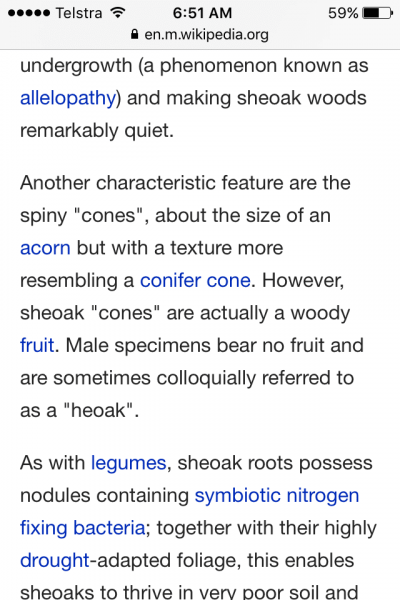
No not related to conifers at all it's really a big legume our soils are very low in N these trees fix N in the soil structure . Here's a few screen shots hope it helps .Are they related to conifers at all? Do you know how they got the name she-oak?
Yeah, I only perused the stuff I saw online but it appears to be yet another one of Australia's fascinating organisms.
The common name came from the first Sailors the look of the trunk reminded the ships carpenters of the Oak and the She comes from the wailing sound the wind makes as it goes through the trees it was said it sounded to the early sailors to be ladies crying and wailing for there return to the home shores I've heard it many times I live on a smaller island near the mainland of Tasmaina it's windy all the timeAre they related to conifers at all? Do you know how they got the name she-oak?
Yeah, I only perused the stuff I saw online but it appears to be yet another one of Australia's fascinating organisms.