
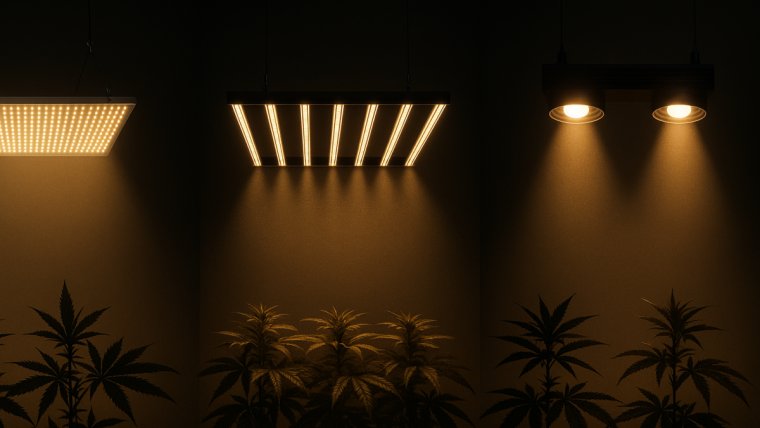
The best LED grow light is not the one with the loudest watt claim, the newest diode name, or the prettiest product photo. It is the fixture that covers your actual canopy evenly, hits the right PPFD for your growth stage, fits your heat and height limits, and gives you enough dimming control to adjust the grow instead of fighting it.
Quick answer
For most modern cannabis tents, bar-style LEDs are the easiest choice for even flowering coverage in 4x4 and larger spaces. Quantum boards are still excellent for 2x2, 2x4, and 3x3 grows where cost, simplicity, and passive cooling matter. COBs are no longer the default best buy for most new growers, but they still make sense for DIY builders, tall plants, deep-canopy supplemental light, and growers who already know how to manage heat sinks, drivers, and beam spread.
Looking for specific models?
This guide compares LED styles, not brands.
For budget to premium picks for 2x2 to 5x5 tents, with price ranges and what members report, see the grow lights by tent size guide.
If you are choosing your first serious LED, do not start with brand loyalty. Start with tent size, canopy shape, PPFD map, fixture-level efficiency, dimming, driver placement, warranty, and the amount of heat your room can remove.
01 · Quick Pick Which LED Type Should You Buy?
| Situation | Best fit | Why | Watch out for |
|---|---|---|---|
| 2x2 tent | Small quantum board or compact bar fixture | Simple coverage, low heat, affordable, easy to hang | Too much wattage too close to seedlings |
| 2x4 tent | Long quantum board, 2-board setup, or slim bar fixture | The rectangular footprint needs lengthwise coverage | A square board can leave weak ends |
| 3x3 tent | Quality quantum board or smaller bar fixture | Both can work if the PPFD map is even | Center hotspots from single-board designs |
| 4x4 tent | Bar-style fixture or multiple boards | Uniform canopy coverage matters more than peak center PPFD | Cheap "4x4" claims with weak edge numbers |
| 5x5 or larger | Bar-style fixture or multiple fixtures | Large canopies need spread, access, and heat distribution | One intense center fixture rarely covers corners well |
| Tall plants or tree-style grow | Bar-style primary plus COB or focused supplemental light | Can improve lower-canopy intensity when managed carefully | Hot spots, bleaching, and uneven flower maturity |
| DIY builder | COB, strips, or custom bar array | Best control over layout and parts | Electrical safety, thermal design, and no plug-and-play warranty |
| First grow on a budget | Known quantum board or entry bar fixture with a real PPFD map | Good results without overcomplicating the room | No-name lights with fake wattage or missing maps |
Bottom line
If you want the simplest modern answer for a 4x4 flower tent, buy a good bar-style LED. If you want the best value for a smaller tent, a good quantum board is still hard to beat. If you want COBs, know why you want them before you buy them.
02 · Guide Stop Comparing "Watts" Like They Grow Plants
Watts tell you how much power a fixture pulls from the wall. Watts do not tell you how much useful plant light reaches the canopy.
When comparing LED grow lights, look for these numbers instead:
- PPF - total photosynthetic photon output from the fixture.
- PPFD - how much usable light lands on a specific canopy area each second.
- DLI - how much usable light the plant receives across the full day.
- PPE - fixture efficiency, usually listed as umol/J.
- PPFD map - the grid that shows center, edge, and corner intensity at a stated height.
- Fixture draw - real wall wattage, not "HPS equivalent" marketing.
- Dimming range - how low and how smoothly the fixture can run.
If a product page only talks about "1000W equivalent" but does not show real watt draw, fixture-level PPE, and a PPFD map, treat it as a red flag.
For old-school lighting terminology, see What Do All of Those Lighting Terms Mean?. For hanging height by growth stage, see PPFD and DLI for Cannabis: Light Intensity and Height by Stage.
03 · Quantum Boards Still the Value Workhorse
Quantum boards are flat LED boards with many small diodes spread across a panel. They became popular because they were efficient, quiet, simple, and much easier to run than older blurple fixtures or hot HID setups.
Best use cases
- 2x2, 2x4, and 3x3 tents.
- Growers who want a simple fixture with passive cooling.
- Budget-conscious growers who still want efficient white light.
- Single-level canopies where the fixture can sit squarely over the plants.
- Rooms where fan noise matters.
Strengths
- Usually cheaper than comparable bar fixtures.
- Simple to hang and maintain.
- Good efficiency when built with quality diodes and drivers.
- Often passively cooled, so there are fewer moving parts.
- Easy for a new grower to understand.
Weaknesses
- Can create a strong center and weaker edges.
- A single board can disappoint in a 4x4 if the PPFD map falls off hard.
- Driver heat can still matter in small tents.
- Plants directly under the center can bleach before edge plants get enough light.
- Some budget boards use good diode names but weak drivers, thin heat sinks, or optimistic coverage claims.
Grower note
A quantum board is not bad because it has a center hotspot. It is bad only if that hotspot prevents you from lighting the full canopy evenly. In a small tent, that same intensity can be exactly what you need.
04 · Bar-Style LEDs Best Coverage for Most Flower Tents
Bar-style LEDs spread diodes across multiple long bars. The big advantage is geometry. Instead of blasting the middle of the tent, the fixture spreads light across the footprint and usually gives better edge and corner coverage.
Best use cases
- 4x4, 5x5, and larger flower rooms.
- Rectangular tents where a single square board leaves weak zones.
- Growers who want even canopy development.
- Rooms where heat needs to be spread out instead of concentrated.
- SCROG, sea-of-green, and flat-canopy grows.
Strengths
- Best average canopy uniformity of the three common LED styles.
- Lower hotspot risk when properly hung.
- Better edge performance in 4x4 and larger tents.
- Often easier to run closer to the canopy because heat and light are spread out.
- Many models include strong dimming and external driver options.
Weaknesses
- Higher upfront price than many boards.
- Bigger footprint can be awkward in tight tents.
- More bars and connectors mean more parts to inspect.
- Cheap bar fixtures can still have poor drivers, weak waterproofing, or inflated PPFD maps.
- Overkill in very small spaces if you cannot dim low enough.
Grower note
Bar-style fixtures are popular because they solve a real grow problem: uneven canopies. If your edge plants always lag under a board, a good bar fixture may improve the whole harvest even if the peak center PPFD is lower.
05 · COBs Still Useful, But More Niche
COB means "chip on board." A COB fixture concentrates many LED emitters into a small light source. Older DIY LED builds used COBs heavily because they were powerful, available, and customizable.
Best use cases
- Experienced DIY growers.
- Supplemental side or corner lighting.
- Tall plants where focused penetration is useful.
- Growers who already own quality COB fixtures.
- Custom rooms where fixture layout matters more than plug-and-play convenience.
Strengths
- Strong focused intensity.
- Small physical footprint.
- Flexible for DIY layouts.
- Can be excellent as supplemental lighting.
- Quality COBs can still grow great cannabis.
Weaknesses
- More hotspot risk.
- More heat per light source.
- Often needs active cooling or serious heat sinking.
- Not as easy for beginners to map evenly.
- Many modern boards and bars beat old COB builds in fixture-level efficiency and usability.
Grower note
Do not rip out working COBs just because they are older. If your canopy is healthy, your electricity cost is acceptable, and your flower quality is good, measure first. Upgrade when the numbers or the grow problem justify it.
06 · Guide How Much Light Does Each Tent Size Need?
Use these as planning ranges, not hard rules. Your target depends on fixture efficiency, height, reflector/lens design, cultivar tolerance, CO2, temperature, humidity, airflow, plant count, and whether you run photoperiods or autos.
| Grow space | Typical LED draw range | Better fixture shape | What to check |
|---|---|---|---|
| 2x2 | About 100-160W | Small board or compact bar | Can it dim low for seedlings? |
| 2x4 | About 220-320W | Long board, twin board, or bar | Are the ends of the tent strong enough? |
| 3x3 | About 240-360W | Board or small bar | Does the PPFD map stay even at the edges? |
| 4x4 | About 430-650W | Bar fixture or multiple boards | Are corners usable in flower? |
| 5x5 | About 650-850W | Large bar fixture or multiple fixtures | Can you remove heat and keep access? |
Important
A very efficient fixture can use fewer watts than an inefficient one and still deliver more light. A weak fixture can draw a lot of power and still underperform. Always pair wattage with a PPFD map and fixture-level PPE.
07 · Guide PPFD and DLI Targets for Cannabis
Stage-by-stage targets, from seedlings and clones to late flower and autos, are in the PPFD and DLI guide, with hanging heights and how to measure your canopy.
DLI is the daily total. A photoperiod plant in flower gets 12 hours of light, so a lower PPFD over more hours in veg can still produce a high daily total. Autoflowers can receive a high DLI at lower PPFD because many growers run them 18-24 hours per day.
Simple DLI formula
PPFD x light hours x 0.0036 = DLI.
Example: 800 PPFD x 12 hours x 0.0036 = 34.6 mol/m2/day.
If the plant is praying, growing fast, and not bleaching, you can increase gradually. If tops bleach, leaves taco, pistils brown early, or the plant drinks erratically, reduce intensity or raise the fixture before blaming nutrients.
08 · Guide How to Read a PPFD Map Without Getting Fooled
A PPFD map is only useful if you know the test conditions.
Check:
- What hanging height was used?
- What tent size or test grid was used?
- Were reflective walls included?
- Was the fixture at 100% power?
- Are edge and corner readings shown, or only the center?
- Is average PPFD listed, not just peak PPFD?
- Is the map from the manufacturer, a third-party tester, or a grower with a meter?
Peak PPFD sells lights. Average PPFD grows canopies.
For a flower tent, a slightly lower peak with stronger edges often beats a high center number with weak corners. That is why bar-style fixtures often outperform single-board fixtures in larger tents even when both look similar on paper.
09 · Guide Diode Names Matter, But Fixture Design Matters More
Samsung LM301H, LM301H EVO, LM301B, Osram reds, CREE chips, Citizen COBs, and Bridgelux strips can all be part of good fixtures. They can also be part of mediocre fixtures.
Do not judge a grow light by diode name alone. Ask:
- What is the complete fixture-level PPE?
- What is the actual wall draw?
- What driver is used?
- Can the driver be mounted outside the tent?
- How thick is the heat sink or bar body?
- What is the warranty?
- Does the company publish real PPFD maps?
- Are replacement parts or support available?
A diode package can test very efficiently under lab conditions. The whole fixture loses efficiency through driver losses, heat, optics, current level, wiring, and spectrum mix. That is normal. What matters to your plant is the final light delivered to the canopy.
10 · Setup Hanging Height, Dimming, and Heat
Start lower power and work up. Most light-burn problems happen because growers install a stronger LED and run it like the old fixture from day one.
Safe setup workflow
- Hang the fixture at the manufacturer's recommended starting height.
- Set the dimmer lower than you think you need.
- Measure PPFD if you have a meter or calibrated app.
- Watch the top leaves for 48-72 hours.
- Increase intensity in steps, not jumps.
- Keep notes on dimmer setting, height, temperature, humidity, and plant response.
Driver heat matters.
External drivers can make a small tent easier to control because the hottest electrical component can sit outside the grow space. Internal drivers are cleaner and simpler, but they add heat where your plants live.
Airflow matters too.
LEDs run cooler than HID at the canopy, but they still turn electricity into heat. A 600W LED is still adding roughly 600W of heat into the room before ventilation and driver placement are considered.
For spectrum basics, see From Seed to Harvest: How Light Spectrum and Intensity Impact Cannabis Growth and Potency and Understanding Lighting Color Temperature.
11 · Electricity Cost Use This Formula
Do not trust blanket claims like "cuts power by 60%" unless the comparison is clearly stated. Compare your actual fixture draw and runtime.
Monthly light cost formula
(Fixture watts / 1000) x hours per day x days per month x electricity rate = monthly light cost.
Example
A 480W LED running 12 hours per day for 30 days at $0.15/kWh costs:
0.48 x 12 x 30 x 0.15 = $25.92 per month.
That does not include exhaust fans, circulation fans, humidifiers, dehumidifiers, heaters, AC, pumps, or controllers. In real rooms, lighting choice also changes cooling demand, so the fixture with the best canopy coverage and manageable heat can be cheaper than the fixture with the lowest sticker price.
If you are comparing against HID, read HID Lights and Growing Cannabis: A Comprehensive Guide so you understand what is changing besides wattage.
12 · Pitfalls Common Mistakes by LED Type
Quantum Board Mistakes
- Buying one board for a 4x4 and expecting strong corners.
- Running the board too close in flower because leaf temperature feels lower than HID.
- Ignoring edge stretch until the canopy is already uneven.
- Buying by diode name while ignoring driver quality and heat sink size.
- Using the center PPFD number as if it represents the whole tent.
Bar-Style Mistakes
- Buying more fixture than the tent can cool.
- Running 100% power from seedling to harvest.
- Hanging the fixture too high and creating soft, stretchy growth.
- Ignoring bar spacing and shadow lines from filters, poles, and hangers.
- Assuming every bar light is automatically good because the shape is modern.
COB Mistakes
- Using too few COBs for the footprint.
- Running focused beams too close to the tops.
- Underbuilding heat sinks or fans.
- Mixing drivers and chips without understanding current and voltage.
- Expecting one intense point source to replace even canopy coverage.
13 · Fixes Troubleshooting LED Problems
| Symptom | Likely lighting issue | First correction |
|---|---|---|
| White or pale top leaves | Too much intensity near the tops | Dim 10-20% or raise the fixture 4-6 inches |
| Tacoing upper leaves | Light/heat stress at canopy | Check leaf temperature, airflow, and PPFD |
| Tall edge plants | Weak side/corner coverage | Rotate plants, spread fixtures, or add edge light |
| Dense center, weak corners | Center-heavy fixture map | Raise fixture slightly or use multiple fixtures/bars |
| Airy lowers | Not enough usable light below top canopy | Thin canopy, train flatter, or add side/supplemental light |
| Room runs hot after LED upgrade | Total wattage or driver heat increased | Move driver out, improve exhaust, or lower wattage |
| Seedlings stall under new light | Too intense too early | Dim heavily and raise the fixture until growth resumes |
For grower discussion, see How Close to Put LED to Plants? and Ideal Light Intensity for Different Stages of Flower Using High Power LEDs.
14 · Guide What About UV, IR, and Far-Red Diodes?
Do not buy a weak main light because it has a few extra spectrum diodes. White-light coverage, fixture quality, and canopy uniformity come first.
Extra red, far-red, UVA, or UVB can be useful in specific situations, but they are not magic yield buttons. Some spectrum additions are cultivar-specific, dose-specific, and easy to overuse. If your base light is underpowered or uneven, fix that first.
Read these before paying extra for spectrum channels:
15 · Guide Best Choice by Grower Type
New grower in a small tent
Buy a reputable quantum board or compact bar fixture with dimming and a real PPFD map. Spend saved money on ventilation, a timer/controller, and a way to measure light.
Personal grower in a 4x4
Start with a bar-style LED or multiple boards. Prioritize even coverage over the highest center reading.
Budget grower
Avoid the cheapest no-name option. A slightly older, proven board from a known brand often beats a flashy high-watt listing with missing data.
Commercial or larger personal room
Use bar-style fixtures or modular multi-fixture layouts. Uniformity, serviceability, dimming control, and heat planning matter more than one fixture's peak spec.
DIY grower
COBs, strips, and custom bar arrays can still make sense. Build for safety first: driver matching, wire gauge, fusing, grounding, thermal design, and strain relief.
Grower upgrading from HID
Expect different canopy behavior. LEDs can bleach tops without feeling as hot as HID. Use measurements and plant response instead of copying your old hanging height.
16 · Guide Buying Checklist Before You Pay
Before buying any LED, answer these:
- What is my exact grow footprint?
- What PPFD range do I want in flower?
- Does the fixture publish a PPFD map for my tent size and height?
- Is the listed PPE for the whole fixture, not just one diode package?
- Can I dim it low enough for seedlings and veg?
- Can I mount the driver outside the tent?
- Will the fixture physically fit with my filter, fan, and hangers?
- Does the company provide real warranty support?
- Can my room remove the heat from the fixture wattage?
- Do I need one fixture, or would two smaller fixtures cover better?
If you cannot answer those, ask before buying. THCFarmer's Growroom Design & Setup forum is the right place to sanity-check a light plan before money leaves your pocket.
17 · FAQ Frequently Asked Questions
For larger flower tents, usually yes, because bar-style fixtures tend to cover edges and corners more evenly. For smaller tents, a quality quantum board can be cheaper, simpler, and just as effective.
Not useless, but more niche. COBs still work well in good builds, especially for DIY or supplemental use. For most new plug-and-play purchases, modern boards and bars are easier to recommend.
Many home grows do well around 700-950 PPFD in mid to late flower without added CO2. Higher intensity can work in dialed rooms, but weak environment control turns more light into stress instead of better flower.
Not automatically. CO2 only helps if light, temperature, humidity, nutrition, airflow, and sealed-room control are already strong. Most home growers should dial the normal room first.
Use watts as a rough sanity check, not the final answer. PPFD map, fixture-level PPE, and coverage uniformity matter more.
It can be a good diode, but do not pay for a diode name alone. A fixture with excellent layout, driver, cooling, and PPFD map can beat a poorly built fixture that advertises a premium diode.
For one full-cycle white LED, 3000K to 4000K can all work. Many growers like 3500K as a balanced seed-to-harvest choice. Spectrum matters, but fixture quality and light distribution matter more for most buying decisions.
Yes. Mixed setups can work well when each fixture has separate dimming and you map the canopy. Use the bar fixture to improve edges and the board where center intensity is useful.
Look for pale tops, bleaching, tacoing, crispy upper leaf edges, stalled growth, or flowers bleaching directly under the fixture. Dim or raise the light and watch new growth.
Not automatically. Measure canopy light, track yield and quality, and compare electricity cost. Upgrade when the current fixture creates a real problem: weak edges, too much heat, poor dimming, high power cost, or unreliable hardware.
18 · Conclusion The Bottom Line
For most cannabis growers:
- Choose bar-style LEDs for the easiest even coverage in 4x4 and larger flower spaces.
- Choose quantum boards for strong value in smaller tents and simple personal grows.
- Choose COBs when you have a specific DIY, supplemental, or tall-canopy reason.
Do not buy the light with the biggest watt number. Buy the light with the best canopy map for your actual space. A fixture that delivers even, controllable light across the whole plant canopy will beat a more expensive fixture that creates hot spots in the middle and weak flowers at the edges.
Bring your tent size, fixture shortlist, PPFD map, budget, heat limits, and growing style to Growroom Design & Setup before you buy. The community has already made most of these expensive mistakes, and that is exactly why the forum exists.
More Lighting questions?
Bring your numbers, room size, and target yields to the forum so other growers can sanity-check the setup before you burn money on the wrong gear.
logic has been posting on THCFarmer since 2008 and now carries 547 learn guides for growers who want the real numbers, tradeoffs, and failure points before they spend time or money.