
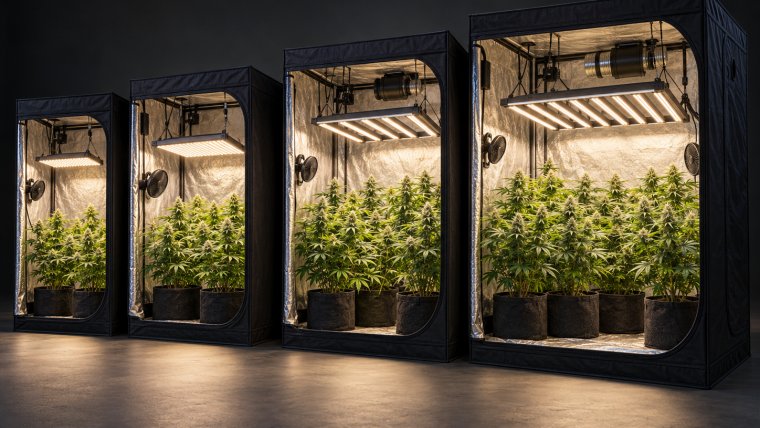
The best grow lights for cannabis are dimmable, full-spectrum LEDs sized to the tent they hang in. Picking one takes three numbers: your tent's footprint, 30 to 40 watts of real wall draw per square foot, and your budget. Get the watts right first. A $170 light at the right wattage grows better flower than a $550 light that is too small for the space.
This guide covers LED grow lights for indoor tents from 2x2 to 5x5 feet, photoperiods and autos, for growers buying a first light or replacing an old one. The table gives a budget, mid-range and premium pick for each tent size, and the sections below explain each pick and what to check before you buy. For how LED styles compare (quantum boards, bars and COBs), see the LED grow light types guide. For light intensity by growth stage, see the PPFD and DLI guide.
Disclosure
AC Infinity is a paid THCFarmer brand partner. AC Infinity, ViparSpectra and Vivosun lights are listed in the THCFarmer shop, and Spider Farmer, Mars Hydro, AC Infinity, ViparSpectra and Phlizon have all run giveaways on the forum. No brand saw, approved or paid for this guide, and this page carries no shop or affiliate links. Every pick passed the same test, described below, and no partner holds more than 2 of the 15 picks.
01 · Quick picks Best grow lights by tent size
Watts are the maker's listed wall draw, not the "equivalent" number on the box. Prices are the US retail range we found when we last checked in October 2026, before coupon codes.
| Tent | Real watts to aim for | Budget pick | Mid-range pick | Premium pick |
|---|---|---|---|---|
| 2x2 | 100 to 150 W | Spider Farmer SF1000, 100 W, $65 to $85 | ViparSpectra XS1500 Pro, 150 W, $95 to $110 | HLG 100 V2, 95 W, around $150 |
| 2x4 | 200 to 300 W | Spider Farmer SF2000, 200 W, $150 to $180 | AC Infinity Ionframe EVO3, 280 W, around $300 | HLG 350R, 330 W, around $550 |
| 3x3 | 250 to 330 W | Mars Hydro FC-E3000, 300 W, $170 to $210 | Spider Farmer SE3000, 300 W, $200 to $240 | HLG 350R, 330 W, around $550 |
| 4x4 | 430 to 500 W | Mars Hydro FC-E4800, 480 W, $275 to $315 | Spider Farmer SE5000, 480 W, $340 to $410 | Photontek X 600W Pro, 600 W, $520 to $665 |
| 5x5 | 650 to 750 W | Mars Hydro FC-E6500, 730 W, around $420 | AC Infinity Ionframe EVO8, 730 W, around $800 | Lumatek Zeus 600W Pro 3.1, 600 W, $745 to $915 |
02 · Guide How we picked these lights
Every light in the table passed four checks: members here report running it, the maker publishes real wall draw and a PPFD map, it dims low enough for seedlings, and it has a written warranty you can read before you buy. Where two lights tied, the one with more member reports won.
The member numbers come from a search of THCFarmer posts from 2019 onward, in which 2,192 members say they run a named LED brand. These are the members who have posted about each brand's lights since 2023:
- Spider Farmer: 536 members
- Mars Hydro: 461
- AC Infinity: 293
- Vivosun: 248
- ViparSpectra: 225
- HLG (Horticulture Lighting Group): 179
We left out 614 giveaway, contest and sponsored test-grow threads, plus every post from 105 brand and vendor accounts, because a free light changes what people write about it. The counts come from keyword matching, so read them as popularity, not quality. Premium brands like Photontek and Lumatek show up less because fewer growers buy $600 lights, not because they grow worse flower.
03 · Guide How many watts your tent needs
Members running LEDs report a median of 27 to 37 watts of real draw per square foot. Small tents sit at the high end because more of their light hits the walls: about 37 W per square foot in a 2x2, about 27 in a 5x5. One member's rule of thumb is 30 watts of quality LED per square foot; another tells new growers to shoot for 35 to 40 to carry plants through flower.
Ignore the big number on the box. One member's "300w" light draws 80 watts at the wall, while another's Lumatek rated at 300 W pulls 337. Use the "actual power" figure on the spec sheet, or check it with a plug-in watt meter.
Every watt also ends up as heat, about 3.4 BTU per hour per watt. A 480 W light adds roughly 1,640 BTU per hour, so a 4x4 still needs an exhaust fan sized for the tent. At 15 cents per kWh, the same light costs about $26 a month on 12 hours a day and about $39 on an 18 hour veg schedule.
Not sure your numbers add up? Post your tent size, plant count and shortlist in Growroom Design & Setup before you buy.
04 · Guide Best grow lights for a 2x2 tent
Aim for 100 to 150 W. Members flowering a full 2x2 cluster around 150 W, and a 100 W light handles "one, maybe two plants".
Budget: Spider Farmer SF1000 ($65 to $85, 100 W)
The most-discussed single light on the forum, with 144 members posting about it since 2023. Dimmer knob, 5-year warranty. Watch for: 100 W is the floor for flowering a 2x2, so plan on one or two plants, not four.
Mid-range: ViparSpectra XS1500 Pro ($95 to $110, 150 W)
Half again the power for a little more money, and the ViparSpectra model members run most. Up to 20 units daisy-chain to one dimmer. Watch for: it is rated for a 3x3 in veg but a 2x2 in flower, so plan around the flower number. US warranty: 3 years.
Premium: HLG 100 V2 (around $150, 95 W)
HLG is the premium brand members run most, and this is its small-tent board. It costs about twice the SF1000 for similar watts: you are paying for build and support, not more light. Watch for: HLG warranties run 1 to 5 years by model and seller, so get the term in writing.
Also proven: the Mars Hydro TS1000 (around $80, 150 W), which 134 members have posted about along with the smaller TS600.
05 · Guide Best grow lights for a 2x4 tent
Aim for 200 to 300 W; the member median is 280 W. The long shape is the problem to solve: a single square board leaves both ends weak, so use a long fixture, a bar light or two small lights side by side.
Budget: Spider Farmer SF2000 ($150 to $180, 200 W)
Rated for a 2x4, with 104 members posting about it since 2023. Watch for: 200 W is the low end, about 25 W per square foot. The SF1000 two-pack (about $130) gives the same 200 W over two footprints and fixes the weak ends.
Mid-range: AC Infinity Ionframe EVO3 (around $300, 280 W)
A Samsung-diode bar fixture at the wattage members actually run in a 2x4. It works with AC Infinity's controllers, and one member gets 10 dimming levels instead of 4 that way. AC Infinity is a paid THCFarmer partner. Watch for: its 2-year warranty is shorter than the 3 to 5 years most other picks carry.
Premium: HLG 350R (around $550, 330 W)
About 40 W per square foot in a 2x4, with room to run dimmed. Watch for: listings disagree on the warranty (1 year on the boards and 5 on the driver, or 5 overall), so confirm it with the seller.
Also worth a look: Spider Farmer's G4500 and SE4500 bars (320 W, $190 to $260). A member who runs both rates the Samsung-diode SE "definitely better" but says the Bridgelux G "holds its own". Measure first: one owner calls the SE4500 "pretty snug" in a 2x4.
06 · Guide Best grow lights for a 3x3 tent
Aim for 250 to 330 W; the member median is 300 W. Bars and boards both work at this size if the PPFD map stays even out to the edges.
Budget: Mars Hydro FC-E3000 ($170 to $210, 300 W)
A Bridgelux-diode bar fixture and the most-run light in Mars Hydro's FC line among members. One member running two calls it "a very good inexpensive fixture". Watch for: the 5-year warranty gives full cover only in year one, then free parts with shipping and repair at your cost.
Mid-range: Spider Farmer SE3000 ($200 to $240, 300 W)
Same wattage with Samsung diodes instead of Bridgelux, and 44 members posting about it since 2023. Watch for: Spider Farmer's warranty also gives full cover in year one only.
Premium: HLG 350R (around $550, 330 W)
The 2x4 premium pick again: in a 3x3 it works out to about 37 W per square foot, right on the member median. Watch for: confirm the warranty term with the seller.
Also worth a look: the Spider Farmer G3000 (around $180, 300 W) is one of the most-discussed 3x3 lights in recent posts. The Vivosun LumaLight 320W ($180 to $275) gives full warranty cover for 2 of its 5 years, longer than Spider Farmer's or Mars Hydro's single year, but only a handful of members have posted about it so far.
07 · Guide Best grow lights for a 4x4 tent
Aim for 430 to 500 W; the member median is 480 W. This is where bar lights earn their price, because a single square board strong enough for the center leaves the corners short. One member's SF4000 board performs well but is slightly too small for a 4x4.
Budget: Mars Hydro FC-E4800 ($275 to $315, 480 W)
A bar fixture at exactly the member median for this tent. Watch for: the same one-year full-cover warranty as the rest of the Mars Hydro line.
Mid-range: Spider Farmer SE5000 ($340 to $410, 480 W)
Samsung-diode bars, with 46 members posting about it since 2023. Watch for: a member testing an SE5000 supplied by Spider Farmer saw half the bars go dim mid-flower from a loose wire connection. Check every connector before the first grow.
Premium: Photontek X 600W Pro ($520 to $665, 600 W)
Rated at 2.7 µmol/J, with Osram and Lumileds diodes and a 5-year warranty. Run it near 80%, which matches the 480 W most members use in a 4x4. Watch for: the included dimmer steps between 25, 50, 75 and 100%, so finer control needs a 0-10V controller. It weighs about 30 lb, and only 9 members have posted about Photontek since 2023.
Also worth a look: the AC Infinity Ionframe EVO6 (around $580, 500 W) is the AC Infinity light members run most, though at about the same price the Photontek gives you 5 years of warranty instead of 2. The HLG BlackBird (600 W, $750 to $850, 3-year warranty) is HLG's option at this size.
08 · Guide Best grow lights for a 5x5 tent
Aim for 650 to 750 W; the member median is 680 W. Heat matters as much as light here: a 730 W fixture adds about 2,500 BTU per hour, the same as a space heater on its 750 W setting, so size the exhaust before you buy the light.
Budget: Mars Hydro FC-E6500 (around $420, 730 W)
The cheapest way to the wattage a 5x5 needs. Watch for: one year of full warranty cover, then parts only.
Mid-range: AC Infinity Ionframe EVO8 (around $800, 730 W)
One member runs AC Infinity's 730 W light in a 5x5, never above 80%, and calls it "flawless". AC Infinity is a paid THCFarmer partner. Watch for: it costs nearly twice the FC-E6500 for the same wattage, with a 2-year warranty. The extra buys controller integration and build, which pays off most if you already run AC Infinity fans and controllers.
Premium: Lumatek Zeus 600W Pro 3.1 ($745 to $915, 600 W)
Rated at about 1,990 µmol/s of light, which a typical 2.7 µmol/J fixture would need about 740 W to match. That efficiency is why 600 W covers a 5x5. One member calls the line "one of the best lights I've ever seen". 5-year warranty. Watch for: the cheaper Zeus 600W Pro 2.9 puts out less light, so check the model before you pay.
Also worth a look: the Spider Farmer SE7000 ($460 to $550, 730 W), a Samsung-diode bar at the same wattage as the FC-E6500.
09 · Guide Two smaller lights or one big one?
Two smaller lights spread light over the whole footprint, let you dim each half for plants at different heights, and leave you a working light if one fails mid-flower. For a 3x3, one member suggested four ViparSpectra P1000s at about $80 each or one SF4000 at about $340. The trade-off is more cords, hangers and drivers to keep outside the tent. In a square tent, one bar fixture is simpler. In a 2x4 or 4x8, two lights are usually the better buy.
10 · Guide Warranties and what actually fails
Diodes rarely die. In member failure reports, the parts that fail are drivers, dimmers and connectors: a TS1000 driver, an SF2000 dimmer, a melted Mars Hydro driver connector, an HLG light that died after 5 years. On the other side, one member has logged more than 10,000 hours on an SF4000 with no real issues. Every major brand has failure reports and none has enough for a fair failure rate, so judge brands on the warranty and how they handle a claim.
- Spider Farmer: 5 years on SF, SE and G series. Year one covers parts, repair and shipping; after that you pay shipping and may pay a depreciation charge for a replacement.
- Mars Hydro: 5-year limited warranty on the FC and FC-E series. Full cover in year one, then free parts with repair and shipping at your cost.
- Vivosun LumaLight: 5 years, with full cover for the first 2.
- Photontek and Lumatek: 5 years on the X 600W Pro and Zeus 600W Pro.
- ViparSpectra: 3 years on US units.
- AC Infinity: 2 years.
- HLG: 1 to 5 years depending on the model; the BlackBird carries 3.
Buy from the maker's store or an authorized dealer and keep the invoice. One member who bought a Mars Hydro light through Amazon struggled to get a warranty claim answered, and one member describes failing drivers sold under HLG model numbers that HLG did not make. To claim, send the order number, clear photos and a short video of the fault, and wait for authorization before shipping anything back.
11 · Pitfalls Common mistakes when buying a grow light
Buying by the number on the box
Lights sold as "1000W" often draw about 100 W: one new grower's "1000w" Amazon light turned out to be about 100 W. Size the light by actual power draw, 30 to 40 W per square foot.
Full power on seedlings
Seedlings want roughly a third of flowering intensity: members aim for 200 to 250 PPFD for the first 2 weeks, against 600 to 950 in flower. A common start is 15 to 25% power at about 30 inches, lowering the light if stems stretch.
Leaving the driver inside a small tent
LED drivers run at roughly 90 to 95% efficiency, so 5 to 10% of the light's power becomes heat in the driver itself. A detachable driver mounted outside the tent keeps that heat out, and it is one of one member's two minimum requirements for any light, along with a continuous dimmer.
Settling for a stepped dimmer
Lights that only switch between 25, 50, 75 and 100% make seedlings and late flower hard to dial in, and members complain about the presets. A continuous dimmer, or a controller with 10 or more levels, lets you adjust in 10% steps or finer.
Trusting seller reviews at face value
One member who returned a light and left an honest review says the seller offered a full refund if they changed it to 5 stars. Weigh forum grow reports over star ratings.
12 · FAQ Frequently asked questions
Yes, for one plant in a 2x2, maybe two. Members in the "Is this 100w light enough" thread put flowering at 35 to 40 W per square foot, or 140 to 160 W for a full 2x2. For a full tent in flower, add a second 100 W light or step up to 150 W.
First check what it really draws. A light that truly pulls 1,000 W lights a 5x5 well; a "1000W" box that draws 100 to 200 W covers a 2x2 to 2x4. Plant count depends more on training than wattage, as the 1000w plant count thread points out: one 5x5 can hold one large trained plant or 25 small sea-of-green plants.
Some are, and the spec sheet tells you which. Check for a real wall-draw figure, a continuous dimmer and a detachable driver, as one member recommends in the cheap Amazon LED thread, and skip any light that lists only an "equivalent" wattage. Proven budget lights like the SF1000, TS1000 and XS1500 Pro cost $65 to $110 and publish their real draw.
The G series uses Bridgelux diodes and costs less; the SE series uses Samsung diodes. In the G4500 or SE4500 thread, an owner of both rates the SE higher but says the G holds its own, and another member doubts the plants would show a difference. With about $40 between them, most members there leaned toward the SE. If money is tight, the G still grows the same tent.
Members split on this. Those who pay more say they are buying quality, name recognition and customer service, including higher diode grades. Others run a reputable mid-range light and call it "excellent bang for the buck". Premium makes the most sense once temperature, humidity and feeding are under control and you want a longer warranty. The full debate is in the high-end lights thread.
Usually not enough to justify the watts. Members in the under-canopy lights thread found the gain on lower buds small for the power used and suggested lighting a second canopy instead. If you add side lighting, mount bars horizontally at about the lower third of the canopy. For UV and far-red add-ons, see the far-red and UV guide.
For most tents, yes. One member who ran both side by side found the HPS used about 30% more electricity for the same crop size and quality, and ran much hotter. Expect a learning curve, because LEDs can burn plants at heights that were safe under HPS. In the HPS to LED bars thread, one grower starts flower at 450 to 500 PPFD, reaching 750 by the end of week 3 and 900 by week 4.
13 · Conclusion Bottom line
Size the light by real watts, 30 to 40 per square foot of tent, then spend what is left on a longer warranty and a smooth dimmer. That one rule separates most good grow light buys from bad ones.
Sources: spec sheets, product listings and warranty pages from Spider Farmer, Mars Hydro, AC Infinity, ViparSpectra, HLG, Photontek, Lumatek and Vivosun, plus US retail listings, checked October 2026. Member figures come from a search of THCFarmer forum posts from 2019 onward, excluding giveaway threads and brand accounts.
More Lighting questions?
Bring your numbers, room size, and target yields to the forum so other growers can sanity-check the setup before you burn money on the wrong gear.

logic has been posting on THCFarmer since 2008 and now carries 547 learn guides for growers who want the real numbers, tradeoffs, and failure points before they spend time or money.