
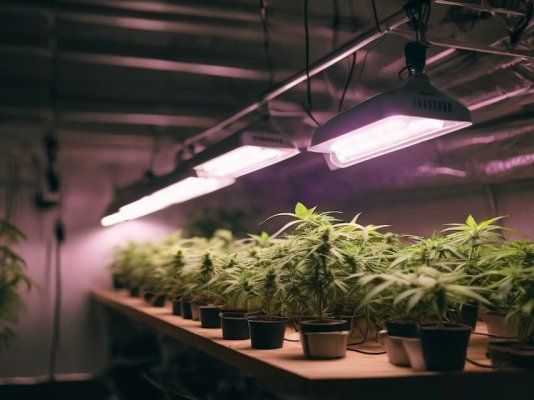
Most light charts tell you to hang an LED at a set height. Height is the wrong number to chase. Cannabis responds to PPFD, the light landing on the canopy each second, and DLI, the total it collects in a day. In most home grows, seedlings do best at about 150 to 300 PPFD, veg at 300 to 650, and flower at 600 to 950. Hit those, and the right height is whatever gets you there.
This guide covers light intensity for indoor cannabis under LEDs, from seedlings and clones through late flower, for photoperiods and autoflowers. It explains PPFD and DLI in plain numbers, how to measure them with a meter or a phone app, how to set height and dimmer, and how to read the plant when the number is wrong. For choosing a light, see the grow lights by tent size guide. For light schedules, see hours of light for veg.
01 · Guide PPFD and DLI targets by growth stage
PPFD is in µmol/m²/s at the top of the canopy. DLI is in mol/m²/day. Ranges are starting points for healthy plants in a typical home room.
| Stage | PPFD | Hours on | DLI | Why this range |
|---|---|---|---|---|
| Seedlings and fresh clones | 150 to 300 | 18 to 20 | 10 to 22 | Small roots move little water: above 300 they stall or curl, below 150 they stretch |
| Early veg | 300 to 500 | 18 | 19 to 32 | Roots and leaf area are building; most plants take this without stress |
| Late veg | 450 to 650 | 18 | 29 to 42 | Full root systems use more light; matches the 350 to 600 most members run |
| Flower, 12/12 | 600 to 950 | 12 | 26 to 41 | Where most home rooms run out of cooling and humidity control before the plant runs out of use for light |
| Flower with added CO2 (1,000 to 1,200 ppm) | 950 to 1,500 | 12 | 41 to 65 | Extra CO2 lets leaves use more light, but only in a tightly controlled room |
| Autoflowers, whole run | 400 to 700 | 18 to 20 | 26 to 50 | Longer days deliver the same daily light at lower intensity |
For the first 3 to 5 days after sprouting, stay near the bottom of the range. One member keeps just-sprouted seedlings at no more than 100 PPFD. For CO2 levels and cost, see the CO2 supplementation guide.
02 · Guide What PPFD and DLI mean
PPFD (photosynthetic photon flux density) counts the usable light, 400 to 700 nm, that lands on one square meter each second. It is the number a quantum meter or phone app reads, and it changes across the canopy: highest directly under the light, lower at the edges and corners.
DLI (daily light integral) is the day's total. To work it out, multiply PPFD by the hours the light is on, then by 0.0036 (3,600 seconds an hour, divided by 1,000,000 to turn micromoles into moles):
- 750 PPFD for 12 hours: 750 x 12 x 0.0036 = 32.4 mol/m²/day
- 500 PPFD for 18 hours: 500 x 18 x 0.0036 = 32.4 mol/m²/day
- 250 PPFD for 18 hours: 16.2 mol/m²/day. The same 250 for 24 hours: 21.6
The first two lines are why autoflowers and veg plants need less PPFD than flowering photoperiods. A plant at 500 PPFD for 18 hours gets the same daily light as one at 750 for 12. Run an auto at flowering-room intensity for 20 hours and you can stress it with a number that looks moderate.
03 · Guide What members actually run
We pulled every forum sentence since 2019 that gives a PPFD number for a single growth stage, 553 in all, from readings and from advice. The middle half of those numbers lines up with the table:
- Seedlings and clones: median 250, middle half 200 to 320 (143 sentences)
- Veg: median 500, middle half 350 to 600 (129 sentences)
- Flower: median about 750, middle half 600 to 950 (281 sentences)
One grower aims for 200 to 250 PPFD for the first 2 weeks after sprout, then 400 to 500 until flower. When a new grower followed a maker's "30% at 24 inches" seedling setting and read about 280 PPFD, a member called that the very high end for seedlings and suggested turning the light down rather than raising it. In flower, one grower starts at 450 to 500 PPFD and works up to 750 by the end of week 3 and 900 by week 4, and another suggests 900 PPFD with no added CO2 as a ceiling that works when everything else is right.
04 · Guide How far can you push it?
Further than most charts suggest, if the room keeps up: in a University of Guelph trial, dry flower yield rose in a straight line from 116 to 519 grams per square meter as canopy PPFD went from 120 to 1,800, with no plateau, under ordinary CO2 (about 440 ppm). Cannabinoid potency did not change, and total terpenes rose with light. The catch: it was one cultivar in a research chamber held at about 25°C and 60% RH.
Home rooms rarely hold conditions that steady, which is why most members stop around 900 to 950 in flower without CO2. More light raises water use, leaf temperature and VPD demand at the same time, and as one member puts it, pushing light shows up the weak spots in your grow. If you want to go past 950, raise it 50 to 100 PPFD a week, about the pace members use when ramping into flower, and watch the plant, not the meter.
05 · Guide How to set height and dimmer
Start from the maker's chart for your light, then check it with a reading. Makers' settings can run hot: the "30% at 24 inches" seedling setting above landed at the top of the seedling range, and one member notes that manufacturers' directions tend to recommend hanging too low.
Pick a starting height
Hang the light where you can reach the target at 40 to 70% power. That leaves room to dim for seedlings and to turn up in flower without moving the light.
Seedlings
A common start is 15 to 25% power at about 30 inches. One member runs a 240 W light at 20% at 30 inches, about 48 W of actual power.
Veg
Keep the light higher and turn the power up. One grower runs the light farther away with more intensity in veg, then lower with less intensity in flower. Higher hanging spreads light more evenly across a young, uneven canopy.
After the flip
Raise intensity in steps over 3 to 4 weeks rather than all at once.
One change at a time
Change height or dimmer, not both, and give the plant 48 to 72 hours before the next change.
Raising the light does not cut PPFD to a quarter when you double the height. That inverse-square rule holds for a bare bulb, not for a wide LED fixture inside reflective walls. One member's reading dropped from 162 PPFD at 16 inches to 63 at 30 inches: the light moved 1.9 times farther, and PPFD fell to about 39%, not the 28% the bare-bulb rule predicts. Measure after moving a light; don't calculate.
06 · Guide Measuring PPFD with a meter or phone app
Measure at the top of the canopy, where the leaves are, not at the pot. Take the center, the four corners and the middle of each edge, then average them. PPFD is highest directly under the light and much lower toward the edges, so a single center reading flatters every fixture.
Phone apps
Photone is free to download, with paid upgrades of a few dollars, and needs a diffuser over the camera: a sheet of printer paper works, or a clip-on diffuser for about $40. Its developer claims accuracy within 5% of lab equipment. A member who compared apps against meters reports Photone reading 5 to 10% low on recent iPhones and Android light apps 20% or more low. Opinions split: one member calls it more of a toy than a calibrated meter, while another finds it more than accurate enough for home grows.
Quantum (PAR) meters
Branded handheld meters such as the Spectrum Technologies LightScout, Hydrofarm Quantum PAR Meter and Photobio Advanced run $135 to $215. The Apogee MQ-500, a common reference meter, costs around $550. Even good meters drift: one member found their Apogee MQ-610 reading 11 to 14% off Apogee's clear-sky calculator. A meter helps most while you learn: as one member says, it helps you understand light intensity quickly while you learn to read the plant.
Lux meters
Lux measures light as the human eye sees it, weighted toward green, so it only estimates PPFD. Apogee's conversion factors run from 0.0122 for HPS to 0.0185 for sunlight (PPFD = lux x factor). White grow LEDs usually fall inside that band, so lux x 0.015 gives a rough figure. For foot-candles, multiply by 10.76 to get lux first. That is why old lux charts mislead: 40,000 to 70,000 lux, a common veg target, works out to roughly 600 to 1,050 PPFD under white LEDs, above what most members run in veg.
07 · Guide Reading the plant
The meter tells you what the light delivers; the plant tells you whether it can use it. Leaves that sit flat and level are happy with the light; praying leaves are asking for more. Praying can also mean too much, especially when the leaves curl like a canoe.
- Too much light: pale or bleached tops nearest the light, upper leaves tacoing or canoeing, crispy tips only at the top of the plant, seedlings that stall.
- Too little light: stretching seedlings, long gaps between nodes, thin stems, airy lower buds in flower.
If symptoms show up at a moderate number, check the climate before blaming the light. A member asked how anyone could be light burning at an honest 300 PPFD, and several members in that thread pointed to humidity and VPD instead. Under LEDs, leaf temperature runs about 4°F below air temperature, so work out VPD from leaf temperature, not the thermometer.
08 · Guide Distances for HPS, T5 and CFL
These lights have no PPFD map on the box, so start from distance and use heat as the limit.
HPS and metal halide
At least 18 inches; members ran 1000 W HPS 2 to 3 feet above the canopy. Air-cooled hoods can sit closer. Hold the back of your hand at canopy height: if it is too hot to keep there for 10 seconds, it is too hot for the plants, the way it was done before meters.
T5 fluorescent
Hang them 6 to 12 inches away, because the tubes run cool and their light falls off fast.
CFL
Hang them 4 to 12 inches away, closer for low-watt bulbs, for the same reason.
09 · Pitfalls Common mistakes
Trusting the maker's height chart without a reading
Maker settings can run hot for seedlings. Check the actual PPFD at the canopy before the first plants go under it.
Measuring only the center
A center reading of 900 can mean corners at 500. Average five to nine points, and set the light by the average.
Running autos at photoperiod PPFD
An auto at 750 PPFD for 20 hours gets about 54 mol/m²/day, two-thirds more than a 12/12 plant at the same setting. Keep autos at 400 to 700.
Jumping to full power at the flip
Plants that were happy at 600 in late veg can bleach if they go straight to 950. Step up over 3 to 4 weeks.
Blaming the light for a climate problem
Yellow, curling new growth at 300 to 500 PPFD is rarely light burn. Check VPD from leaf temperature and the root zone first.
10 · FAQ Frequently asked questions
150 to 300, starting at the low end. In the how much PPFD for seedlings thread, members aim for about 150 to 250 in the first 2 weeks. Fresh sprouts do fine at 100 to 150 for the first few days. If seedlings stretch, add light in small steps; if leaves curl up or growth stalls, back off.
300 to 500 in early veg and 450 to 650 once the plants are established, on an 18 hour day. That gives a DLI of about 19 to 42. Most members run 350 to 600, and the dial in PPFD thread covers how to get there with height and dimmer.
600 to 950 without added CO2, reached in steps over the first 3 to 4 weeks after the flip. With CO2 at 1,000 to 1,200 ppm and tight climate control, 950 to 1,500 can pay off. Research shows yield still rising at 1,800 in a controlled chamber, but home rooms usually hit their cooling and humidity limits first.
For a home room without CO2, usually yes. Plants can use it in research conditions, but at 1,500 the canopy drinks and heats faster than most tents can handle, and the extra light turns into stress. The intense PPFD thread shows how quickly climate problems surface when the light goes up, even with added CO2.
PPFD is a per-square-meter rate, but you read it at the top of each plant. Members in the measuring PPFD thread measure at the crown of the plant. For a multi-plant canopy, take the center, corners and edges and average them.
Yes, because they run longer days. At 18 to 20 hours, 400 to 700 PPFD gives a DLI of 26 to 50, overlapping the 26 to 41 a photoperiod gets from 600 to 950 at 12 hours. The autoflower 24 vs 18/6 thread covers the schedule side.
You can, but members are split on whether it helps. In the 24 hour seedlings thread, most replies recommend 18/6, while one runs seedlings, clones and veg on 24 hours and sees no difference, and another tried both and found them about equal, with 18 hours saving electricity. Going from 18 to 24 hours adds a third to the DLI, so if you run 24, keep PPFD at the low end of the seedling range.
11 · Guide Next steps
Once intensity is dialed in, the next lever is the schedule: see hours of light for veg. If your light cannot reach these numbers at a sensible height, the grow lights by tent size guide shows how many watts each tent needs.
Sources: Rodriguez-Morrison, Llewellyn and Zheng (2021), Frontiers in Plant Science 12:646020; Apogee Instruments PPFD to lux conversion factors; Photone app and accessory listings. Meter prices checked October 2026. Member figures come from a search of THCFarmer forum posts from 2019 onward, excluding giveaway threads and brand accounts.
More Lighting questions?
Bring your numbers, room size, and target yields to the forum so other growers can sanity-check the setup before you burn money on the wrong gear.

logic has been posting on THCFarmer since 2008 and now carries 547 learn guides for growers who want the real numbers, tradeoffs, and failure points before they spend time or money.