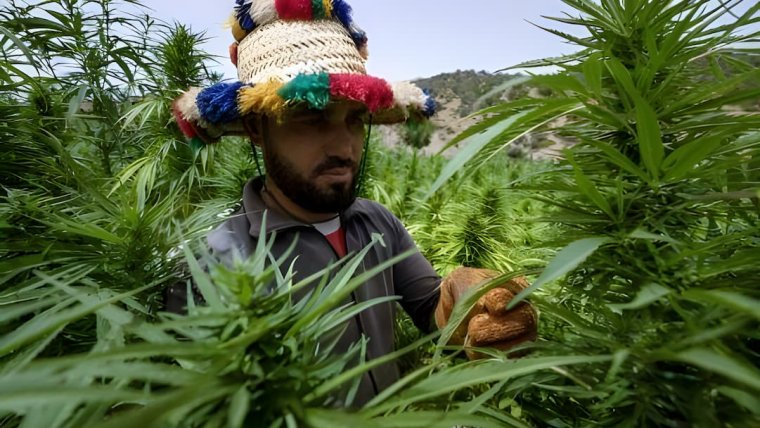
Just two years ago, Abdesselam Ichou began legally growing cannabis as part of Morocco's legalization of the plant for medicinal and industrial uses in an impoverished region of the country. Now, he is among thousands of legal farmers whose cultivation area has reached new heights and cut into the still-dominant illegal trade in Morocco, the world's largest cannabis resin producer, according to the United Nations.
In 2021, the North African country passed a law allowing the cultivation of medical and industrial-use cannabis in areas of Rif, a mountainous region that has long been a major source of illicit hashish smuggled into Europe. "I never imagined that one day I would be able to grow cannabis without the fear and anxiety of being arrested, robbed, or not being able to sell my harvest," said Ichou, 48, proudly showing his leafy crops in the commune of Mansoura, in the Chefchaouen region southeast of Tangiers.
Morocco's partial legalization of cannabis aimed to combat drug trafficking and improve the livelihoods of farmers, supporting up to 120,000 families in the region whose economy relies on cannabis, which has been grown there for centuries. In its first harvest of legal, low-potency cannabis last year, the country reported an output of 296 tonnes, according to ANRAC, Morocco's cannabis regulating agency.
For Ichou, it was "a record harvest of almost eight tonnes on one hectare (2.5 acres)" that provided him with a steadier income than illegal cultivation. He sold the crop at 80 dirhams ($8) per kilogram, grossing $64,000. The Moroccan firm that bought it decided to invest in two more hectares for the next harvest.
In Chefchaouen, Hoceima, and Taounate—the Rif provinces where non-recreational cannabis cultivation is legal—the number of farmers increased from 430 to 3,000 in a year, according to ANRAC. The surface area of legal cannabis crops increased almost tenfold, going from 286 hectares in 2023 to 2,700 hectares in 2024. However, this pales in comparison to the 55,000 hectares that official figures say were grown illegally in 2019.
Said El Gueddar, 47, another legal cannabis grower, initially had apprehensions but realized that legalization is the right path to follow. He belongs to a cooperative and has "a lot of hope, because it can only be better than living in the precariousness of illegality."
After relying on imported seeds for legal cultivation, beldia, a local drought-resilient variety of the plant, will be harvested for the first time in August. With Morocco hit by a six-year drought, "beldia is a major asset for us," said Ichou, who created a cooperative with dozens of other farmers dedicated to growing the local variety on more than 200 hectares.
For industrial cannabis use, ANRAC has issued more than 200 permits, including about 60 in cannabis processing, 20 for seed importation, and around 30 for cannabis export. Aziz Makhlouf seized the opportunity by creating Biocannat, a cannabis processing factory employing 24 people in Bab Berred, southeast of Chefchaouen. Since the start of the year, his factory has transformed around 30 tonnes of cannabis into various products, including CBD resin, oil, flour, creams, candies, and food supplements.
While cannabis regulation helps to "slowly build a reliable and resilient economy," it remains challenging "to absorb the illegal sector as of now because it has its market," said Mohamed El Guerroudj, the head of ANRAC. Legal growers could eventually make a 12-percent turnover compared to four percent on the illegal market, according to official studies.
For now, the kingdom's priority is to help improve the lives of the population who rely economically on the plant. Treating "cannabis production as a normal agricultural sector," Guerroudj said, will enable them to emerge "out of the shadows... towards the light."
In 2021, the North African country passed a law allowing the cultivation of medical and industrial-use cannabis in areas of Rif, a mountainous region that has long been a major source of illicit hashish smuggled into Europe. "I never imagined that one day I would be able to grow cannabis without the fear and anxiety of being arrested, robbed, or not being able to sell my harvest," said Ichou, 48, proudly showing his leafy crops in the commune of Mansoura, in the Chefchaouen region southeast of Tangiers.
Morocco's partial legalization of cannabis aimed to combat drug trafficking and improve the livelihoods of farmers, supporting up to 120,000 families in the region whose economy relies on cannabis, which has been grown there for centuries. In its first harvest of legal, low-potency cannabis last year, the country reported an output of 296 tonnes, according to ANRAC, Morocco's cannabis regulating agency.
For Ichou, it was "a record harvest of almost eight tonnes on one hectare (2.5 acres)" that provided him with a steadier income than illegal cultivation. He sold the crop at 80 dirhams ($8) per kilogram, grossing $64,000. The Moroccan firm that bought it decided to invest in two more hectares for the next harvest.
In Chefchaouen, Hoceima, and Taounate—the Rif provinces where non-recreational cannabis cultivation is legal—the number of farmers increased from 430 to 3,000 in a year, according to ANRAC. The surface area of legal cannabis crops increased almost tenfold, going from 286 hectares in 2023 to 2,700 hectares in 2024. However, this pales in comparison to the 55,000 hectares that official figures say were grown illegally in 2019.
Said El Gueddar, 47, another legal cannabis grower, initially had apprehensions but realized that legalization is the right path to follow. He belongs to a cooperative and has "a lot of hope, because it can only be better than living in the precariousness of illegality."
After relying on imported seeds for legal cultivation, beldia, a local drought-resilient variety of the plant, will be harvested for the first time in August. With Morocco hit by a six-year drought, "beldia is a major asset for us," said Ichou, who created a cooperative with dozens of other farmers dedicated to growing the local variety on more than 200 hectares.
For industrial cannabis use, ANRAC has issued more than 200 permits, including about 60 in cannabis processing, 20 for seed importation, and around 30 for cannabis export. Aziz Makhlouf seized the opportunity by creating Biocannat, a cannabis processing factory employing 24 people in Bab Berred, southeast of Chefchaouen. Since the start of the year, his factory has transformed around 30 tonnes of cannabis into various products, including CBD resin, oil, flour, creams, candies, and food supplements.
While cannabis regulation helps to "slowly build a reliable and resilient economy," it remains challenging "to absorb the illegal sector as of now because it has its market," said Mohamed El Guerroudj, the head of ANRAC. Legal growers could eventually make a 12-percent turnover compared to four percent on the illegal market, according to official studies.
For now, the kingdom's priority is to help improve the lives of the population who rely economically on the plant. Treating "cannabis production as a normal agricultural sector," Guerroudj said, will enable them to emerge "out of the shadows... towards the light."