
Y
Yamon
- Posts
- 61
- Reactions
- 112
- Joined
- Oct 26, 2025
- Points
- 33
Hi Y'all.
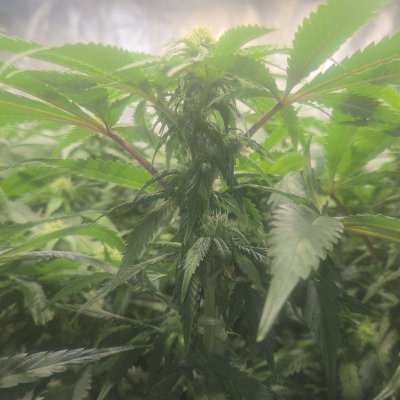
I have started an 18/12 schedule starting around day 17 of flower. I would have started at day 10 but hadn't thought of it yet.
Some thoughts to consider.
Extra Light in Flowering Doesn’t Revert Cannabis to Veg — Here’s Why
Physiology-based explanation to debunk the “extra light = reversion to veg” myth:
1. The real trigger: darkness, not light
Cannabis is a short-day (photoperiod) plant. Flowering is triggered and maintained by uninterrupted periods of darkness, not by the number of hours of light. As long as the plant receives the minimum dark window (usually ~12 hours for photoperiod strains), it will remain in flower.
2. Why people get it wrong
A common myth is that any light longer than 12 hours will force the plant back to veg. This misunderstanding comes from oversimplifying the 12‑12 schedule taught in textbooks. While 12‑12 is standard for flowering, extra light does not erase the dark signal. The plant senses darkness cues through phytochrome pathways, not by tallying light hours.
3. Natural variability
Plants evolved under variable conditions: cloudy days, shading, storms, or even volcanic dust can drastically change light intensity and duration. Cannabis has survived and flowered for millions of years under these conditions, which demonstrates that it is highly resilient and flexible in its light usage. What matters is the continuity of darkness.
4. Effects of extended light
More light hours = more energy for photosynthesis, allowing faster node stacking, taller stretch, and more biomass.
As long as dark periods are maintained, flowering continues normally.
Resin, trichome, and bud development are generally not negatively affected; in fact, extra energy may enhance overall growth.
5. Bottom line
Flowering depends on darkness continuity, not on capping light at 12 hours.
Extra light during flowering does not revert the plant to veg, it simply provides more energy to build bigger, stronger colas.
Reversion occurs only if the plant’s dark period is interrupted or shortened below the flowering threshold.
Conclusion: Growers can safely experiment with slightly longer light periods during flowering (e.g., 18‑12) to maximize stretch and energy capture, as long as the dark period remains uninterrupted.
I have started an 18/12 schedule starting around day 17 of flower. I would have started at day 10 but hadn't thought of it yet.
Some thoughts to consider.
Extra Light in Flowering Doesn’t Revert Cannabis to Veg — Here’s Why
Physiology-based explanation to debunk the “extra light = reversion to veg” myth:
1. The real trigger: darkness, not light
Cannabis is a short-day (photoperiod) plant. Flowering is triggered and maintained by uninterrupted periods of darkness, not by the number of hours of light. As long as the plant receives the minimum dark window (usually ~12 hours for photoperiod strains), it will remain in flower.
2. Why people get it wrong
A common myth is that any light longer than 12 hours will force the plant back to veg. This misunderstanding comes from oversimplifying the 12‑12 schedule taught in textbooks. While 12‑12 is standard for flowering, extra light does not erase the dark signal. The plant senses darkness cues through phytochrome pathways, not by tallying light hours.
3. Natural variability
Plants evolved under variable conditions: cloudy days, shading, storms, or even volcanic dust can drastically change light intensity and duration. Cannabis has survived and flowered for millions of years under these conditions, which demonstrates that it is highly resilient and flexible in its light usage. What matters is the continuity of darkness.
4. Effects of extended light
More light hours = more energy for photosynthesis, allowing faster node stacking, taller stretch, and more biomass.
As long as dark periods are maintained, flowering continues normally.
Resin, trichome, and bud development are generally not negatively affected; in fact, extra energy may enhance overall growth.
5. Bottom line
Flowering depends on darkness continuity, not on capping light at 12 hours.
Extra light during flowering does not revert the plant to veg, it simply provides more energy to build bigger, stronger colas.
Reversion occurs only if the plant’s dark period is interrupted or shortened below the flowering threshold.
Conclusion: Growers can safely experiment with slightly longer light periods during flowering (e.g., 18‑12) to maximize stretch and energy capture, as long as the dark period remains uninterrupted.

 thats cool.as hell.




 Florigen Cascade — Simplified View (Applied to Your 18/12)
 In 12/12:
 Bottom line:
