

effexxess
- Posts
- 71
- Reactions
- 111
- Joined
- Aug 25, 2022
- Points
- 33
These studies from the past two years recommend very high light intensities. 900 in veg and up to 1800 in flower. Study extracts follow:
Cannabis Yield, Potency, and Leaf Photosynthesis Respond Differently to Increasing Light Levels in an Indoor Environment 2021
Victoria Rodriguez-Morrison, David Llewellyn and Youbin Zheng
The objectives of this study were to establish the relationships between canopy-level LI (light intensity), leaf-level photosynthesis, and yield and quality of drug-type cannabis. … Plants were grown for 12 weeks in a 12-h light/12-h dark ‘flowering’ photoperiod under canopy-level PPFDs ranging from 120 to 1800 μmol·m-2·s-1 provided by light emitting diodes.
… dry inflorescence yield increased linearly with increasing canopy-level PPFD up to 1,800 μmol·m−2·s−1, while leaf-level photosynthesis saturated well-below 1,800 μmol·m−2·s−1. The density of the apical inflorescence and harvest index also increased linearly with increasing LI, resulting in higher-quality marketable tissues and less superfluous tissue to dispose of. There were no LI treatment effects on cannabinoid potency, while there were minor LI treatment effects on terpene potency
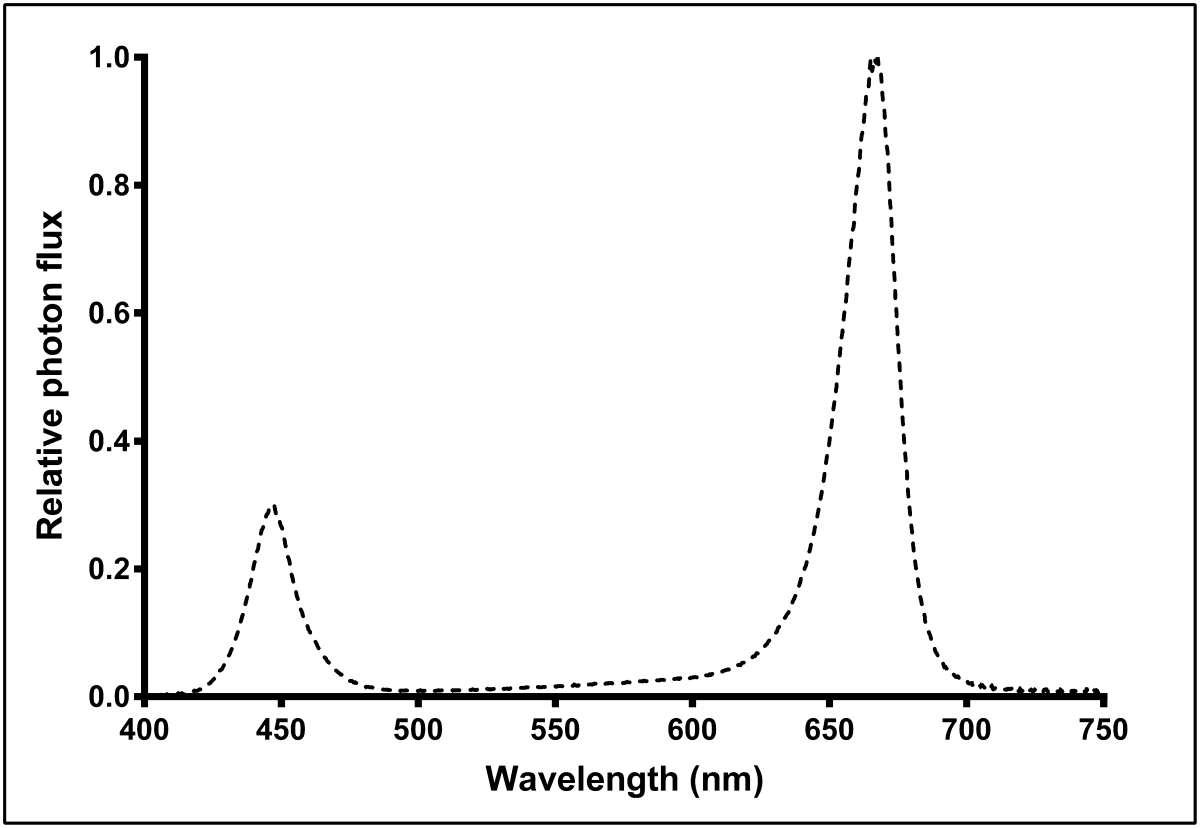
FIGURE 1 | Relative spectral photon flux distribution of Pro650 (Lumigrow) light-emitting diode (LED) fixtures.
“Blurple” light. The photon flux ratio of B (400–500 nm), green (G, 500–600 nm), and R (600–700 nm) was B18:G5:R77.
It was predicted that cannabis yield would exhibit a saturating response to increasing LI, thereby signifying an optimum LI range for indoor cannabis production. However, the yield results of this trial demonstrated cannabis’ immense plasticity for exploiting the incident lighting environment by efficiently increasing marketable biomass up to extremely high—for indoor production—LIs. Even under ambient CO2, the linear increases in yield indicated that the availability of PAR photons was still limiting whole-canopy photosynthesis at APPFD levels as high as ≈1,800 μmol·m−2·s−1 (i.e., DLI ≈78 mol·m−2·d−1).
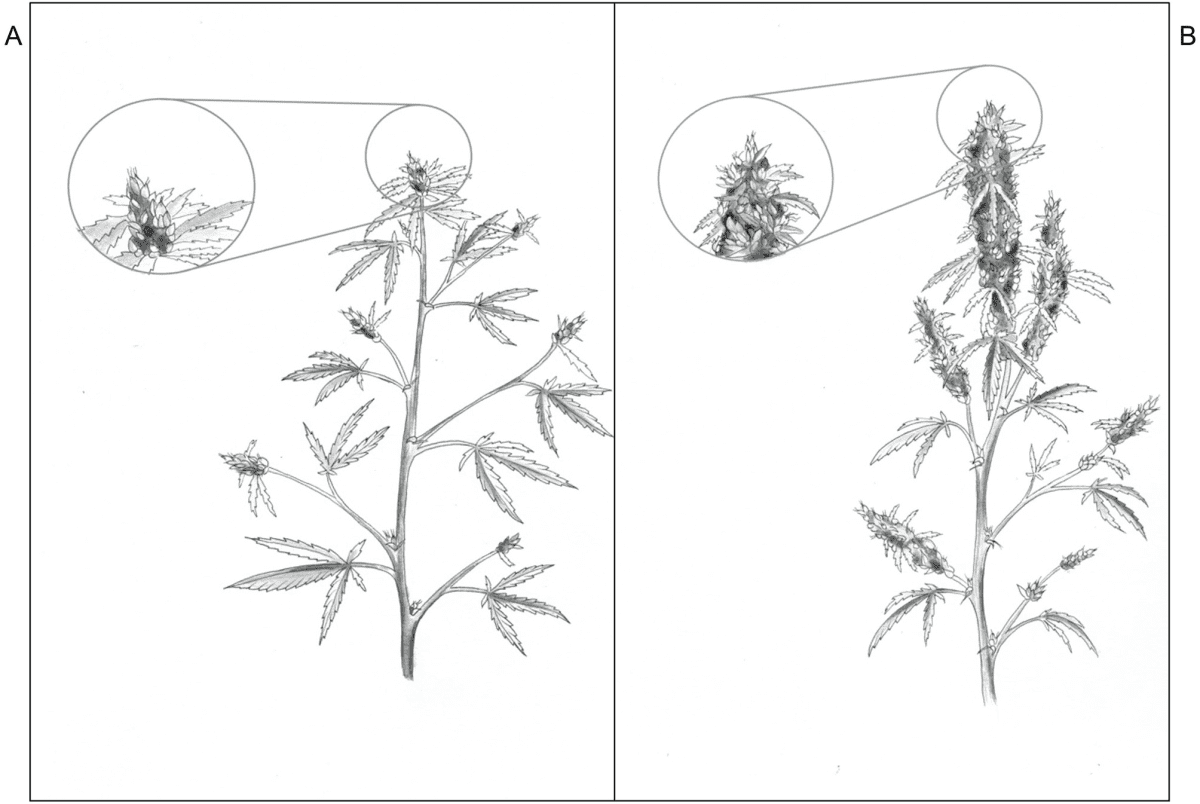
FIGURE 6 | Sketches of Cannabis sativa ‘Stillwater’ plants grown under low (A) and high (B) photosynthetic photon flux density (APPFD), 9 weeks after initiation of 12-h photoperiod
Overall, the impact that increasing LI had on cannabis morphology and yield were captured holistically in the plant sketches in Figure 6, which shows plants grown under higher LIs had shorter internodes, smaller leaves, and much larger and denser inflorescences (resulting in higher harvest index), especially at the plant apex.
Increasing Light Intensity Enhances Inflorescence Quality. Beyond simple yield, increasing LI also raised the harvest quality through higher apical inflorescence (also called “cola” in the cannabis industry) density—an important parameter for the whole-bud market—and increased ratios of inflorescence to total aboveground biomass (Figures 7B,C).
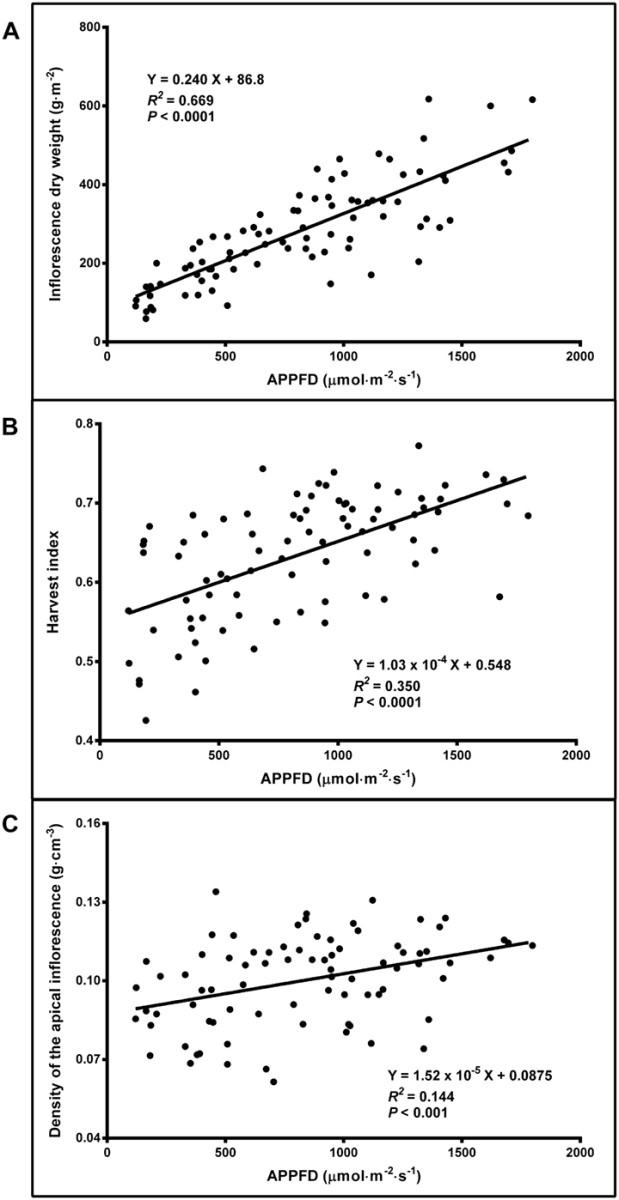
FIGURE 7 | The relationship between average apical photosynthetic photon flux density (APPFD) applied during the flowering stage (81 days) harvest index (total inflorescence dry weight / total aboveground dry weight) (B), and apical inflorescence density (based on fresh weight) (C) of Cannabis sativa ‘Stillwater’. Each datum is a single plant.
CONCLUSION. The results also indicate that the relationship between LI and cannabis yield does not saturate within the practical limits of LI used in indoor production. Increasing LI also increased harvest index and the size and density of the apical inflorescence; both markers for increasing quality. However, there were no and minor LI treatment effects on potency of cannabinoids and terpenes, respectively.
High light intensities can be used to grow healthy and robust cannabis plants during the vegetative stage of indoor production (2021)
Abstract. Although the vegetative stage of indoor cannabis production can be relatively short in duration, there is a high energy demand due to higher light intensities (LI) than the clonal propagation stage and longer photoperiods than the flowering stage (i.e., 16 – 24 hours vs. 12 hours). … To determine the vegetative plant responses to LI, clonal plants of ‘Gelato’ were grown for 21 days with canopy-level photosynthetic photon flux densities (PPFD) ranging between 135 and 1430 μmol·m-2·s-1 on a 16-hour photoperiod (i.e., DLI daily light integrals of ≈ 8 to 80 mol·m-2·d-1). Plant height and growth index responded quadratically; the number of nodes, stem thickness, and aboveground dry weight increased asymptotically; and internode length and water content of aboveground tissues decreased linearly with increasing LI. … Generally, PPFD levels of ≈ 900 μmol·m-2·s-1 produced compact, robust plants that are commercially relevant, while PPFD levels of ≈ 600 μmol·m-2·s-1 promoted plant morphology with more open architecture – to increase airflow and reduce the potential foliar pests in compact (i.e., indica-dominant) genotypes.
:quality(85):strip_exif()/https://www.thcfarmer.com/attachments/1663775604752-png.1284296/ "1663775604752")
There was almost a 3-fold increase in DW (dry weight) over the 135 to 1430 μmol·m-2·s-1 APPFD range in the present study, although 90% of the maximum increase in DW was attained at an APPFD of only ≈ 900 μmol·m-2·s-1.
In contrast, plants were smaller at ≈ 900 vs. 600 μmol·m-2·s-1 but had ≈ 15% higher DW and ≈ 6% thicker stems (i.e., ≈ 13% higher cross-sectional area).
Since the number of nodes saturated at relatively low LI, a canopy-level PPFD target of about 900 μmol·m-2·s-1 may be most appropriate for producing robust but not overly compact plants while also minimizing lighting-related energy and infrastructure costs. Although not as common in commercial settings, production facilities that target more open plant architecture and greater energy conservation may opt for canopy-level PPFD target of ≈ 600 μmol·m-2·s-1.
Few contemporary recommendations suggest exposing vegetative cannabis plants to PPFDs higher than 800 μmol·m-2·s-1 in indoor production systems. The current study demonstrates that vegetative cannabis can be exposed to substantially higher LIs (than commonly-used in the industry) with positive morphological outcomes that can prime plants for the transition into the flowering phase.
Note: "Blurple light" spectrum LEDs used for study!
:quality(85):strip_exif()/https://www.thcfarmer.com/attachments/1663776230137-png.1284297/ "1663776230137")
F igure 1. Relative spectral photon flux distribution of blue (B) and red (R) LEDs used during the propagation and vegetative stages
Cannabis Yield, Potency, and Leaf Photosynthesis Respond Differently to Increasing Light Levels in an Indoor Environment 2021
Victoria Rodriguez-Morrison, David Llewellyn and Youbin Zheng
The objectives of this study were to establish the relationships between canopy-level LI (light intensity), leaf-level photosynthesis, and yield and quality of drug-type cannabis. … Plants were grown for 12 weeks in a 12-h light/12-h dark ‘flowering’ photoperiod under canopy-level PPFDs ranging from 120 to 1800 μmol·m-2·s-1 provided by light emitting diodes.
… dry inflorescence yield increased linearly with increasing canopy-level PPFD up to 1,800 μmol·m−2·s−1, while leaf-level photosynthesis saturated well-below 1,800 μmol·m−2·s−1. The density of the apical inflorescence and harvest index also increased linearly with increasing LI, resulting in higher-quality marketable tissues and less superfluous tissue to dispose of. There were no LI treatment effects on cannabinoid potency, while there were minor LI treatment effects on terpene potency
FIGURE 1 | Relative spectral photon flux distribution of Pro650 (Lumigrow) light-emitting diode (LED) fixtures.
“Blurple” light. The photon flux ratio of B (400–500 nm), green (G, 500–600 nm), and R (600–700 nm) was B18:G5:R77.
It was predicted that cannabis yield would exhibit a saturating response to increasing LI, thereby signifying an optimum LI range for indoor cannabis production. However, the yield results of this trial demonstrated cannabis’ immense plasticity for exploiting the incident lighting environment by efficiently increasing marketable biomass up to extremely high—for indoor production—LIs. Even under ambient CO2, the linear increases in yield indicated that the availability of PAR photons was still limiting whole-canopy photosynthesis at APPFD levels as high as ≈1,800 μmol·m−2·s−1 (i.e., DLI ≈78 mol·m−2·d−1).
FIGURE 6 | Sketches of Cannabis sativa ‘Stillwater’ plants grown under low (A) and high (B) photosynthetic photon flux density (APPFD), 9 weeks after initiation of 12-h photoperiod
Overall, the impact that increasing LI had on cannabis morphology and yield were captured holistically in the plant sketches in Figure 6, which shows plants grown under higher LIs had shorter internodes, smaller leaves, and much larger and denser inflorescences (resulting in higher harvest index), especially at the plant apex.
Increasing Light Intensity Enhances Inflorescence Quality. Beyond simple yield, increasing LI also raised the harvest quality through higher apical inflorescence (also called “cola” in the cannabis industry) density—an important parameter for the whole-bud market—and increased ratios of inflorescence to total aboveground biomass (Figures 7B,C).
FIGURE 7 | The relationship between average apical photosynthetic photon flux density (APPFD) applied during the flowering stage (81 days) harvest index (total inflorescence dry weight / total aboveground dry weight) (B), and apical inflorescence density (based on fresh weight) (C) of Cannabis sativa ‘Stillwater’. Each datum is a single plant.
CONCLUSION. The results also indicate that the relationship between LI and cannabis yield does not saturate within the practical limits of LI used in indoor production. Increasing LI also increased harvest index and the size and density of the apical inflorescence; both markers for increasing quality. However, there were no and minor LI treatment effects on potency of cannabinoids and terpenes, respectively.
High light intensities can be used to grow healthy and robust cannabis plants during the vegetative stage of indoor production (2021)
Melissa Moher, David Llewellyn, Max Jones and Youbin Zheng
Abstract. Although the vegetative stage of indoor cannabis production can be relatively short in duration, there is a high energy demand due to higher light intensities (LI) than the clonal propagation stage and longer photoperiods than the flowering stage (i.e., 16 – 24 hours vs. 12 hours). … To determine the vegetative plant responses to LI, clonal plants of ‘Gelato’ were grown for 21 days with canopy-level photosynthetic photon flux densities (PPFD) ranging between 135 and 1430 μmol·m-2·s-1 on a 16-hour photoperiod (i.e., DLI daily light integrals of ≈ 8 to 80 mol·m-2·d-1). Plant height and growth index responded quadratically; the number of nodes, stem thickness, and aboveground dry weight increased asymptotically; and internode length and water content of aboveground tissues decreased linearly with increasing LI. … Generally, PPFD levels of ≈ 900 μmol·m-2·s-1 produced compact, robust plants that are commercially relevant, while PPFD levels of ≈ 600 μmol·m-2·s-1 promoted plant morphology with more open architecture – to increase airflow and reduce the potential foliar pests in compact (i.e., indica-dominant) genotypes.
There was almost a 3-fold increase in DW (dry weight) over the 135 to 1430 μmol·m-2·s-1 APPFD range in the present study, although 90% of the maximum increase in DW was attained at an APPFD of only ≈ 900 μmol·m-2·s-1.
In contrast, plants were smaller at ≈ 900 vs. 600 μmol·m-2·s-1 but had ≈ 15% higher DW and ≈ 6% thicker stems (i.e., ≈ 13% higher cross-sectional area).
Since the number of nodes saturated at relatively low LI, a canopy-level PPFD target of about 900 μmol·m-2·s-1 may be most appropriate for producing robust but not overly compact plants while also minimizing lighting-related energy and infrastructure costs. Although not as common in commercial settings, production facilities that target more open plant architecture and greater energy conservation may opt for canopy-level PPFD target of ≈ 600 μmol·m-2·s-1.
Few contemporary recommendations suggest exposing vegetative cannabis plants to PPFDs higher than 800 μmol·m-2·s-1 in indoor production systems. The current study demonstrates that vegetative cannabis can be exposed to substantially higher LIs (than commonly-used in the industry) with positive morphological outcomes that can prime plants for the transition into the flowering phase.
Note: "Blurple light" spectrum LEDs used for study!
F igure 1. Relative spectral photon flux distribution of blue (B) and red (R) LEDs used during the propagation and vegetative stages
Last edited:


