I do not agree . ph swing is natural in soil . in soiless media the natural buffering capacity ( or action exchange capacity) completely eliminates need for ph adjustment in most cases. when ph drifts up or down it will INFLUENCE the amount of nutrient absorption but IT DOES NOT STOP . it will be +/-15 at best . in tissue culture they routinely run 4.5 to reduce biological contamination. there is no issue with trace minerals until 7.5 when chelated mineral will drop out . now ph is logarithmic meaning it is x10 per point up or down .6 is 10x more acid than 7 .5 is 100x .that also means it takes thst much chemical reactivity. it take 10x more acidity to go from 6 to 5 . .in water ph buffering is the calcium and magnesium carbonate or water hsrdness
agsin now, having been producing on a large scale for 20 of those 30 years I can give anecdotal evidence that the ph is the last issue. salt buildup in the medium is responsible for the vast ( 80%+) of all issues relating to nutrient. the nutrient formulas are mostly the same . a nitrogen to potassium ratio of 1 to 1 and a potassium to nitrogen ratio of 1.5 to 1 ( misconception that bloom is more phosphorus . it is defined by a minimum of 1.5 to 1 K to N . phosphorus is raised by 20% at most ) .
I can provide my own formulas i have made and used for 30 years. costs about 10$ to make 20 liter 100 to 1 concentrate.
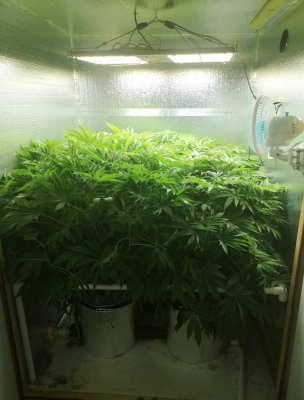
my average yields with no supplement, addictive, training techniques, special lights co2 on a simply drip water in promix or flood drain in nft and rockwool was between 1 lb to 1.25 lb per 4x4 area with a 600 hps .I actually did a bit better as we had them on movers and averages that with what would have been closer to 300watt average


 manicbotanix.com