
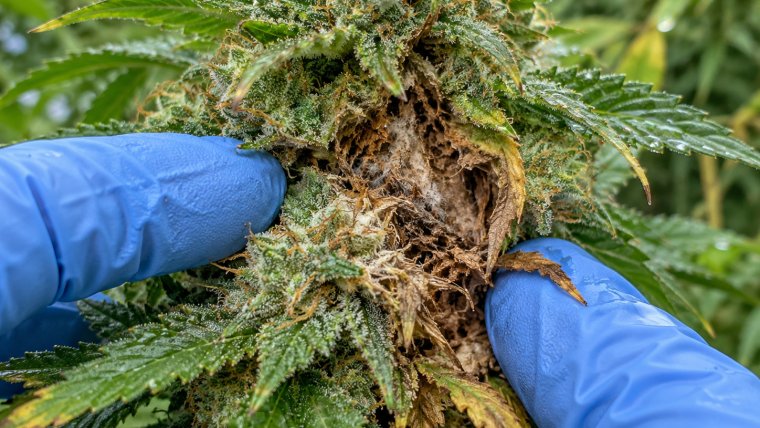
Most growers think bud rot starts when they see gray fuzz. By then it has usually been working inside the cola for days. It starts at the stem in the middle of a dense bud, where water sits longest, and the first sign from outside is often one sugar leaf gone dull or limp while everything around it looks healthy. Catch it then and you lose one bud. Miss it through a week of wet weather and you can lose the plant.
This guide covers bud rot on cannabis, indoor and outdoor: how to spot it early, what to do the day you find it, which buds you can keep, and how to prevent it next season. It draws on about 11,500 forum posts from members who have dealt with it since 2008.
Disclosure
THCFarmer has no partnership with any brand named in this guide and does not sell these products. They are named because members use them. This page does not link to any store.
01 · Quick answer How to stop bud rot spreading
- Put a bag over the rotted bud before you cut, so spores fall into the bag and not onto the plant.
- Cut 1 to 4 inches past any brown or gray tissue, because the rot runs along the stem before you can see it.
- Tug on the dull or dead leaves of every big cola on that plant and its neighbors. Leaves that slide out easily mean more rot.
- Fix the water problem the same day: room humidity under 50% in late flower, or cover outdoor plants and dry them off after rain.
- Chop early if new rot keeps appearing every few days.
02 · Guide What causes bud rot
Bud rot is gray mold, a fungus called Botrytis cinerea. Its spores are in outdoor air almost everywhere and ride indoors on clothes, fans and clones, so you cannot keep them out. You can only control the conditions it needs. Extension services at NC State and Utah State put the danger zone at 65 to 75°F with wet or humid conditions, and both say it gets in through damaged or dying tissue, not healthy flowers.
That explains where it shows up. A fat cola holds water at its core for hours after rain, dew or a humid night, and the dead sugar leaves tucked inside give the fungus a foothold. When members name a cause, the same ones come up again and again: rain and morning dew, high humidity, big dense colas, poor airflow and cold nights. Caterpillars are the other big one. They chew into buds and leave wet droppings behind, and rot follows. If you find rot early in flower, before the buds are fat, look for a caterpillar or a broken branch first.
Most bud rot threads on THCFarmer come from outdoor growers in wet autumns, but a tent that runs humid with the lights off can rot a cola just as fast.
03 · Early signs What bud rot looks like
The outside of the bud looks fine until late, so check the biggest colas first, every day from about week 5 of flower.
One limp or dull leaf
A single sugar leaf sticking out of a cola turns dull, droopy, yellow or brown while the rest of the bud looks normal. As one outdoor grower put it in How to recognize bud rot at earliest stages: "if you spot a single drooping or wilted leaf when all other leaves around it on the bud look normal, you found bud rot."
The tug test
Gently pull that leaf. A healthy leaf holds on. A leaf rooted in rot slides out with almost no resistance, often with a bit of brown bud attached. Dozens of members use this test, and one summed it up in A couple of my buds are turning brown: "give it a tug if it comes off in your hand easily you got the rot."
Brown or gray at the stem
Spread the bud open where the leaf came out. Rot shows as brown, tan or gray tissue around the stem, mushy when fresh and dusty once it dries.
Gray fuzz and dust
Later, gray fuzz covers the outside and a puff of gray dust comes off when you touch it. That dust is spores, so stop touching and get a bag.
The smell
Members describe a damp, musty smell when they open a rotting cola, different from the plant's normal smell.
For member photos at every stage, see Budrot tips and pictures to aid identification and Do you see bud rot or not?.
04 · Guide Bud rot vs mold, mildew and caterpillar damage
Bud rot is one kind of mold, but not every white, brown or gray spot is bud rot. Check this before you start cutting.
| What you see | Bud rot | Powdery mildew | Caterpillar damage | Normal ripening |
|---|---|---|---|---|
| Color | Brown or gray inside, gray fuzz later | White powder on top of leaves | Brown, dry patches | Orange or brown pistils |
| Where it starts | Inside dense colas, at the stem | Fan leaves, then buds | Where they chewed in | Pistils all over the bud |
| Feel | Mushy, then dusty | Wipes off with a finger | Dry and crumbly | Firm bud |
| Quick check | Leaf slides out on a tug | Wipe test | Black specks of droppings | Calyxes swell, nothing pulls out |
Powdery mildew sits on the surface and has its own fixes, covered in What is powdery mildew on cannabis?. Treat caterpillar damage as an early warning, because it often turns into rot. In the "buds turning brown" thread above, most members who looked closely found caterpillars, not mold.
05 · Guide How to prevent bud rot indoors
Indoors, bud rot is a humidity problem first. Utah State and NC State both advise keeping greenhouse humidity below 50%. Members who give a number mostly run late flower at 40 to 50% and treat 60% as the line not to cross. Aim lower than the room seems to need, because the air inside a dense cola is wetter than the air your hygrometer reads.
Watch lights-off humidity
When the lights go off, the room cools and humidity often jumps 10 to 20 points. That is when most indoor rot starts, so set the dehumidifier for the dark period.
Size the dehumidifier to the room
Plants put most of the water you give them back into the air. A 30 to 50 pint home dehumidifier, about $150 to $300, handles a tent or a small room. A room running several lights in flower usually needs 70 pints a day or more.
Move air through the canopy
A fan blowing over the tops does not dry the inside of a cola. Put oscillating fans below and between the plants too.
Thin the plant
Strip the lower third and the big fan leaves that shade the middle around week 3 of flower. Members who have lost colas also top their plants for several medium colas instead of one giant one. After their first rot, one grower in BUD ROT = WHOLE harvest trash? stopped growing big colas and started a regular pest and disease plan.
For humidity targets at every stage, see the temperature and humidity guide.
06 · Guide How to prevent bud rot outdoors
Outdoors you cannot control humidity, so the job is keeping buds from staying wet. Rain and dew are the cause members name most, and nearly half of the bud rot threads on THCFarmer start in September or October.
Cover before rain
Put clear plastic or a tarp over the plants on stakes or a frame, with the sides open so air still moves. A cover with no airflow traps damp air around the buds. Members compare setups in Do you protect your outdoor plants against rain?.
Dry the plants off
Shake the dew and rain off the colas every morning in late flower, and use an electric leaf blower after a storm. Gas blower exhaust can harm the plants. One Pennsylvania grower in Is bud rot ever salvageable? spent "an hour each morning shaking the dew out of those giant colas until mid-October" and lost only about a quarter pound.
Open the plant up
Tie the lower branches outward so air and sun reach the middle, as in How do I improve outdoor air exposure and reduce chances of mold?. Pull dead and yellow leaves out of the canopy, because dead tissue is where the fungus gets in.
Stop caterpillars before the buds close up
Spray BT (Bacillus thuringiensis, sold as Monterey B.t. or Bonide Thuricide, about $20 to $25 for a 16 oz concentrate) every 5 to 7 days while moths are active, and again after rain, because sunlight breaks it down within days. Spinosad (Captain Jack's Deadbug Brew, about $15 to $25 for 16 oz) is the stronger option. It is toxic to bees until it dries, so spray it at dusk. Check the label for the last spray before harvest, and see How to keep caterpillars off your cannabis plants.
Plan around the forecast
If the trichomes are mostly cloudy and a week of rain is coming, many members chop rather than gamble. See Rain less than a week til harvest and Rain is coming, how long to wait before harvest.
Choose plants for your climate
Members do not agree on which strains resist rot, but they agree that bud structure matters more than the label: dense, single-cola plants rot first, and airier, earlier-finishing plants rot less. If your autumns are wet, pick plants that finish before the rains start.
07 · Guide What to do when you find bud rot
Act the same day. In wet weather, rot can spread to the next bud within a few days.
Bag it first
Slide a plastic bag over the bud, cut below it and seal the bag. Turn off fans near that plant while you work, so you do not blow spores across the room.
Cut wide
Remove the bud plus 1 to 4 inches of healthy-looking stem and bud around it. Members who cut tight say it comes back, because the rot has already traveled inside the stem, and the 4-inch rule comes from Bud rot? Now what?. On a small bud, take the whole bud.
Wait until the plants are dry
NC State advises against removing infected parts while plants are wet, because spores spread more easily. Outdoors, work late morning after the dew is gone.
Check everything nearby
Tug-test every big cola on that plant and the plants around it, and look closely at the buds directly below the rot, since spores fall.
Clean up
Wash your hands and wipe scissors with 70% isopropyl alcohol before you touch a clean plant. Put the bagged buds in the trash, not the compost.
Chop early when it keeps coming back
If you find new rot every 2 or 3 days, or in several colas at once, and the weather is staying wet, harvest. If it is one spot on one cola, often from caterpillar damage, cut it out and let the plant finish. In Bud Rot is Killing Me!, a long-time outdoor grower says that cutting out only the rotted buds still saved 50 to 75% of some plants in bad seasons.
08 · Guide Sprays and other bud rot treatments
No spray kills rot that is already inside a bud. As a member put it in Information about preventing bud rot: "There's not really a treatment that kills bud rot." Sprays can only help protect healthy tissue before buds get dense, and spraying fat colas late in flower puts water where you least want it.
Hydrogen peroxide or alcohol on the cut
Many members dab or mist the cut area with drugstore 3% hydrogen peroxide (about $1 to $3 a bottle) or a 50/50 mix of 91% isopropyl alcohol and water. It may kill spores on the surface. It does not reach rot inside the next bud, and the evidence is members' experience, not trials.
Bacillus biofungicides
Serenade Garden (Bacillus subtilis QST 713, about $15 to $25 for a ready-to-use bottle) is labeled for gray mold on garden crops. It is a preventive for healthy tissue, sprayed in veg and early flower. Member reports are mixed: some credit it with keeping rot away, others found it worked on mildew but not on mold.
Potassium bicarbonate
GreenCure (about $15 to $20 for 8 oz) and MilStop (about $60 to $95 for 5 lb) are mainly powdery mildew products. Some growers use them as a general preventive before buds form.
Before using any product on cannabis, check that its label covers the use and that your state allows it. Most legal states publish a list of pesticides allowed on cannabis.
09 · Guide Can you salvage buds with bud rot?
You can save the rest of the plant. You cannot save the rotted bud.
What to keep
Buds from other branches and plants that pass the tug test, look clean when you open them and smell normal. Dry them apart from anything that was near the rot, and check them again before jarring.
What to throw away
Any bud with brown or gray tissue, fuzz or a musty smell, plus the buds that were touching it.
The gray area
Members are split on rot-adjacent material. Some turn it into hash, tincture or butter on the idea that heat or solvent kills the mold. Others refuse to use any of it.
Warning: moldy cannabis and your health
Heat and solvents kill mold, but they do not remove the toxins some molds leave behind. The World Health Organization notes that most mycotoxins are chemically stable and survive food processing. You cannot tell by looking which molds are in a rotted bud: researchers have found Penicillium and Aspergillus on cannabis buds, and both include toxin-producing species (Punja and others, 2019). A CDC-led study found cannabis users had higher odds of fungal infections. It showed a link, not proof of cause, and the infections were rare but serious for people with weakened immune systems. If you or the person you grow for is immunocompromised, has lung disease or is in cancer treatment, do not smoke, eat or extract anything from a plant with visible mold.
If you decide to process clean trim and buds from a rot-affected plant, read Salvaging moldy buds and making trichome butter with the warning above in mind.
10 · Guide Can bud rot spread after harvest?
Yes. Botrytis keeps growing on cut plants in a damp drying room, and NC State lists post-harvest losses as part of the disease. Members find it on the drying line every season, as in BUD ROT = WHOLE harvest trash?.
Open every big cola before you hang it, and break the biggest into smaller pieces so their cores can dry. Dry at 60 to 70°F and 55 to 60% humidity, as covered in How to dry and cure cannabis, and squeeze-check dense buds daily for the first 3 days. If you find rot while drying, bag it and pull the branches on either side. In the jar, fuzz or a musty smell means those buds go in the trash, and everything else from that harvest gets a closer look. For jar humidity, see signs it's time to stop burping your jars.
11 · Pitfalls Common bud rot mistakes
Running fans while cutting
Moving rotted buds in a strong airflow spreads spores to every plant downwind. Turn nearby fans off while you bag and cut, then back on.
Cutting too close
A cut right at the edge of the brown leaves rot inside the stem. Take 1 to 4 inches beyond what you can see.
Spraying fat colas in late flower
Water on dense buds in the last 3 to 4 weeks feeds rot and never reaches the rot already inside.
Composting rotted buds
Spores from a compost pile end up back in next year's garden. Bag the rot and put it in the trash.
12 · FAQ Bud rot FAQ
Not if you catch it early. Members routinely cut out one or two rotted colas and harvest the rest. New rot in new colas every few days is the signal to chop. From BUD ROT = WHOLE harvest trash?.
The rotted bud is not. Buds from the rest of the plant are, if they pass the tug test and look clean when opened. From Is bud rot ever salvageable?.
Most members say no for the bud the mold was in, because rot spreads further inside than it shows. Clean buds from other branches are fine. From Budrot tips and pictures.
It kills mold it touches on the surface, which is why members dab it on cut areas. It does not reach rot inside a bud, and soaking fat colas adds water. From Can hydrogen peroxide kill mould late in flower?.
Not always. Brown, dry patches early in flower are often caterpillar damage, and orange pistils late in flower are normal. Tug a leaf and open the bud: mushy brown tissue at the stem is rot. From A couple of my buds are turning brown.
Not sure if it is rot? Post in the Cannabis Infirmary with a photo of the cola opened at the stem, the week of flower, and your night-time humidity or recent weather.
Sources: about 11,500 posts in THCFarmer bud rot threads from 2008 on, with brand accounts excluded; THCFarmer's earlier guides "Budrot (Botrytis)" and "Botrytis or Gray Mold"; NC State Extension, Gray Mold of Industrial Hemp (2019, revised 2024); Utah State University Extension, Bud Rot (Botrytis spp.) hemp IPM note; Punja and others, Frontiers in Plant Science 10:1120 (2019); World Health Organization, Mycotoxins fact sheet (2023); Benedict, Thompson and Jackson, Emerging Infectious Diseases 26(6) (2020); product labels and US retail listings checked October 2026.
More Pests & disease control questions?
Bring your numbers, room size, and target yields to the forum so other growers can sanity-check the setup before you burn money on the wrong gear.

logic has been posting on THCFarmer since 2008 and now carries 547 learn guides for growers who want the real numbers, tradeoffs, and failure points before they spend time or money.