
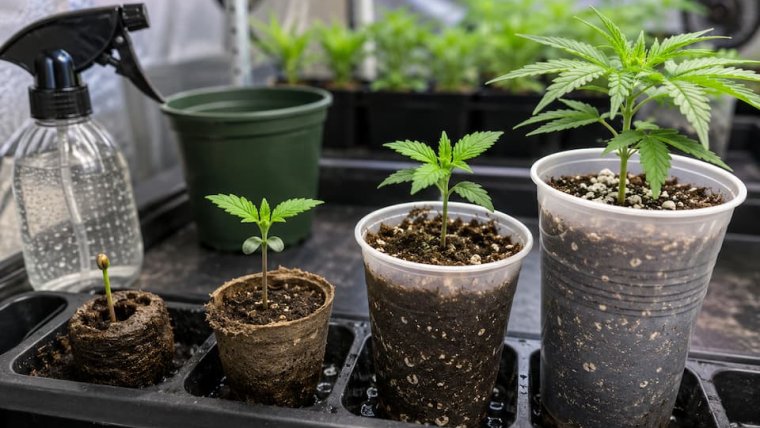
Seedlings make new growers nervous because everything is small, slow, and easy to overdo. A healthy cannabis seedling does not need a big feeding program in the first three weeks. It needs a lightly moist root zone, gentle light, warm air, enough humidity, and time to build roots before you push it like a veg plant.
Quick answer
For the first three weeks, keep seedlings warm, bright but not blasted, and watered in small amounts around the root zone instead of soaking the whole container every day. Most trouble comes from watering again before the medium has air, using soil that is too hot, feeding too early, placing lights too far away or too intense, or transplanting before the root ball can hold together.
This guide walks through cannabis seedlings day by day, a practical cannabis seedling watering schedule, how to start marijuana seeds without drowning them, what light and humidity should look like, and when to transplant seedlings from solo cups. Use the photo threads near the end to compare real seedlings by age, then start a thread if your plant does not match what you are seeing.
01 · Guide Seedling Timeline by Day and Week
Do not judge a seedling by one photo from one grow. Genetics, medium, temperature, light intensity, seed age, and how deeply the seed was planted can all change the pace. The goal is steady progress, not a perfect calendar.
| Age | What you should see | What to watch |
|---|---|---|
| Day 0-2 | Seed cracks, taproot appears, or planted seed is waiting below the surface | Do not dig it up unless the medium is clearly wrong or drying out completely |
| Day 2-5 | Seedling breaks the surface, cotyledons open, stem starts reaching for light | Stretching, helmet head, dry surface, or a wet cold container |
| Day 5-8 | First true leaves expand; second set may start | Do not feed hard; keep water close but not against the stem |
| Day 8-14 | More root growth, second and third nodes, stronger stem, faster daily change | Wet cups, weak light, early nutrient burn, or stalled new growth |
| Day 15-21 | Several nodes, broader leaves, stronger drinking, possible transplant window | Rootbound solo cups, overwatering in large pots, light stress, and transplant timing |
Day 0-2: starting the seed
If you are learning how to start marijuana seeds, keep it simple. Germinate in a damp paper towel, starter plug, rockwool cube, or directly in a mild seedling mix. The seed should be damp, warm, and dark, not floating in water for days. Once a taproot shows, plant it shallow, usually about 1/4 to 1/2 inch deep, with the root pointing down if you can handle it safely. Do not pack the medium tight. Roots need air as much as moisture.
Day 2-5: sprout and cotyledons
The first leaves are cotyledons. They are little built-in food stores, not the final leaf shape. At this point the seedling may look tiny above ground because a lot of the work is happening below ground. Keep the medium lightly moist near the seedling, keep the air warm, and avoid blasting it with a powerful LED just because the light is available.
Day 5-8: first true leaves
This is where new growers often start adding nutrients too early. If the seedling is in a mild soil or starter mix, it usually has enough to get moving. If it is in coco, rockwool, or an inert plug, it may need a very light seedling-strength feed, but still keep it mild. Burnt tips, dark curled leaves, and stalled growth after feeding are signs you pushed too soon.
Day 8-14: roots before leaves
The second week can feel slow. A seedling may spend several days building roots before the top growth takes off. A day-14 seedling should usually have healthy green color, a firmer stem, and more than one true leaf set, but size can vary. If it is stretching hard, move light closer or increase intensity carefully. If it is squat, curled, pale, or droopy, check watering and light before adding bottles.
Day 15-21: the handoff into early veg
A 3 week old cannabis seedling should be shifting toward early vegetative growth. It may have three to five nodes, a stronger stem, and a root system that drinks faster than it did in week one. This is when some seedlings are ready to leave a solo cup, while others need a few more days. The plant tells you by how quickly the cup dries, how sturdy the root ball is, and whether roots are reaching the drainage holes.
02 · Guide Watering Without Drowning Seedlings
There is no perfect cannabis seedling watering schedule that works for every grow. A seedling in a solo cup of airy seedling mix does not drink like an autoflower started in a five-gallon final pot. A seedling under warm light in fabric pots does not dry like one in a cold plastic cup. Use the schedule below as a starting point, then adjust by pot weight, medium, and plant response.
| Age | Typical watering approach | Main rule |
|---|---|---|
| Days 1-5 above soil | Mist or water a small ring near the seedling, often 10-30 ml at a time in small cups | Keep the starter zone lightly moist, not soaked |
| Days 5-10 | Widen the ring as roots move outward, often 30-80 ml in a solo cup when needed | Water only after the top lightens and the cup loses weight |
| Days 10-21 | Water a wider ring or partial cup volume, often 80-200 ml depending on container and medium | Let roots chase moisture and keep oxygen in the medium |
Those numbers are not a command. They are a reminder that seedlings drink small amounts at first. If the cup is still heavy, wait. If the top is bone dry and the seedling is falling over, water. If the surface looks dry but the cup still feels heavy, the core is probably wet.
Water near the roots, not on the stem
Early roots are close to the seedling but not only directly under the stem. Water in a small ring about an inch or two away from the stem, then widen the ring as the plant grows. This encourages roots to search outward. Constantly wetting the stem can invite damping-off problems in a cool, stagnant setup.
Small cup versus final pot
In a solo cup, watering is easier to learn because the cup dries quickly and tells you when roots are working. In a large final pot, especially with autos, do not soak the whole container to runoff every day just because that is how a mature plant is watered. Keep the seedling zone moist and let the larger pot stay breathable until roots expand.
Soil and living soil
Soil seedlings like moisture and air together. A mild starter mix is safer than hot amended soil for the first week or two. In living soil, avoid drying the whole pot to dust, but also avoid keeping a tiny seedling in a cold swamp. If the container is large, water a small ring and let biology and roots catch up.
Coco and inert media
Coco is not watered like soil once the root system is established, but tiny seedlings still need oxygen. Use a mild nutrient solution appropriate for coco, keep pH in the right range, and do not let salts build in a small cup. If the seedling is in a plug or small coco starter, the margin for drying out is smaller, so check more often.
Rockwool and plugs
Rockwool should be moist but not dripping. Shake off extra water after soaking and keep cubes warm. A cube that stays cold and saturated can stall a seedling fast. Once roots show, move it into the next medium before roots dry or circle too long.
If your seedling is overwatered
An overwatered cannabis seedling often droops while the medium is still wet. The leaves may look puffy, twisted, heavy, or slow. Growth stalls because roots are short on oxygen. The fix is usually not more nutrients. Stop watering until the container has a real dryback, add gentle airflow around the cup or pot, keep the room warm, and wait for new growth. Do not keep pulling the seedling up, flushing it, feeding it, and changing the light all in the same day.
Seedling already drooping in wet soil? Start a Cannabis Infirmary thread with photos, seedling age, container size, medium, how much you watered, light type, distance, temperature, and humidity. A wet seedling can recover, but helpers need the setup details before they can tell whether it is overwatering, hot soil, weak roots, or light stress.
03 · Guide Light, Humidity, and Transplant Timing
Seedlings need light, but they do not need to be punished by it. Weak light creates long stretchy stems. Excess light creates tacoing, pale tops, crispy edges, and stalled growth. The sweet spot is enough light to keep the seedling compact while it can still pray, breathe, and build roots.
Light schedule
A simple 18/6 schedule is a safe default for most seedlings. Some growers run 20/4 or 24 hours during the earliest stage, especially with autos, but 24/0 is not required for a healthy seedling. If you do run long hours, keep intensity gentle and watch the plant. A dark period is not wasted time; seedlings still respire and manage water balance.
Light intensity
If you have a PAR meter, start around 100-150 PPFD for fresh sprouts, 150-250 PPFD in week two, and roughly 200-300 PPFD by week three if the plant is responding well. Without a meter, use the plant. Stretching means it wants more light or a closer source. Tacoing, bleaching, leaf-edge crisping, or a seedling that refuses to grow can mean too much intensity, too much heat, or air that is too dry.
Light distance
Seedling distance depends on the fixture. A T5 or small fluorescent can be closer than a strong LED board or bar light. Many LEDs need to start high and dimmed, then move closer as the seedling strengthens. Do not copy one distance from another grow unless the light, dimmer setting, and environment are similar.
Temperature and humidity
Aim for warm, stable conditions. A good beginner range is about 72-78 F during lights on, with nights not dropping much below the high 60s. Relative humidity around 65-75% is useful in week one, 60-70% in week two, and 55-65% by week three. Gentle airflow matters, but do not point a fan hard at a tiny stem all day.
When to transplant seedlings from solo cups
Transplant when the seedling has enough roots to hold the medium together but before it is badly rootbound. Common signs are roots reaching drainage holes, the cup drying much faster than it used to, three to five healthy nodes, and a stem strong enough to handle the move. If the cup falls apart when you slide it out, it was probably too early. If roots are circling heavily and the plant dries every few hours, it waited too long.
How to transplant without a setback
Water lightly ahead of time so the root ball is cohesive, not muddy. Prepare the next pot first. Make the receiving hole, support the stem, tip the cup, and move the root ball without squeezing it apart. Bury a stretched stem slightly deeper if the medium and stem are healthy, then give gentle light for a day while the roots settle.
Common mistakes in the first three weeks
- Mistake: Feeding because the seedling looks small. Small is normal early. Feed only when the medium requires it or the plant is truly asking.
- Mistake: Watering every morning by habit. Seedlings do not care what day it is. They care whether roots have air and moisture.
- Mistake: Starting in hot soil. Strong compost, heavy amendments, or full-strength nutrient soil can burn seedlings before they have roots to handle it.
- Mistake: Chasing stretch with too much light at once. Increase intensity gradually and support the stem if needed.
- Mistake: Transplanting a loose cup. A weak root ball breaks apart easily and can stall the plant.
04 · Guide Best Seedling Threads to Compare Against
THCFarmer has years of seedling cases with photos, ages, mediums, lights, and grower feedback. Use these threads as comparison points, not as a single standard every plant must match.
Age-labeled seedling photo examples
- How do these 5 and 8 day seedlings look - useful for early photo comparison, wet-medium warnings, and "do not feed yet" advice.
- First indoor grow day 14 from seed - useful for day-14 comparison, stretch, watering rhythm, and light feedback.
- Is this normal for a seedling? 3 weeks old - useful for 3 week old cannabis seedling pictures and normal leaf development questions.
Watering, overwatering, and stalled seedlings
- Watering seedlings how much is too much, how much is too little? - useful for big-pot watering, organic soil, and frequency versus amount.
- First grow, possibly overwatered female 2 week old seedling - useful when a seedling is drooping, yellowing, or sitting in wet soil.
- Seedling wont grow. please help - useful for stalled seedling troubleshooting and the details helpers ask for.
Light and transplant timing
- Should i run my lights 24hrs for seedlings - useful for light schedule questions and seedling intensity discussions.
- When Should I Transplant?? - Solo Cups To Pots - useful for visual transplant timing and root-zone readiness.
- Seeds & Germination Learn category - useful for germination and early seedling background.
- Transplanting Learn category - useful for repotting and root-bound basics.
Help-post checklist
If you start a thread, include:
- Seedling age by day from sprout, not just from seed drop.
- Photos: whole seedling, close-up, cup or pot, medium surface, and light setup.
- Medium: soil, coco, living soil, rockwool, plug, peat mix, or hydro.
- Container size and whether it has drainage.
- Watering: how much, how often, pH if known, and whether the cup feels heavy.
- Light: fixture, wattage or dimmer setting, distance, and schedule.
- Environment: temperature, humidity, fan strength, and dome use.
- Nutrients or amendments already used, including "just a little" feed.
- What changed in the last three days.
05 · FAQ Cannabis Seedling Care
Water when the seedling zone is getting dry and the cup or pot has lost weight, not on a fixed calendar. Fresh sprouts may only need a small misting or 10-30 ml around the root zone. By weeks two and three, the amount increases as roots fill the container.
It usually droops while the medium is still wet. Leaves may look heavy, puffy, twisted, or stalled. The container often feels heavy for too long. Let it dry back, warm the root zone, add gentle airflow, and avoid feeding until new growth improves.
In mild soil, usually not much or not at all early on. In coco, rockwool, or inert media, seedlings may need very light feed sooner because the medium does not supply much nutrition. The safest rule is mild inputs, healthy roots, and no full-strength feeding.
Seedlings can survive under long light schedules, but 24/0 is not required. An 18/6 schedule is a safe beginner default. If you run 20/4 or 24/0, keep intensity gentle and watch for stress.
Transplant when roots hold the cup together, the plant has several healthy nodes, and the cup dries faster than it used to. Do not wait until the seedling is severely rootbound, but do not move it so early that the root ball falls apart.
A healthy week-three seedling usually has multiple true leaf sets, a stronger stem, and visible momentum toward veg. Some are bigger than others. Compare new growth, color, stem strength, and root-zone behavior instead of judging by size alone.
06 · Bottom Line Keep Seedlings Simple
The first three weeks are about roots, rhythm, and restraint. Keep the medium lightly moist, not soaked. Keep light strong enough to prevent stretch, not so strong that the plant stalls. Keep temperature and humidity friendly. Feed only as much as the medium and seedling actually need. Transplant when the root ball is ready, not because a calendar said so.
If your seedling is healthy, the best move is usually steady care. If it is drooping, yellowing, stretching badly, or stuck for several days, do not guess in silence. Start a seedling help thread with photos and the checklist above so experienced growers can compare your plant against real seedling cases and help you make the next move without stacking mistakes.
Need grower-specific help?
Seedling already drooping in wet soil? Start a Cannabis Infirmary thread with photos, seedling age, container size, medium, how much you watered, light type, distance, temperature, and humidity. A wet seedling can recover, but helpers need the setup details before they can tell whether it is overwatering, hot soil, weak roots, or light stress.

logic has been posting on THCFarmer since 2008 and now carries 558 learn guides for growers who want the real numbers, tradeoffs, and failure points before they spend time or money.