
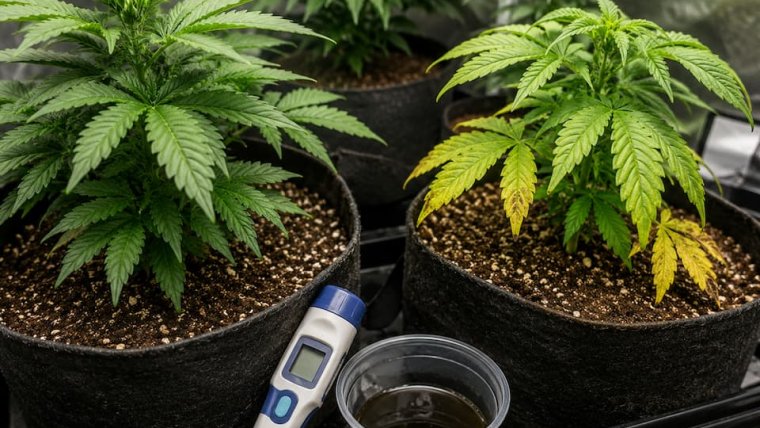
If your cannabis plant is yellowing, spotting, clawing, or stalling in soil, the answer is not always "add more nutrients." Soil problems usually start in the root zone: watering rhythm, pH, soil strength, amendment timing, salt buildup, container size, temperature, and whether the plant can actually take up what is already in the pot.
Quick answer
For most cannabis grown in soil, keep irrigation water and the active root zone around the mid-6 pH range, usually about 6.2-6.8 as a practical target. Before feeding harder, confirm your pH meter is calibrated, check whether the pot is too wet or too dry, and look at the newest growth. If pH is off, correct it gradually. If the soil mix is too hot, compacted, salty, or staying wet, more bottles can make the plant worse.
This guide is for soil growers trying to troubleshoot pH, soil mixes, nutrient brands, Happy Frog, Miracle-Gro, compost tea, and common product questions. Use it as a first-pass checklist, then compare the THCFarmer threads and Learn guides near the end when your case needs real grower examples.
01 · Guide Start with pH and Watering Before Adding More Nutrients
Nutrient troubleshooting starts with a boring question: can the roots use what is already there? A plant can look deficient even when the soil contains plenty of nutrition if the pH is out of range, the medium is saturated, roots are cold, salts have built up, or the soil was too strong for the plant stage.
Soil pH for cannabis
Soil cannabis usually behaves best when the root zone stays near the mid-6 range. A useful beginner target is about 6.3-6.8 going in, with 6.5 as a calm middle point. Living soil growers often avoid chasing exact runoff numbers because the soil biology, organic matter, and buffering capacity matter too. Bottle-fed soil growers need to watch pH more closely because repeated feedings and salt buildup can shift the root zone over time.
| What you are checking | Useful range or clue | What it tells you |
|---|---|---|
| Input pH | Usually about 6.3-6.8 for soil | Whether your water or feed is starting in a reasonable range |
| Slurry pH | Soil sample mixed with neutral water | A better look at the medium than one random runoff reading |
| Runoff pH | Use as a trend, not a panic button | May hint at salt buildup, channeling, or root-zone drift |
| Pot weight | Heavy for days or feather-light too fast | Whether roots are getting air and steady moisture |
| New growth | Healthy, pale, twisted, burnt, or stalled | Whether the correction is helping the active plant tissue |
Best soil pH tester for cannabis
The best soil pH tester is usually not a cheap two-prong probe shoved into a pot and trusted like lab equipment. Those probes can be useful as rough moisture or trend tools, but many growers get misled by them. A calibrated digital pH pen for liquids plus a proper soil slurry test is more useful for most home growers. If you want to test soil directly, use a real soil pH meter designed for the job, keep it clean, and confirm readings against another method before making a major correction.
Calibrate before you diagnose
A pH meter that has not been calibrated can create confident bad decisions. Keep 7.0 and 4.0 calibration solution on hand, store the probe correctly, and replace old solution when it gets contaminated. If the same water reads differently every time, stop troubleshooting the plant and troubleshoot the meter first.
How to do a simple soil slurry test
Take soil from the active root zone, not only dry crust from the top. Mix one part soil with about one to two parts distilled or neutral water in a clean cup. Stir it, let it sit 15-30 minutes, stir again, then measure the liquid. The exact method can vary, but the goal is the same: test the medium itself instead of guessing from one runoff number after water has found the easiest path through the pot.
Runoff cautions
Runoff can help, especially in bottle-fed soil, but it can also mislead you. If water channels down the side of a dry pot, runoff may not represent the root zone. If the first runoff is very concentrated, it may show salts that were sitting in pockets. If you chase every runoff reading with a flush, you can stress roots and wash out the soil's buffer. Use runoff as one clue beside slurry pH, plant symptoms, pot weight, and feed history.
Watering first, nutrients second
Overwatering in soil is usually not one big watering. It is watering again before the root zone has enough oxygen. A wet root zone can look like nitrogen deficiency, calcium deficiency, magnesium deficiency, droop, or general hunger because damaged roots cannot move nutrients well. Learn the pot weight. Water thoroughly when the plant is ready, then let the container dry back enough that air returns to the root zone.
When feeding more makes sense
Feeding more makes sense when the plant is actively growing, the pot is drying normally, pH is reasonable, roots are healthy, and symptoms match a real shortage. It does not make sense when the soil is wet, cold, sour-smelling, packed tight, recently transplanted, or already showing burnt tips and clawing. In soil, the safest correction is often smaller than the grower wants it to be.
Soil/nutrient help checklist
- Plant age and stage: seedling, veg, early flower, mid flower, late flower, clone, or transplant.
- Medium: bagged soil, living soil, peat mix, compost blend, amended soil, or outdoor ground.
- Brand or recipe: Happy Frog, Ocean Forest, Miracle-Gro, Pro-Mix, Roots, homemade mix, compost, or amendments.
- Container: size, drainage, fabric or plastic, recent transplant, and whether roots have filled the pot.
- Watering: how often, how much, runoff or no runoff, pot weight, and dryback time.
- pH: input pH, slurry pH if tested, runoff pH if used, meter type, and last calibration date.
- Nutrients: brand, strength, schedule, top dress, compost tea, cal-mag, microbes, and recent changes.
- Water source: tap, well, RO, rainwater, softened water, or filtered water.
- Symptoms: lower leaves, top growth, leaf tips, margins, spots, stems, roots, or whole plant.
- Environment: temperature, humidity, airflow, light type, light distance, and recent heat or cold.
- Photos: whole plant, damaged leaves, pot surface, container, and label or ingredient list from the soil bag.
Still stuck after the checklist? Ask a soil/nutrient question with your photos, medium, watering rhythm, pH readings, feed schedule, plant stage, and what changed in the last week. If you are using living soil, compost teas, dry amendments, or no-bottle organics, the Organic Soil forum is usually the better lane.
02 · Guide Fixing Soil pH Problems
The goal is not to force the pot to one perfect number overnight. The goal is to bring the root zone back into a range where the plant can take up nutrients without shocking it. Soil has buffering capacity. Organic matter, lime, peat, compost, minerals, and water chemistry all push back against sudden changes.
Signs pH may be involved
pH trouble often looks like multiple deficiencies at once. You may see yellowing, rusty spots, interveinal chlorosis, purple stems, weak new growth, burnt-looking margins, or a plant that refuses to respond to normal feeding. The clue is the pattern: nutrients are present, but uptake is inconsistent. If you have been feeding correctly and the plant still looks hungry, pH belongs near the top of the suspect list.
How to lower soil pH
First, confirm the problem with a reliable test. If your soil is only slightly high, start by adjusting future irrigation or feed water into the proper range. Do not dump strong acid into the pot. For longer-term soil correction, growers may use sulfur, acidic organic matter, peat-based mixes, or pH-adjusted water, but these work on different timelines. Elemental sulfur is not an instant rescue. It depends on soil biology and time. For a plant in trouble right now, gradual water/feed pH correction is usually the safer first step.
Fast high-pH correction workflow
- Calibrate the pH pen.
- Check input water and feed solution.
- Run a slurry test from the root zone.
- If the slurry is high, water or feed in the low-to-mid 6 range for soil.
- Avoid stacking pH down, extra nutrients, cal-mag, microbes, and flushes all on the same day.
- Watch new growth for three to seven days.
How to raise soil pH
Low soil pH can make some nutrients too available and others harder to use. It can also happen in peat-heavy mixes, heavily fertilized soil, or containers where salts have built up. In new soil mixes, dolomite lime or garden lime is commonly used as a buffer, but it should be mixed and given time. In a live plant container, be careful. A mild top dress of lime may help over time, but it is not a magic overnight fix. If the plant is crashing and the medium is clearly wrong, transplanting into a better-balanced soil may be safer than trying to chemically force a bad mix back into shape.
When to flush soil
Flush when there is a reason: a severe overfeed, obvious salt buildup, wrong product used, very hot bottled feed in a small pot, or runoff/plant evidence that lines up with toxicity. Do not flush every yellow leaf. Flushing a wet or weak root zone can make oxygen stress worse. If you flush, use correctly pH-adjusted water, let the pot drain well, and do not immediately hammer the plant with full-strength feed afterward.
When to transplant instead
Transplanting can solve problems that pH adjustment cannot. If the soil is too hot for a seedling, compacted, waterlogged, sour, full of slow-release fertilizer, or physically wrong for cannabis roots, a careful transplant may be the cleanest fix. This is especially true when a young plant is in a product that keeps feeding whether the plant wants it or not.
Do not chase old leaf damage
Damaged leaves rarely turn perfect again. Judge the correction by new growth, root-zone behavior, and whether the problem stops spreading. If you correct pH today, the plant may need several days to show cleaner growth. Pulling every damaged leaf immediately can remove useful evidence and stress the plant further.
Common pH mistakes
Mistake: Trusting one cheap probe reading
One reading from an uncalibrated tool is not enough reason to flush, transplant, or acidify a pot. Confirm with calibration, a slurry test, and plant symptoms.
Mistake: Adjusting pH too hard
Soil does not need violent swings. If you push the root zone from one extreme to another, the plant may look worse even if your number looks prettier.
Mistake: Confusing runoff with the whole pot
Runoff can move through channels and salt pockets. Use it as a clue, not the entire diagnosis.
Mistake: Adding nutrients to fix lockout
If pH or roots are blocking uptake, more fertilizer may raise salt levels without feeding the plant.
Mistake: Forgetting water source
Hard tap water, softened water, high alkalinity, RO water with no buffer, and well water can all change the pH story. Post your water source when asking for help.
03 · Guide Soil Mixes and Brand Choices
The best cannabis soil mix is not always the richest mix. Cannabis roots need structure, drainage, air, moderate nutrition, and a pH buffer. A good soil holds moisture without staying soggy, feeds the plant without burning it, and lets the grower match amendments to the plant stage.
Simple cannabis soil mix basics
A beginner-friendly soil usually has three jobs: base, aeration, and nutrition. The base might be peat, coco, compost, or a bagged potting mix. Aeration can come from perlite, pumice, rice hulls, or similar material. Nutrition can come from compost, worm castings, dry amendments, mineral amendments, or bottled nutrients. If a mix has no aeration, it can stay wet too long. If it has too much nutrition, seedlings burn. If it has too little buffer, pH swings become more likely.
| Soil component | What it does | Beginner caution |
|---|---|---|
| Peat or potting base | Holds water and gives roots a physical medium | Can trend acidic without lime or buffering |
| Compost or worm castings | Adds biology and slow nutrition | Too much can make a dense, wet mix |
| Perlite, pumice, rice hulls | Adds air and drainage | Too little aeration is a common soil mistake |
| Dry amendments | Feeds over time | Needs timing; top dress before the plant is starving |
| Lime or mineral buffer | Helps stabilize pH | Works over time, not as instant emergency medicine |
Happy Frog soil cannabis questions
FoxFarm Happy Frog is a common bagged soil for cannabis because it is widely available and generally milder than some hotter mixes. Many growers use it successfully, especially for veg and transplants, but it is not automatic perfection. Seedlings can still struggle if the container stays wet, the batch is strong, the plant is fed too soon, or the grower assumes the soil has everything forever. If you use Happy Frog, watch how long the initial charge lasts, then feed or top dress gradually instead of waiting until the plant is starving.
Fox Farm Ocean Forest and hotter soils
Ocean Forest and similar richer soils can be useful, but they can be too hot for small seedlings or sensitive plants. Some growers layer milder soil near the seedling and richer soil below, or start in a light mix and transplant later. If tips burn early, leaves darken and claw, or seedlings stall in a rich bagged soil, do not assume the plant needs more food. It may need time, better watering, or a milder root zone.
Miracle-Gro for cannabis
Miracle-Gro questions usually mix several different products together: potting soil, moisture-control mixes, slow-release fertilizers, tomato food, and general plant food. The big concern for cannabis is control. Many Miracle-Gro soils and fertilizers are designed for general gardening, not for a cannabis grower trying to control stage-specific nutrition, dryback, and final flower quality. Slow-release fertilizer can keep feeding when you are trying to back off, and moisture-control soil can stay wet longer than cannabis roots like in containers.
Can cannabis survive in Miracle-Gro? Sometimes, yes. Is it the easiest path for a new grower who wants control? Usually no. If you already planted in it, do not panic. Watch the plant, avoid adding extra nutrients until you know what the soil is doing, and consider transplanting into a cannabis-friendlier mix if seedlings burn, stay wet, or show toxicity.
Compost tea recipe cannabis basics
Compost tea is a tool, not a cure-all. Organic growers use teas to support soil biology, apply soluble organic inputs, or water in amendments. A simple aerated compost tea often starts with quality compost or worm castings, clean water, aeration, and sometimes a small food source like unsulfured molasses. Keep equipment clean, avoid brewing in extreme heat, and use fresh tea rather than letting it sit until it smells bad. A compost tea that smells rotten is not a premium biological product.
When compost tea helps
Compost tea makes the most sense in a living soil or organic program where the rest of the system supports biology: good compost, aeration, mulch, proper moisture, and reasonable pH. It makes less sense as an emergency fix for a plant locked out by bad pH, drowning roots, or a toxic soil mix. If the root zone is already wet, adding more liquid because "tea is natural" can still overwater the plant.
Bottle nutrients in soil
Bottled nutrients can work well in soil, but use the schedule as a starting point, not a command. Start lighter than the label when the plant is young or the soil already contains food. Watch leaf tips, color, runoff trends if you use them, and how fast the plant drinks. If a soil plant is dark green, clawing, and burnt at the tips, more nitrogen is not the move.
Dry amendments and top dressing
Dry amendments need timing. They are not instantly available like a bottle feed. Top dress before the plant is completely starving, water it in, and give biology time to work. If you wait until the plant is pale and crashing, you may need a short-term bridge while the top dress breaks down, but keep it moderate.
Cal-mag in soil
Cal-mag can help in the right situation, especially with RO water, LED intensity, or mixes that lack calcium or magnesium. It can also become the bottle growers add to every problem. Before adding cal-mag, ask whether pH is in range, whether the water already has calcium and magnesium, whether the plant is transpiring properly, and whether the symptom is actually calcium or magnesium related.
04 · Guide Best Forum Threads and Guides
The strength of THCFarmer is that soil advice does not have to live as a generic chart. You can read the clean Learn guide, then compare real grower threads where people show the product, the plant, the mistake, and the fix.
Learn guides to read first
- The Essential Guide to Testing Soil pH for Cannabis Cultivation - use this as the core pH testing background.
- Soil & Soilless Learn category - browse soil, media, and root-zone articles.
- Fertilizers & Nutrients Learn category - browse nutrient, amendment, and feeding articles.
pH testing and adjustment threads
- Can anyone help me find a good soil pH meter? - useful for current soil pH tester discussion and real product-selection concerns.
- Soil PH meter recommendations anyone? - useful as an older comparison point for pH meter recommendations.
- Best practice to lower soil pH? - useful for lowering pH without overcorrecting.
- Soil pH too low! Help! - useful when the problem is low pH rather than high pH.
Soil mix and brand threads
- Your favourite simple soil recipe? - useful for practical cannabis soil mix ideas and grower-tested recipes.
- Things to be aware of with Happy Frog Soil - useful for Happy Frog soil cannabis questions and beginner expectations.
- Fox Farm vs Pro-Mix vs Roots Organic - useful when choosing a bagged soil or soilless base.
- Miracle-Gro potting soil, can I use it? - useful for beginner Miracle-Gro soil questions.
- Miracle-Gro as a fertilizer - useful for separating Miracle-Gro fertilizer experience from potting-soil questions.
Compost tea and organic feeding threads
- Tea Recipe - a long-running Nutrients and Fertilizers discussion with many compost tea and feeding ideas.
- Favorite Tea Recipes For Veg And Bloom - useful for comparing veg and bloom tea recipes.
- How to Make the Best Compost Tea - useful for a simple compost tea recipe cannabis starting point.
- Compost tea pH adjustment options - useful when compost tea and pH collide.
Forum sections to use
- Organic Soil - best for living soil, compost, dry amendments, no-till, soil recipes, top dressing, and teas.
- Nutrients and Fertilizers - best for bottled nutrients, feeding schedules, fertilizer products, deficiencies, additives, and nutrient troubleshooting.
- Cannabis Infirmary - best when the plant is actively sick and you need diagnosis from photos.
05 · FAQ Soil pH and Nutrient Troubleshooting
A practical target for soil-grown cannabis is usually around 6.2-6.8, with about 6.5 as a steady middle point. Do not chase tiny swings. Focus on calibrated readings, healthy dryback, and clean new growth.
For most home growers, a calibrated digital pH pen for water/feed plus a soil slurry test is more useful than a cheap two-prong probe. If you buy a direct soil pH meter, choose one designed for soil, keep it clean, and confirm suspicious readings before making big changes.
Confirm the soil is actually high, then correct gradually. Start by adjusting future water or feed into the proper soil range. Avoid dumping strong acid into the pot. Longer-term amendments like sulfur take time and depend on soil biology.
Flush only when the evidence supports it, such as severe salt buildup, a bad feed mistake, or toxicity. If the pot is already wet or roots are weak, flushing can make oxygen stress worse. Often, gradual pH-corrected watering is safer.
Happy Frog can work well for cannabis, especially as a milder bagged soil, but it still needs proper watering, drainage, and timing. Do not feed too early just because the plant is in a common cannabis-friendly soil.
Some growers make it work, but Miracle-Gro products often reduce control because some mixes hold extra moisture or include slow-release fertilizer. For beginners, a cannabis-friendly soil or a plain base with controlled amendments is usually easier to manage.
Compost tea can support an organic soil system, but it does not fix every deficiency. If pH is out, roots are drowning, or the soil mix is toxic, tea may add more water without solving the real problem.
Not automatically. Spots can involve calcium or magnesium, but they can also come from pH lockout, overwatering, salt buildup, pests, leaf damage, or light stress. Check pH, water source, root health, and symptom location before adding another bottle.
06 · Bottom Line Fix the Root Zone, Not Just the Leaf
Soil pH and nutrient problems are easiest to fix when you slow down. Test with a calibrated meter. Use a slurry test when the pot itself is suspect. Learn the container's wet and dry weight. Know what is in your soil mix before adding more fertilizer. Treat Happy Frog, Miracle-Gro, compost tea, cal-mag, and bottled nutrients as tools with tradeoffs, not magic answers.
If the plant is still getting worse after the checklist, bring the evidence to THCFarmer. Post the medium, water source, pH numbers, feeding history, plant stage, photos, and what changed recently. Soil growers can usually help fast when they can see the root-zone story instead of guessing from one damaged leaf.
Ask a soil/nutrient question or compare your setup in Organic Soil with your pH readings, soil brand or recipe, watering rhythm, nutrients, photos, and recent changes.
More Soil & Soilless questions?
Ask a soil/nutrient question or compare your setup in Organic Soil with your pH readings, soil brand or recipe, watering rhythm, nutrients, photos, and recent changes.

logic has been posting on THCFarmer since 2008 and now carries 558 learn guides for growers who want the real numbers, tradeoffs, and failure points before they spend time or money.