Inside the Trichome
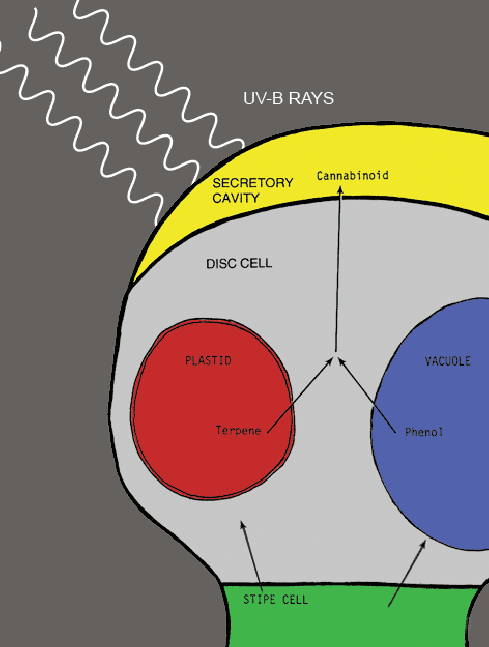
THC and other cannabinoids are produced in only one place on the cannabis plant: inside the heads of the trichomes. How it happens: Organelles produced by the plant called Vacuoles – which contain phenols, a chemical compound similar to alcohol [pictured below in
blue], and another type of organelle called plastids – containing hydrocarbons called terpenes [
red], make their way up the trichome stalk [
green] and combine inside the secretory cavity into a fibrous mat [
yellow]. This concentrated mat is hit by UV-B light waves, causing the creation of cannabinoids. Since all of the psychoactive ingredients are produced inside the trichome, these tiny resin hairs have long been sought after by hash and oil makers and can be separated from the plant and harvested in a variety of ways.
______
Cannabinoids
Cannabinoids are a class of chemical compounds which include the phytocannabinoids (oxygen-containing C21 aromatic hydrocarbon compounds found in the cannabis plant), and chemical compounds which mimic the actions of phytocannabinoids or have a similar structure (e.g. endocannabinoids, found in the nervous and immune systems of animals and that activate cannabinoid receptors). The most notable of the cannabinoids is ∆9-tetrahydrocannabinol (THC)—the primary psychoactive compound of cannabis.
Synthetic cannabinoids encompass a variety of distinct chemical classes: the classical cannabinoids structurally related to THC, the nonclassical cannabinoids including the aminoalkylindoles, 1,5-diarylpyrazoles, quinolines and arylsulphonamides, as well as eicosanoids related to the endocannabinoids
Phytocannabinoids
Phytocannabinoids, also called natural cannabinoids, herbal cannabinoids, and classical cannabinoids, are only known to occur naturally in significant quantity in the cannabis plant, and are concentrated in a viscous resin that is produced in glandular structures known as trichomes. In addition to cannabinoids, the resin is rich in terpenes, which are largely responsible for the odour of the cannabis plant.
Phytocannabinoids are nearly insoluble in water but are soluble in lipids, alcohols, and other non-polar organic solvents. However, as phenols, they form more water-soluble phenolate salts under strongly alkaline conditions.
All-natural cannabinoids are derived from their respective 2-carboxylic acids (2-COOH) by decarboxylation (catalyzed by heat, light, or alkaline conditions).
Types
At least 85 cannabinoids have been isolated from the cannabis plant. All classes derive from cannabigerol-type compounds and differ mainly in the way this precursor is cyclized.
Tetrahydrocannabinol (THC), cannabidiol (CBD) and cannabinol (CBN) are the most prevalent natural cannabinoids and have received the most study. Other common cannabinoids are listed below:
(CBG) Cannabigerol
(CBC) Cannabichromene
(CBL) Cannabicyclol
(CBV) Cannabivarin
(THCV) Tetrahydrocannabivarin
(CBDV) Cannabidivarin
(CBCV) Cannabichromevarin
(CBGV) Cannabigerovarin
(CBGM) Cannabigerol Monoethyl Ether
Tetrahydrocannabinol (THC) is the primary psychoactive component of the plant. THC has approximately equal affinity for the CB1 and CB2 receptors.
Delta-9-Tetrahydrocannabinol (Δ9-THC, THC) and delta-8-tetrahydrocannabinol (Δ8-THC), mimic the action of anandamide, a neurotransmitter produced naturally in the body. The THCs produce the high associated with cannabis by binding to the CB1 cannabinoid receptors in the brain.
Cannabidiol (CBD) is not particularly psychoactive in and of itself, and was thought not to affect the psychoactivity of THC. However, recent evidence shows that smokers of cannabis with a higher CBD/THC ratio were less likely to experience schizophrenia-like symptoms. This is supported by psychological tests, in which participants experience less intense psychotic-like effects when intravenous THC was co-administered with CBD (as measured with a PANSS test). Cannabidiol has no affinity for CB1 and CB2 receptors but acts as an indirect antagonist of cannabinoid agonists. Recently it was found to be an antagonist at the putative new cannabinoid receptor, GPR55, a GPCR expressed in the caudate nucleus and putamen. Cannabidiol has also been shown to act as a 5-HT1A receptor agonist, an action which is involved in its antidepressant, anxiolytic, and neuroprotective effects.
It appears to relieve convulsion, inflammation, anxiety, and nausea. CBD has a greater affinity for the CB2 receptor than for the CB1 receptor
CBD shares a precursor with THC and is the main cannabinoid in low-THC Cannabis strains.
Cannabinol (CBN) is the primary product of THC degradation, and there is usually little of it in a fresh plant. CBN content increases as THC degrades in storage, and with exposure to light and air.
Cannabigerol (CBG) is non-psychotomimetic but still affects the overall effects of Cannabis. It acts as an α2-adrenergic receptor agonist, 5-HT1A receptor antagonist, and CB1 receptor antagonist. It also binds to the CB2 receptor.
Tetrahydrocannabivarin (THCV) is prevalent in certain South African and Southeast Asian strains of Cannabis. It is an antagonist of THC at CB1 receptors and attenuates the psychoactive effects of THC.
Cannabichromene (CBC) is non-psychoactive and does not affect the psychoactivity of THC.
Plant profile
Cannabis plants can exhibit wide variation in the quantity and type of cannabinoids they produce. The mixture of cannabinoids produced by a plant is known as the plant's cannabinoid profile. Selective breeding has been used to control the genetics of plants and modify the cannabinoid profile. For example, strains that are used as fiber (commonly called hemp) are bred such that they are low in psychoactive chemicals like THC. Strains used in medicine are often bred for high CBD content, and strains used for recreational purposes are usually bred for high THC content or for a specific chemical balance.
Quantitative analysis of a plant's cannabinoid profile is usually determined by gas chromatography (GC), or more reliably by gas chromatography combined with mass spectrometry (GC/MS). Liquid chromatography (LC) techniques are also possible, although these are often only semi-quantitative or qualitative. There have been systematic attempts to monitor the cannabinoid profile of cannabis over time, but their accuracy is impeded by the illegal status of the plant in many countries.
Plant synthesis
Cannabinoid production starts when an enzyme causes geranyl pyrophosphate and olivetolic acid to combine and form CBG. Next, CBG is independently converted to either CBD or CBC by two separate synthase enzymes. CBD is then enzymatically cyclized to THC. For the propyl homologues (THCV, CBDV and CBNV), there is a similar pathway that is based on CBGV.
History
Cannabinoids were first discovered in the 1940s, when CBD and CBN were identified. The structure of THC was first determined in 1964.
Due to molecular similarity and ease of synthetic conversion, CBD was originally believed to be a natural precursor to THC. However, it is now known that CBD and THC are produced independently in the cannabis plant.