Log In Register

If you have chemistry questions....

  • Thread starter Thread starter squiggly
  • Start date Start date
  • Tagged users Tagged users None

If you have chemistry questions....

squiggly 463 Replies 202,694 Views
Page 8 of 24 · Replies 141–160 of 464
i think i might be overthinking all of this with regards to N and Ca in CalciNit...could it be that the 15.5 % on the label refers to how much nitrate is going to be available in regards to the whole solution (taking into consideration the big molecule)? and im getting confused because the P-K ratios on bags are for P2O5 and K2O, and we convert those because the plant just eats the P and K out of there? where as it eats the whole NO3?

i hope that isn't too confusing...and i really appreciate you coming in here during finals week..i know what the stresses of a science education can be like (bs physics)...

I was thinking something similar--that perhaps they've provided you with what's going to be there to help the layman ignore all of this mathiness.

What does your ppm meter tell you?

Strictly speaking--calcium nitrate is Ca(NO3)2.

What's you've pasted there must be specified for someone to know the difference (i.e. the double salt of calcium nitrate and ammonium nitrate). It may be that this formula is the "accepted" formula for "calcium nitrate" when it comes to fertilizer--but as you'll recall, I work with organic soil and have no need for such rules of thumb :)

To get the number you're looking for (if you're sure that is your chemical formula--again ask the supplier) just go through and add up the mass numbers of all the atoms, it's not that difficult--it's just tedious, welcome to my world.
 
I see your Q got skipped.

CaCl2 and Calcinit can be mixed together, they often are in Cal/Mag products (MagiCal for example) but neither of them can be mixed with MgSO4, the Ca and S will react and precipitate out of solution.

The MKP can be added to the Jacks Pro hydro directly, its the most abundant salt in Jacks Pro already, the MOST has such a high amount of S in it that id be cautious of mixing it in a concentrated amount with anything really besides the MgSO4, but see if squiggly has anything to add.

So I guess you could do:

Part A:
Jacks Pro Hydro
MKP

Part B:
CalciNit
CaCl2

Part C:
MgSO4
MOST

MOST is really unnecessary if you already have the Jacks Pro Hydro, although the micronutrient package in Jacks could use more Zn IMO, so buying a little Zinc sulfate or Zinc EDTA makes more sense if you want to use the Jacks. The CaCl2 is also very unnecessary, blooming cannabis loves lots of NO3, despite the popular belief that it doesn't. N demands will always be more than Ca demands. If the plant will ever want the Ca, it will want the NO3 that comes with it in CalciNit. Also Ca accumulates both in soil and hydroponic solutions more than any other nutrient, and too much Ca can really delay maturation (another very little known fact) so application rates for Ca should decrease over time.

P.S. You really don't want to be ADDING any chloride to your mix, unless you're using RO water and reagent grade salts i can almost guarantee your plant is already getting way more chloride than it wants without adding any. The only reason i can see to expose your plant to the additional chloride is if you want to use the CaCl2 as a foliar spray, since CaCl2 has the lowest point of dilequescence out of all Ca salts (at ~32% RH), giving it the greatest efficacy of all Ca salts when it comes to foliar applications. It also has some fungicidal effects.


I forgot to ask about the K2s04 0-0-50, I'd assume I can add that with the Mgso4 due to the sulfur?

Thanks again, I really appreciate the help, Im trying to studdy up on the mixing so I can eventually do it myself.
 
I'd prefer to keep EDTA out if it were me, just as an aside.

EDTA is really great at abstracting metal ions--probably wouldn't have a significant effect with how many of them are floating around, but it's just more fuel to the fire in my opinion.
 
you smart guys make my head hurt. You guys are way over my pay grade
 
What equipment would a chemist use to make the purist Rick Simpson's Oil with ISO?

Rick Simpson's Oil and pure aren't the same thing.

To make an oil similar to simpson's--we'd use what's known as a soxhlet extractor.

To make a pure oil, we'd either do the same thing and then purify the crude extract, we'd use some form of supercritical CO2 extraction, or we'd do a cold extraction similar to the thermos method (if we wanted to skip the purification step and weren't after a single compound).
 
Thanks Squiggly! appreciate you giving me some advice even with our differences. Going to make my first batch of RSO and was thinking there has to be a better way than using a rice cooker lol. idk got about 10 zips put aside for some trial and error. Going with 99.5% ISO.
 
Thanks Squiggly! appreciate you giving me some advice even with our differences. Going to make my first batch of RSO and was thinking there has to be a better way than using a rice cooker lol. idk got about 10 zips put aside for some trial and error. Going with 99.5% ISO.

I do this shit not onlyfor the love of the plant, its economy, and for science--but also for the people who stand with me in that love--regardless of differences.

Do we disagree politically? Yes.

However, I can't remember you ever treating me with anything but the respect I've offered to you (which admittedly hasn't always been the utmost level for EITHER of us--but it's certainly been more than none, which is how much was exchanged between myself and the various people I've ignored thus far).

It should be noted that I literally undertook every possible angle of olive-branch reaching that I could with those people before being essentially forced to ignore them. I'm not a guy who shies from disagreement and conflict, I embrace it--I see you as a kindred spirit in that sense and would love nothing more than to help you out and build bridges rather than burn them.

I do this because I feel you'd do the same, essentially. I can't think of anyone who isn't "deserving" to know any scientific information they'd like to know. Until I die it's my goal to never avoid an opportunity to share the knowledge I've gained--else what the fuck have all these sleepless nights been for?

It comes down to what type of a man you want to be. I think both of us here want to be good men, and that settles that--so far as I'm concerned.
 
When I pour some tap water and watch its pH, over time it becomes more alkaline. Is it due to gasses evaporating or dissolving to or from the nearby air? This happens even after using a carbon filter to remove chlorine.
Outgassing of CO2. CO2 makes the water column acid, O2 drives it up to basic again. Then there's the issue of the alkalinity of the water supply in the first place.

CO2 is used in aquaria, in planted tanks for the plants and to help keep the water acidic. It is also a problem for folks who keep miniature reefs in areas where winters are cold. The home heating system increases CO2 levels sufficiently to cause acidification of the marine water column, and this kills corals.
 
Outgassing of CO2. CO2 makes the water column acid, O2 drives it up to basic again. Then there's the issue of the alkalinity of the water supply in the first place.

CO2 is used in aquaria, in planted tanks for the plants and to help keep the water acidic. It is also a problem for folks who keep miniature reefs in areas where winters are cold. The home heating system increases CO2 levels sufficiently to cause acidification of the marine water column, and this kills corals.

I was operating under the assumption that this was common knowledge. You definitely need to adjust your pH AFTER you have allowed CO2 levels to equilibrate with the res for awhile. Many people actually keep their res out of the room for this exact reason.

Once you get the total amount of CO2 dissolved that's going in (which will be in there as dissociated carbonic acid to some degree--which is causing the acidity)--you need to readjust your pH.

A little trick which could be useful--you can actually add a bit of baking soda (or probably better a more suitable bicarbonate salt) to bring your pH back up, and this will create a buffer in your system.

Interestingly enough, your blood uses exactly this buffer system (as well as a few others), and it is extremely well balanced. Once the buffer has been formed, it will resist pH change in one direction or the other--you can adjust your pH accordingly and (supposing you do not deplete the buffer) it should keep it's value until plant activity drives it in one direction or the other.

If you want to predict exactly how much CO2 is going to dissolve into your res, you can use a value known as Henry's Constant to evaluate this. This should allow you to predict what level ppms should drop to in a sealed room when equilibrium is reached. The equation is not particularly difficult, if anyone has trouble with it let me know and I'll help out.
 
Squiggly,
How come no one will hire this stoner lab technician ? LOL
Appreciate your work on here :)
 
Squiggly,
How come no one will hire this stoner lab technician ? LOL
Appreciate your work on here :)

Because bachelors level dudes end up washing the dishes anymore these days. Slim pickins.

Also might need to pass a drug test.
 
Because bachelors level dudes end up washing the dishes anymore these days. Slim pickins.

Also might need to pass a drug test.
How random is the ua cuz yould cross that bridge when you get there no?
 
Hey squiggly I was wondering if u could help me with a precipitation problem.

I mix my nutes and then 2 days later it looks like my root excel is precipitating out. Here's what I do:

Mix base nutes, silica 1st, than Epsom salt, that CNS17 (that's the base) this keeps the res clear no dyes at all
Then I add a little pH down to get the pH in the 5.8-6 range.
Then I add fulvic acid and root excel.
And adjust my pH to what I want at the end between 5.8-6

While I do this my Venturi is on the whole time and everything is mixed in so there is no sediment at the bottom. Everything is fine for a couple days but by day 3 the water goes from slightly brown to clear and what looks like brown sediment start to appear on the sides and sticks to the res, some is also floating. I'm guessing that root excel is precipitating out because the res goes from brown to clear water with brown floating shit in it.

I was wondering if you have any idea how I could fix this. Also the Venturi is on 24/7 and the res stays between a pH of 5.8-6.0. I'm going to call the manufacturer and see if they have any idea but I'm not going to hold my breath with them.

Thanks for all your info here it's always fun reading ur posts, even the ones I have to read twice
 
I love this thread. It makes my head spin. Thanks Squiggly... you do an awesome job. Big up to chitown, too. :)

Will you please explain the use of acids to isomerize bho? What exactly is happening? Also, is this process practical for the average joe, provided he has the proper safety equipment and instruction beforehand?
 
I love this thread. It makes my head spin. Thanks Squiggly... you do an awesome job. Big up to chitown, too. :)

Will you please explain the use of acids to isomerize bho? What exactly is happening? Also, is this process practical for the average joe, provided he has the proper safety equipment and instruction beforehand?

Yes I can explain this, and I have a day off--so here it comes, gimme a bit here to get the images together I'll need, and yes you can do it but to my mind its very inefficient and unpredictable.

I'd like to see the THC isolated from an extract and then do this process--not have it done on a "chemical soup" crude extract (although reports are from folks like graywolf that results are favorable--I'd want to see the chemical analysis first--NMR, IR, Mass Spec, etc). But yes, you can do this.
 
Will you please explain the use of acids to isomerize bho?


fig2.gif


The previous image depicts on the ring structure of the various THC isomers (typically the ring is shown on the leftmost handed side of the molecule if you look it up). You can identify it by finding the single methyl group (CH3) bonded to a ring. That's the one we're changing.

Okay so a quick debrief on this ring:

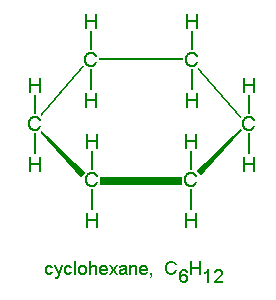
It is a derivative of cyclohexane

Cyclohexane.gif


In the THC rings, there are a total of 5 hydrogens missing from the ring.

1. 2 hydrogens have been removed to form a double bond.

2. 1 hydrogen has its place taken by the CH3 (methyl) group.

3. 2 more hydrogens have their places taken by bonds made to the rest of the molecule (depicted as blank lines in the first structure).


What sulfuric acid is, is basically a very pervasive hydrogen deliver system to this ring. Acids produce H+ ions (and sulfuric acid imparts to them through methods outside the scope of this discussion a very large chemical potential in comparison with say acetic acid).

What happens during this reaction is that the double bond of the ring is hydrogenated, or quenched, with hydrogen ions. Essentially this turns the thing back in cyclohexane which now only has the hydrogens missing from #2 and #3 above. The double bond is now gone.

After awhile, when all of the THC has reacted this way--we remove the acid.

The double bond wants to reform again, it only broke down in the first place because we changed the conditions the molecule was in. When it is back in a less acidic environment, it quickly prefers to return to the state it originally held in that environment--with a double bond.

This is intuitive and follows from thermodynamics.

In terms of the double bond changing its position, this is again a function of thermodynamics.

In the plant, enzymes can be used to overcome thermodynamic unfavorability--and so we can end up with less stable isomers. It just turns out to be our luck that if done synthetically (thermodynamically--rather than enzymically) the most stable product is also the most potent one.

So, to summarize:

1. We add hydrogens to the double bond, by changing conditions.

2. We revert to the initial conditions, and the double bond reforms.

3. It reforms where the greatest stability can be achieved by the molecule--and this also happens to be the most active form.
 
In the THC rings, there are a total of 5 hydrogens missing from the ring.

1. 2 hydrogens have been removed to form a double bond.

2. 1 hydrogen has its place taken by the CH3 (methyl) group.

3. 2 more hydrogens have their places taken by bonds made to the rest of the molecule (depicted as blank lines in the first structure).


What sulfuric acid is, is basically a very pervasive hydrogen deliver system to this ring. Acids produce H+ ions (and sulfuric acid imparts to them through methods outside the scope of this discussion a very large chemical potential in comparison with say acetic acid).

What happens during this reaction is that the double bond of the ring is hydrogenated, or quenched, with hydrogen ions. Essentially this turns the thing back in cyclohexane which now only has the hydrogens missing from #2 and #3 above. The double bond is now gone.

After awhile, when all of the THC has reacted this way--we remove the acid.

The double bond wants to reform again, it only broke down in the first place because we changed the conditions the molecule was in. When it is back in a less acidic environment, it quickly prefers to return to the state it originally held in that environment--with a double bond.

This is intuitive and follows from thermodynamics.

In terms of the double bond changing its position, this is again a function of thermodynamics.

In the plant, enzymes can be used to overcome thermodynamic unfavorability--and so we can end up with less stable isomers. It just turns out to be our luck that if done synthetically (thermodynamically--rather than enzymically) the most stable product is also the most potent one.

So, to summarize:

1. We add hydrogens to the double bond, by changing conditions.

2. We revert to the initial conditions, and the double bond reforms.

3. It reforms where the greatest stability can be achieved by the molecule--and this also happens to be the most active form.


...hey everybody, check out the big brain on Squig! :)

Okay, so I get it. Sort of (I am not a chemistry guy). Maybe I should clarify by asking *WHY* this isomerization is done to an extract that has already been de-carbed? I'm assuming the heat applied during purge de-carbs the source material?? Or am I completely lost?

Thanks, ftw
 
...hey everybody, check out the big brain on Squig! :)

Okay, so I get it. Sort of (I am not a chemistry guy). Maybe I should clarify by asking *WHY* this isomerization is done to an extract that has already been de-carbed? I'm assuming the heat applied during purge de-carbs the source material?? Or am I completely lost?

Thanks, ftw

Because THC-A is a different molecule with different reactivity than THC.

Just because an atom is on the other end of the molecule doesn't mean it can't have an effect on the other side. Induction, as this is known, is a key component of molecular structure and function.
 
Okay... that makes more sense. I think. I'm going to have to process this over a while, since its all new to me. I think my original question makes me seem more familiar with chemistry than I am. I know nothing.

What I'm really getting at, is *why*? Why take the extra step to isomerise? Is this about improving potency or purity?
 
Page 8 of 24 · Replies 141–160 of 464
Back
Top Bottom