Log In Register

The Fat Leaf Breeding Project

  • Thread starter Thread starter lino
  • Start date Start date
  • Tagged users Tagged users None

The Fat Leaf Breeding Project

lino 189 Replies 28,677 Views
Page 5 of 10 · Replies 81–100 of 190
Next, we'll build Punnet charts to test for Tallness as Dominate in Cannabis and we'll have data to plug into our equation.

 
So Lino, I'm a Breeder and I can find out if the Tall (T) gene in Cannabis is Dominate with a Punnet chart. I dont need your math equation to prove it either.

REPLY: Okay, i talk to myself so you guys can learn, Reply;
Yes we are going to chart the Tall (T) gene in cannabis after i explain the equation. And that is correct we're about to put the Lino Cannabis Tall (T) gene theory to the test. But what IF I said to my breeding staff:
I need the Tall (T) gene charted in my SubCool (T) plant Genotype, and I need many LINKAGE traits mapped, plotted and graphed and I would like to know my ratios in my Subcool (T) plant Genotype for, Main Breeder Lino claims we have these linkages to the SubCool (T) gene
  • SubCool (T) gene is Dominate compared to the SubCool (t) short plants that are recessive.
SubCool (T) gene Linkages
that need to be mapped and rations on seed stock to be discovered;
  1. Tastes - Lino say a carrier gene of orange is abundant linkage to SubCool (T) gene. guesstimate @ 75%
  2. Hermy, a recessive trait of lower branch hermy - might have a Sex Linked association that needs to be found. Rec @ 25%
  3. Discover the % of plants that make jelly red hash and quantify if there is a Linkage to SubCool (T) gene . Lino says the terpene profiles will produce jelly red hash in 90 - 98% Genotype. ANd many Phenotype tastes associated the SubCool (T) gene red jelly hash.
  4. on and on
And what if your Geneticist ask for many trait linkage maps to the SubCool (t) gene short plant Linkages that need to be mapped and rations on seed stock to be discovered;
How do you manage all this data? What if your working in a nursery and your breeding 100's cannabis plants and 100 of tomatoes and flowers, How do you track all the data for breeding purposes?

This is a nitemare. But there are several apps that help with this. In a simple common spread sheet, MS Xcel , you can have your collected data during your breeding experiment from another spread sheet to auto populate the equation.
The equation can auto populate another spread sheet and put all your data into tabular data where is easy to spot Dominate and Recessive genes and find linkage associations.
examples

So, should you reject your null hypothesis or not? This is hard to answer at this point. Here's a summary of your observed and expected data:
Shit I dont want to write a <table >
Okay for this example we'll propagate 400 SubCool seeds. Remember I'm showing you this turorial Azz Backwards... This is some Tabular Data the we collected in the grow room from our breeding of subCool plants.

THIS WILL MakE MORE sEnse after you build the Charts.

What and Where did 400 seeds of Subcools JillyBean CV (that mean cultivar) come from.
We germinated and grew Tall (T) and short (t) Jillybean plants.
We crossed a healty (T) x (t) and made 1000'd of seeds. We germ 400 for the test.

The reason that we have not created the Punnet Chart yet is because I want you to be able to look at percentage of plants and understand the Parents probabilities in traits before you create Punnet Charts, Its helpful to speculate Punnet chart results before and after (Expected and Observed)

400 plants
ExpectObserve


After building the Punnet Chart you will realize that 75% and 25% are significant data, From this we can assume with confidence that Lino was correct in that
JillyBean is a (T) dominate strain
and
the parents were a Heterzygos from tall and short genes cross of (T x t) x (T x t) or another way to say this
(Tt) x (Tt)

Okay up next is the math resolved for X and
will build the punnet chart
And even Pollen Chuckers should now how to create a heterozygote trait for breeding purposes and determining Dom and Rec traits... And remember i teaching azz backwards, you may not have a true understanding of Dom and Rec but dont worry follow me and I'll make you a breeder soon.
 
Last edited:
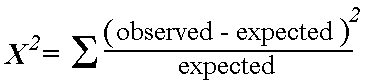
Before I begin, Ive heard and havnt tried it yet but Google Calculator is bad azz so I'm pretty sure it would work with this equation, you might have to Observed and Expected values a numerical only tho. Not sure, that be cool if it works in variables but I doubt its that smart. who knows?

chisq.gif


Before you do this math remember I'm azz backwards so read the bottom before you begin.

  • For tall plants: Χ2 = (305 - 300)2 / 300 = 0.08
  • For short plants: Χ2 = (95 - 100)2 / 100 = 0.25
  • The sum of the two categories is 0.08 + 0.25 = 0.33
  • Therefore, the overall Lino (T) plant experiment is Χ2 = 0.33
Like always I do thing different and Prob wrong on this. But I cross out the Sq Roots on boths sides at the start of the equation. I come up with a close answer for X, not x2

The whole point is to Recognize Lino Speculated
(T) @ 75% - i'm dam close
(t) @ 25% - i'm dam close

And to realize that this need to be done to identify Linkage Genes also.

Okay experienced breeder see a heterozygos punnet chart coming so lets build it...
when building taste charts dont forget about my visual taste and Smell Chart to assist you, that has science of data collection to add to that chart design so there a lot more going on there to help you out as you get used to using for writing or breeding.
Up Next Punnet Chart design by Lino....
 
okay Guys, we've went from JR high skool level biology and we'll drop down to elementary skool science now.
So now before we build the chart but lets ask. Ive asked 1000s of cannabis growers and breeders
What strains have you grown that are STABLE and or UNIFORM.

Before you answer let me clarify, most of us dont have a clear understanding of
STABLE and or UNIFORM crops.
Stable Crop - Can be bred to itself and the offspring crop will be of uniformity.
Uniform Crop - all plants are almost identical with less than 3% that large varients in genotypes.

imo
Norther Lights - Uniform Crops and semi-stable.
Low Ryder by Joint Doctor - stable and uniform with only 2 Genotypes 6" & 12" plants.

This leads me into the next definition "Breeding Stock"
many strain might have traits that are Dom and can be used for that Dom trait to Try and input into your new cross of plants.
You may hear the verbage; I use this strain to add OG taste, I use this strain to add firmness to buds and on and on, This is said to be Breeding Stock, but to a breeder and not a pollen chucker the term Breeding Stock means a well documented strain in his seed bank.

True Breeding Stock - confusing as all level of breeders and horticultirst, geneticist, pollen chuckers use it differently.

True Breeding Stock - Uniform and stable strain. And I would like most of the traits to be
Example (TT) or completely recessive (tt), that is my definition of True Breeding Stock but like a said it has many other ppl using this term differently.

I know I missed some true breeding stock strains , so let us know what strains you've worked with that meets any of these definitions .
 
Breeding Stock means a well documented strain
Right on! If you don't know the lineage of your stock, or haven't extensively "tested" them, you don't really know what you've got. That's not breeding, that's pollen chucking.
Sure, you CAN get some good plants just chucking pollen but they most likely won't be stable or uniform.
Thumbsup


My GDP IBL (Ken's) is very uniform and stable. Only 2 phenotypes - Purple & Green. All look and grow alike though (aside from color).
One thing I've found is the males grow differently than females in many strains. If you don't understand this, you're likely to think you've got several different phenos until they are sexed. I can tell the girls from the boys long before they ever pop a flower.
 
Now we'll clairfy more terms:

Most miss used terms on the Farmer
GENOTYPE & PHENOTYPE, but its actually complex to understand, well have a lot better understanding soon.

And you'll get a clear understanding of Dom and Rec, lot more on that then you'll realize at this point. Linkage types, Co Dominance and we'll get this all clarified so you can be a better breeder and pollen chucker.

This is why we have plants that are not uniform and its hard to find True Breeding stock in cannabis. Pollen Chucker dont chart their plants. This concept is the most important tool to your Breeding Programs. You can grow out plants and cross them and start to have very good speculative idea of who the parents (traits and strains) of your orignal seeds were.

SubCool JillyBean real example data;
Okay lets separate the gene pool, or we could say lets separate the genotypes and then we can make heterozygos crosses.

Lino, Why the hell do I need to learn how to make heterozygos crosses.????
This is great way to determine what traits exist in the strain and what traits are Dom. We're not going to learn about homozygos breeding in this tutorial but its rite in front of face in our charts, if your studying hard you'll see homozygous traits in your strains.
 
Right on! If you don't know the lineage of your stock, or haven't extensively "tested" them, you don't really know what you've got. That's not breeding, that's pollen chucking.
Sure, you CAN get some good plants just chucking pollen but they most likely won't be stable or uniform.
View attachment 714028

My GDP IBL (Ken's) is very uniform and stable. Only 2 phenotypes - Purple & Green. All look and grow alike though (aside from color).
One thing I've found is the males grow differently than females in many strains. If you don't understand this, you're likely to think you've got several different phenos until they are sexed. I can tell the girls from the boys long before they ever pop a flower.
Trait that belong to a particular sex
M - skunk
F - lemon
Hermy -
These are Sex Linked Traits,
And you're exactly rite bout pollen chucking ,,, you about to see why we get so many heterozygous seeds that were buying... Up Next Punnet Chart to find Dominance and Rec for that matter.
 
Right on! If you don't know the lineage of your stock, or haven't extensively "tested" them, you don't really know what you've got. That's not breeding, that's pollen chucking.
Sure, you CAN get some good plants just chucking pollen but they most likely won't be stable or uniform.
View attachment 714028

My GDP IBL (Ken's) is very uniform and stable. Only 2 phenotypes - Purple & Green. All look and grow alike though (aside from color).
One thing I've found is the males grow differently than females in many strains. If you don't understand this, you're likely to think you've got several different phenos until they are sexed. I can tell the girls from the boys long before they ever pop a flower.
Posting data like that is Gold to Breeders!
 
Hetero

3/4 or 75% of the offspring will be Tall if (T) is dominate.
25% will be Rec. I'm not covering Rec in this tutorial.

Look at the data at the top and note ; that leads us to believe that Subcool plant is dominate for Tall plants... Light bulbs should be going off for Pollen Chuckers. I speculated a heterozygous breeding after the 10 JillyBeans plants reached maturity, How did I know that? the 75% ratio was my 1st clue...

I hope this made sense and light bulbs are going off rite now.

Now that you know the rules for using the test, it's time to consider an example of how to calculate Lino charting system. Recall that when Mendel crossed his pea plants, he learned that tall (T) was dominant to short (t). You want to confirm that this is correct, so you start by formulating the following null hypothesis: In a cross between two heterozygote (Tt) plants, the offspring should occur in a 3:1 ratio of tall plants to short plants. Next, you cross the plants, and after the cross, you measure the characteristics of 400 offspring. You note that there are 305 tall pea plants and 95 short pea plants; these are your observed values. Meanwhile, you expect that there will be 300 tall plants and 100 short plants from the Mendelian ratio.

So guys that how I know when I'm handed Heterozygous bred plants .

Get It?

This can go on for Rec. You can get Stable strains ,,,, think about this to spin your breeding mind. We had a 10% chance of hermy on the Tall plant... Can we breed out the herm trait by breeding the short (t) plants (tt),,, got you thinking if your breeder and not a chucker now....

Do you see it now,, You can breed in several directions. What if you had 100's of Punnet charts and linkages like the Hermy example. Just with fancy spread sheet we can produce data that let breeders with certainty before the seeds are germinated.

Stop and think bout this what it data is compiled in an open source breeding app by parsing with some like Java. And what if all the plants in world from the USDA and London and the other largest plant databases into one Large DB where punnet data for all plants are stored . I imported and combined over 900,000 plants from these databases into a common delimited file. I have it in MySQL and access also. I pondering a app to - how to tie breeding info to each plant species in open source.
 
Last edited:
absorb all that and will go over dominace-rec- CoDom- hetero and homo very light-

I'm done but study this so you can undertand your charts and outcomes in breeding.

One of Gregor Mendel's greatest contributions to the study of heredity was the concept of dominance. Mendel observed that a heterozygote offspring (LIKE our JILLYBEANS) can show the same phenotype as the parent homozygote, so he concluded that there were some traits that dominated over other inherited traits. However, the relationship of genotype to phenotype is rarely as simple as the dominant and recessive patterns described by Mendel. As the study of inheritance expanded beyond the seven traits Mendel initially examined and also included organisms other than pea plants, biologists began to notice a variety of relationships between alleles that code for the same trait. These allelic interactions were not exclusively recessive or dominant, and they greatly enriched our understanding of how genotype leads to phenotype.

Genotype - Tall Plant
Phenotype, - Plant that becomes taller stretching for light that is to far away.

NO NEED to STUDY THIS hard...
the point is that cannabis is often like the flowers on the bottom if this chart. We have to understand that there are levels of Dom and Rec is all that needs to be taken away from this.
36131_42.jpg


anyway just understand that its not blk and wht,,,
Complete versus Partial Dominance


Dominance affects the phenotype derived from an organism's genes, but it does not affect the way these genes are inherited. Complete dominance occurs when the heterozygote phenotype is indistinguishable from that of the homozygous parent. However, sometimes the heterozygote displays a phenotype that is an intermediate between the phenotypes of both homozygote parents (one of which is homozygous dominant, and the other of which is homozygous recessive). This intermediate phenotype is a demonstration of partial or incomplete dominance. When partial dominance occurs, a range of phenotypes is usually observed among the offspring. Although the offspring may show a variety of phenotypes, each one will lie along a continuum bracketed by the homozygous parental phenotypes.
 
there are levels of Dom and Rec
I agree 100%.
When I said I had 2 phenos (purple & green) . . . I meant some will be "full" purple, showing signs of purple from the beginning. However, some only show purple at the end.
They both carry the purple gene but show it in different ways.
Would this be PP and pp?
I'm not real sure myself, I think there is more to that purple gene than we know. And other genes can effect how it is expressed.
If I could just grow out 400 plants . . . .
Damn, this gets so complicated some times - makes my brain hurt! Need to go medicate . . .
 
I really need to.come back.and.read this properly when I'm done this work. Got a busy 2 weeks and every time.I come back to this post to.skim through its like I've missed a whole semester lol
 
@lino does this relate to identifying sex & genotypes by looking at the seed through the microscope?
 
Instead of listening to Lino here, how about researching through the googles what he is talking about, Lino won't seem like a god of biology, but a student.
 
Instead of listening to Lino here, how about researching through the googles what he is talking about, Lino won't seem like a god of biology, but a student.
God of bio,,, this is basic , this jr and hs level bio.... this is what we were taught in elementry skool.

Call me a God of biology when I instruct HS DNA markers and New DNA gel slab technology

Scratch that, when i create a new animal species from bone marrow again Ill except that title again

Google, what? Did you find my online tutorials, those are much more detailed cuz those are paid for classes . I have partners who instruct this course also so i not sure what you mean by. Google. Are you refering to my Google Analytics Academy graduation a few weeks ago..
 
Ive toned down my curriculum from college level,, got feedback that many of you guys were not into the DNA make up of cannabis so I resorted to basic bio so I'm not sure if I'm boring you guys and if you want me to up the level or what is being referred to by googling for research if anyone is instructing cannabis breeding on my levels I would love to know who they are and the links to them.

I've only met two breeders in my life that understand and know the DNA con sed of hermaphroditism in cannabis and plants and humans, those guys have PhD's and you got to have login information to read their stuff so I'm just confused by google comment and would love to find another cannabis breeder/instructor
 
hell im happy with what you are teaching.. keep it up, and maybe add a few advance bones that might be beneficial to the topic at hand we can look into with a basic idea what we should be looking for.
thank you for your time.

chris.
 
Page 5 of 10 · Replies 81–100 of 190
Back
Top Bottom