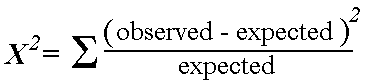
You might have seen this in math class. Guess what? This works for plant breeding also. We'll use this equation to examine the role of chance in producing deviations between observed and expected values. The test depends on an extrinsic hypothesis, because it requires theoretical expected values to be calculated.
We already started the equation.
'expected' Value = Cannabis Tall Plants Dom (T)
'observed' Value = equals punnet charts value ratios that you're about to build
You need to understand X squared. And (value)2
I'll explain the weird symbol in a moment.
The test indicates the probability of that chance alone produced the deviation between the expected and the observed values . When the probability calculated from Lino's chi-square test is high, it is assumed that chance alone produced the difference. Conversely, when the probability is low, it is assumed that a significant factor other than chance produced the deviation.
So why cant I just use a Punnet Chart to determine probability? What does the equation accomplish?
So check it out. Medel did not use statistics, and neither did Bateson, Saunders, Punnett, and Morgan during their experiments that discovered genetic LINKAGE. FYI i gave instruction on Sex Linked genetics breeding but lets not forget that colors and many traits will link to other trait, now to my fellow geneticist: this is where the pollen chucker have a Superior understanding of this they just dont know how to put it into science or charts.
SCIENTISTs here is a FYI, A geneticist combined with a pollen chucker will help you establish very informative starting points in your charts for instance;
If you ask you assigned Pollen Chucker to breeding program with a genetiscist and ask the PC about Tall Plants, he will have a seed bank that will have his plants already designated Sativa, they dont have that charted HOWEVER good Pollen Chuckers know many LINKED traits to their strains but not charted but you can develop your Hypothetical EXPECTED values with the correct questions of the PCs. The know Sex Linked traits but they dont know it you have to ask the correct questions to the PCs they can tell potencies, hermaphrodites, and many other Sex Linked traits to start charts with very accurate Expected Values.
So why the big stupid equation Lino?
How many times do you cross a plant and the results were not exactly what you expected? This equation proves if the plants genetics are correct AS COMPARED to what is claimed by the breeders claims.
This equations works for many statistical tests that we've applied to biological data, scientists judged the 'goodness of fit' between
theoretical and observed experimental results simply by inspecting the data and drawing conclusions based on our Punnet Charts compared to our Prediction of the traits/gene. Although this method can work perfectly if one's data exactly matches one's predictions, scientific experiments often have variability associated with them, and this makes statistical tests very useful to prove your genetic designation (geneticist) ,
Pollen Chuckers - this will prove your Trait proclamations.
So what the hell is the funky symbol in that math equation?
It is called the Summation sign. Ppl use it to say they are wrong Zero times. X needs to equal Zero to show that we are never wrong in our prediction or "expected" Value. In our prediction we need to be close but not exactly at Zero. If we plant 500 plants will all the plants do exactly what we say ? And in this case of plant breeding our predictions will need to close to predictions but not exact. I'm not going to show the + and - value part of the equations. Lets just say we need to be close to prove DOMINANCE.
The symbol represents the sum of the Expected Frequencies of accuracy in Expected Values. Using this formula, the difference between the observed and expected frequencies is calculated for each experimental outcome category. The difference is then squared and divided by the expected frequency. Finally, the values for each outcome are summed together, as represented by the summation sign (Σ). We try to get as close to zero as possible. X = the value of inaccuracy.