
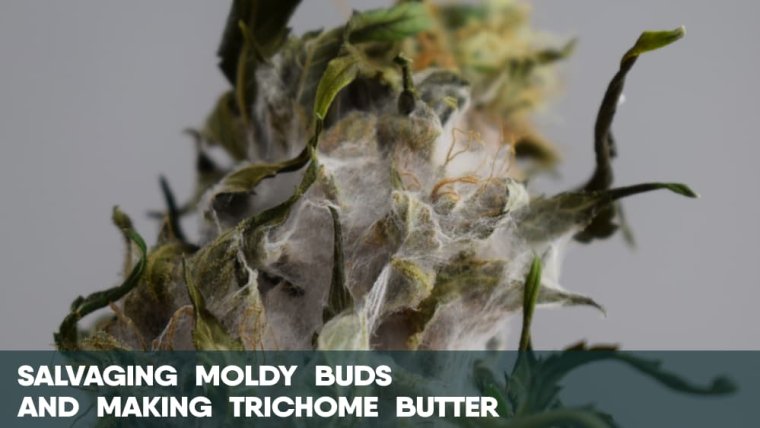
The rotted colas are in a trash bag. On the bench you still have a pile of sugar trim, a few buds that hung next to the rot, and jars from the same plant that look fine. Every autumn someone asks the forum whether the doubtful material can go into hash or butter, since the heat will kill the mold anyway. The clean buds and trim are worth saving. The moldy material is not, whatever you do to it, because the problem is not the mold you can see but the toxins you cannot.
This guide is for home growers sorting a damaged harvest. It covers what to keep and what to throw away after mold or bud rot hits, on the plant, on the drying line or in the jar; what decarbing, washing and extraction can and cannot do; and how to make trichome butter from clean trim. An earlier version of this page said cooking could neutralize mold and gave a butter recipe for moldy buds. That advice was wrong, and this rewrite replaces it. To catch rot early and stop it spreading, see Bud rot on cannabis: identify, prevent and salvage.
Warning: no kitchen method makes moldy weed safe
Heat can kill live mold, but some molds leave toxins behind, and the World Health Organization notes that most mycotoxins are chemically stable and survive food processing. None of the home fixes, from a water cure to a peroxide or alcohol wash, a decarb or a long slow cook, has been shown to remove them, and there is no home test for them. If you or anyone you share with is immunocompromised, has lung disease or is in cancer treatment, use nothing from a plant that had visible mold.
01 · Quick answer Can moldy buds be saved?
The moldy buds cannot. Most of the harvest around them can.
- Bin every bud with brown or gray tissue, fuzz, webbing or a musty smell, plus the buds that touched it.
- Check the rest one bud at a time: tug the small leaves, break it open at the stem and smell it.
- Dry or freeze the keepers the same day, away from anything that was near the rot.
- Save clean sugar trim for hash or trichome butter, made with the method below.
- Do not decarb, wash, cook or extract the moldy material. None of those steps removes the toxins.
02 · Guide What to keep and what to throw away
Rot and mold spread further inside a bud than they show, so cut wide and judge each bud on its own. Members routinely bin one or two rotted colas and harvest the rest of the plant.
| What you have | Keep or bin | Why |
|---|---|---|
| Buds from plants with no rot | Keep | Still open the biggest colas before drying |
| Buds from other branches of a plant with rot | Keep if they pass the checks below | Rot starts in single dense colas |
| The rotted bud, even with the brown part cut out | Bin | Rot runs inside the bud before it shows |
| Buds touching the rot or within 1 to 4 inches of it | Bin | The margin members cut to get ahead of it |
| Sugar trim from buds that passed the checks | Keep | The best material for trichome butter |
| Leaves and trim from around the rot | Bin | Same spores and dying tissue as the rot |
| Dried buds with fuzz, webbing or a musty or ammonia smell | Bin, then check the rest of the jar | Mold grew after harvest |
| Buds that smell like hay or cut grass, with no mold | Keep | Hay smell comes from a fast dry, not mold |
Before a bud goes on the keep pile, put it through four checks.
Tug the leaves
Pull gently on the small dull or dead leaves sticking out of the bud. If they slide out with no resistance, the stem underneath is rotting. This is the tug test from the bud rot guide.
Open it at the stem
Break the bud in half from the base. Brown, gray or mushy tissue at the center means rot, even when the outside looks perfect. As one member put it in First harvest, should I trash it because of mold?, rot "always starts from the inside out".
Smell it
A damp, musty or ammonia smell means mold. A hay or grass smell usually means the buds dried too fast, which hurts flavor but is not a safety problem, as covered in How to dry and cure cannabis.
Look with a loupe
A 30x to 60x jeweler's loupe is enough to see single trichome heads, which look like tiny glass stalks with round heads, clear, cloudy or amber. Mold looks like fine white threads or "loose felt", in the words of a member in the same thread, and sometimes gray dust that puffs off when you tap the bud. If you cannot tell, post a close-up in the Cannabis Infirmary before you decide.
Dry or freeze the keepers fast
Hang keepers at 60 to 70°F and 55 to 60% humidity, the drying guide's targets, away from the rot, or freeze them the same day if they are going into hash. Wet material left in a closed bag is how mold starts on clean buds. One Massachusetts grower in Decarbing fresh (wet) frozen buds cuts well below each moldy spot, bins anything that touched mold and freezes the rest for edibles.
03 · Guide Does decarboxylation kill mold?
It can kill live mold. It does not make moldy weed safe. A standard decarb holds weed at 240°F for 30 to 40 minutes, as covered in THCFarmer's decarb guide. Nobody has shown that a kitchen decarb kills every spore in a rotted bud, and the bigger problem is what the mold left behind. Some molds make toxins as they grow, and the WHO says most of those toxins survive cooking and processing.
Lab work backs that up for cannabis. In a 2021 study, researchers added aflatoxins and ochratoxin A to dried cannabis flower at the highest level European rules allow, made an ethanol extract and decarbed it at 125 to 130°C (257 to 266°F). The toxins were still there, at about 2 to 7 times the flower limit by weight (Serafimovska and others, 2021).
You also cannot tell by looking which molds are in a rotted bud. Gray mold is the one you see, but researchers sampling cannabis buds have also found Penicillium, Aspergillus and Cladosporium, and some Penicillium and Aspergillus species make mycotoxins (Punja and others, 2019). Nobody yet knows how much toxin, if any, they make in buds.
Cooking into butter or oil
Butter and oil infusions run cooler than a decarb, held below a simmer for 2 to 3 hours, as in the butter and oil guide. Straining takes out plant material. It cannot take out anything that has dissolved into the fat, and a long cook is not a cleaning step.
Smoking or vaping
Smoking puts whatever is on the bud straight into your lungs. In a CDC-led study of insurance records, cannabis users had 3.5 times the odds of a fungal infection compared with non-users. That is a link, not proof of cause, and the infections were rare. The authors note that contaminated cannabis has been tied to aspergillosis and other serious fungal infections, and that organ transplant recipients are already advised not to smoke cannabis.
The water cure
The old version of this page told readers to soak moldy buds in distilled water for a week. Members water-cure clean bud to smooth harsh smoke, but there is no evidence it removes mycotoxins, and the rotted tissue is still in the bud afterward.
Hydrogen peroxide and alcohol washes
Members bud-wash in dilute hydrogen peroxide at harvest, spray a 50/50 mix of 91% isopropyl alcohol and water on infected spots, or soak moldy buds in 200-proof alcohol. These can kill mold on the surfaces they touch. They do not reach rot inside a dense bud or have any shown effect on toxins already made, and a strong alcohol soak strips the resin off as well.
Freezing
Freezing stops mold growing while the buds are cold. It does not kill it or remove toxins, so moldy buds come out of the freezer as moldy buds.
04 · Guide Hash, rosin and oil from moldy buds: what extraction can and cannot do
This is where members disagree most.
The case for
Members who wash moldy material say most of the mold leaves with the plant matter. One member who bubble-washes moldy material, after cutting out the rot and a peroxide bud wash, argues in Can you make bubblehash from moldy weed? that "any spores are small enough to pass through all bags". Another, who washed 10 pounds that had molded, says most of the mold floats out with the first bag and the later bags come out clean. Others trust only a butane or alcohol extraction to kill the spores, though the member who said so in Making hash with budrot would still throw out rotted buds.
The case against
Other members bin all of it. "A little hash isn't worth a respiratory infection and/or a trip to the emergency room," one wrote in the same bubble hash thread. Another added: "when health experts say mold on weed isn't safe, I sit up straight and pay attention."
What extraction can do
Separate trichome heads from plant material, leave most leaf and loose debris behind, and turn clean trim into a cleaner, stronger product.
What extraction cannot do
Sort out toxins. Screens sort by size, so anything stuck to the resin heads comes along with them. Filters catch particles, not anything dissolved in a solvent, and rosin presses use heat, which is the decarb problem again. In the 2021 study above, toxins came through an ethanol extraction at 2 to 7 times the flower limit by weight. Nobody has published the same test for bubble hash or rosin, so treat any extract of moldy material as carrying whatever the bud carried, in a stronger dose.
Use extraction to get more out of clean trim, not to rescue moldy buds.
05 · Guide How to make trichome butter from clean trim
Trichome butter is butter made from kief or hash instead of whole plant material. With the leaf left behind, it tastes less grassy, leaves no green sludge to strain and cooks in a fraction of the time. It is the best use for a pile of sugar trim from buds that passed the checks above. Material you had doubts about does not go in.
- Collect clean sugar trim only: the small resin-coated leaves from buds that passed the tug, stem and smell checks. Leave out fan leaves, which carry little resin.
- Separate the trichomes. For dry sift, freeze dried trim for at least an hour, then shake it over a 100-mesh screen (about 150 microns), which lets resin heads through and holds back most leaf. For ice water hash, follow How do I make ice hash? or the budget method in How can I make ice hash for less than $5?.
- Dry ice water hash completely before you store or use it, then keep it in a jar with a desiccant as in Drying and storing kief, pollen and seeds. One member's bubble hash grew mold after 2 weeks in a sealed zip bag (Mold on my hash).
- Weigh the kief or hash and estimate the dose before you cook (worked example below). A common starting ratio is 1 gram of kief per stick (113 g) of butter.
- Decarb it at 240°F for 30 to 40 minutes, spread thin on parchment in a small oven-safe dish. The THC in kief is still in its raw THCA form, like the flower it came from, so members use the same setting the decarb guide gives for flower.
- Melt unsalted butter on low in a double boiler, or in a jar standing in simmering water, stir in the decarbed kief and hold it for 30 to 60 minutes, stirring now and then. Keep it below a simmer so the butter does not brown. Kief has almost no leaf to steep, so it does not need the 2 to 3 hours flower butter takes.
- Strain through fine mesh or a coffee filter only if you see grit, chill until solid, and label it.
Worked example
Kief potency varies widely, so this uses an assumed 40% THC, not a measurement. One gram of kief at 40% holds about 400 mg of THCA. Decarbing turns that into about 350 mg of THC (multiply by 0.877), and a conservative 70% transfer into the butter leaves about 245 mg in the stick. A stick is 8 tablespoons, so each tablespoon carries about 30 mg, and 24 cookies made with the whole stick come out near 10 mg each, a strong serving for many people. The edible potency guide suggests a first test serving of 1 to 2.5 mg and waiting at least 2 hours before taking more.
Store it cold and dry
Keep trichome butter in a sealed, labeled container in the fridge, or in the freezer for longer storage. Water left in or under the butter gives mold a place to start, so if you used water in the pan, lift the butter off and pat it dry. If a batch grows mold, throw out the whole batch instead of scraping it. For recipes, see Cannabis recipes and edibles: start here.
06 · Pitfalls Common mistakes
Cutting out the fuzz and keeping the rest of the bud
Rot runs further inside than it shows. Bin the whole bud and anything within 1 to 4 inches of it.
Mixing doubtful trim into a clean batch
One bag of trim from around the rot puts the whole batch of hash or butter in doubt. Keep clean material separate from the moment you cut.
Drying keepers next to the rot
Gray mold keeps spreading after harvest, and NC State Extension counts post-harvest losses as part of the disease. Dry keepers in a different space, or at least on a different line, at 55 to 60% humidity.
Giving salvaged edibles to someone else
The person eating cannot judge what went in. Make butter for others only from material you would smoke yourself, and label the estimated dose.
Guessing the dose
Kief is several times stronger than the trim it came from, so the same weight makes far stronger butter. Run the numbers before you bake.
07 · FAQ Salvaging moldy buds FAQ
Members do, and members refuse to. Washing leaves most loose mold behind, but nobody has shown it removes toxins, and the ethanol extract in the 2021 study concentrated them. Bubble-wash clean trim and bin the moldy buds. From Can you make bubblehash from moldy weed?.
Not the moldy part. Cut it out wide, keep the buds that pass the checks above, and use clean trim for hash or butter. Some members suggest a topical oil from moldy bud instead; we found no research on whether that is safer. From Is there any way to salvage moldy bud?.
Members suggest freezing it so the mold rises to the surface, or an alcohol wash. Neither removes toxins, so bin it, and next time dry ice water hash completely before sealing it. From Mold on my hash.
Lab filters of 0.2 to 0.45 micron catch whole spores, but not anything dissolved in the oil. Members in that thread also point out that winemakers use botrytis grapes. A rotted bud can carry other molds too, and you cannot tell which by eye. From Filtering botrytis affected cannabis oil.
Check them first. A hay smell usually means a fast dry, a flavor problem only, while fuzz, webbing, a musty smell or gray tissue inside means mold and the trash. From Making hash with budrot.
If you would not smoke it, do not cook it, wash it or press it either. Make your butter from the trim of buds you would happily smoke, and bag the rest for the trash.
Sources: THCFarmer member threads on salvaging moldy buds, hash from bud rot and kief butter (2009 to 2025), linked above; World Health Organization, Mycotoxins fact sheet (2023); Serafimovska and others, Frontiers in Medicine 8:759856 (2021); Punja and others, Frontiers in Plant Science 10:1120 (2019); Benedict, Thompson and Jackson, Emerging Infectious Diseases 26(6) (2020); NC State Extension, Gray Mold of Industrial Hemp (2019, revised 2024); THCFarmer's decarb, edible potency and butter and oil guides.
More Hashish and oil questions?
Bring your numbers, room size, and target yields to the forum so other growers can sanity-check the setup before you burn money on the wrong gear.

logic has been posting on THCFarmer since 2008 and now carries 547 learn guides for growers who want the real numbers, tradeoffs, and failure points before they spend time or money.