
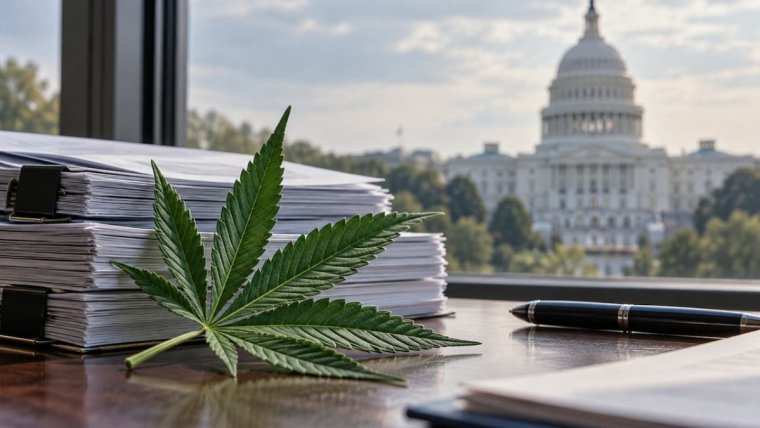
The U.S. Government Accountability Office (GAO) says the Drug Enforcement Administration and Food and Drug Administration lack comprehensive written procedures for parts of the federal drug scheduling process. The findings arrive while a broader proposal to move marijuana from Schedule I to Schedule III remains under review.
In its September 23 report, GAO examined DEA scheduling actions involving 208 substances from 2020 through 2025. DEA considered recommendations from the Department of Health and Human Services (HHS) in all 95 cases where it was required to do so. By the end of 2025, DEA had issued final rules for 84 of those substances, and every decision matched HHS’s recommendation. The remaining 11 were under extended temporary scheduling orders.
That record does not mean GAO gave the agencies a clean bill of health. Investigators found that DEA lacks policies spelling out staff roles, responsibilities and procedures for major scheduling tasks. FDA has policies covering some aspects of the process, but no comprehensive written instructions for how its staff should carry out evaluations and develop recommendations. GAO specifically called for FDA to clarify how it assesses a substance’s potential for abuse relative to other drugs.
GAO also found that an agreement governing how FDA consults the National Institute on Drug Abuse is more than 40 years old and no longer reflects the offices and procedures in use today. GAO recommended that DEA and FDA establish the missing procedures and that FDA and the National Institutes of Health update the agreement. The agencies agreed with the recommendations.
GAO’s review does not find that DEA mishandled the marijuana case, invalidate the hearing, or set a deadline for a final decision. The 84-to-84 figure concerns past decisions across different substances; it is not a forecast for marijuana. For growers and patients following federal reform, the immediate takeaway is about process: the watchdog wants the agencies to put their evaluation methods and responsibilities in writing while the larger marijuana decision remains pending.
In its September 23 report, GAO examined DEA scheduling actions involving 208 substances from 2020 through 2025. DEA considered recommendations from the Department of Health and Human Services (HHS) in all 95 cases where it was required to do so. By the end of 2025, DEA had issued final rules for 84 of those substances, and every decision matched HHS’s recommendation. The remaining 11 were under extended temporary scheduling orders.
That record does not mean GAO gave the agencies a clean bill of health. Investigators found that DEA lacks policies spelling out staff roles, responsibilities and procedures for major scheduling tasks. FDA has policies covering some aspects of the process, but no comprehensive written instructions for how its staff should carry out evaluations and develop recommendations. GAO specifically called for FDA to clarify how it assesses a substance’s potential for abuse relative to other drugs.
GAO also found that an agreement governing how FDA consults the National Institute on Drug Abuse is more than 40 years old and no longer reflects the offices and procedures in use today. GAO recommended that DEA and FDA establish the missing procedures and that FDA and the National Institutes of Health update the agreement. The agencies agreed with the recommendations.
What this means for marijuana
HHS supports moving marijuana to Schedule III. DEA held a hearing on the broader rescheduling proposal in June and July 2026. A separate, narrower final rule has already placed certain FDA-approved marijuana products and products covered by state medical marijuana licenses in Schedule III; the wider proposal is a distinct proceeding.GAO’s review does not find that DEA mishandled the marijuana case, invalidate the hearing, or set a deadline for a final decision. The 84-to-84 figure concerns past decisions across different substances; it is not a forecast for marijuana. For growers and patients following federal reform, the immediate takeaway is about process: the watchdog wants the agencies to put their evaluation methods and responsibilities in writing while the larger marijuana decision remains pending.