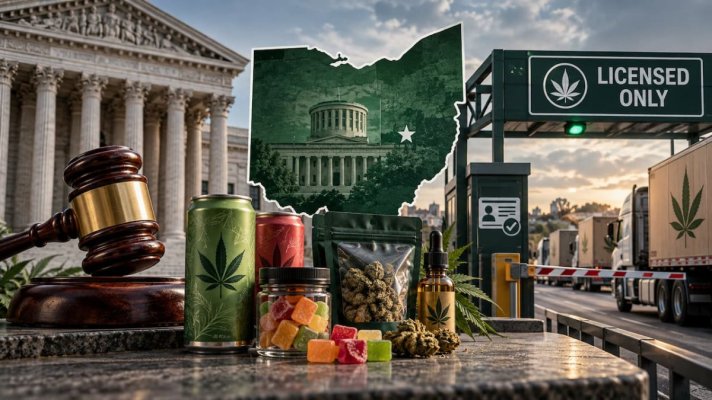
A federal appeals court has cut back the order that let a group of hemp companies keep selling THC drinks and other intoxicating hemp products in Ohio without going through the state's cannabis licensing system. On Friday, September 25, the U.S. Court of Appeals for the Sixth Circuit granted part of Ohio's request to put that preliminary injunction on hold while the state appeals it. Bloomberg Law, which first reported the order, says the practical result is that the companies can no longer sell in Ohio unless they hold a license from the state's marijuana regulators. Ohio didn't get everything it asked for, though. The court also found that the geographic strings Ohio attaches to those licenses have dormant Commerce Clause problems, and it said the state can't refuse approval to a seller because of where that seller is located.
The court declined to lift the injunction entirely because Ohio hadn't made a strong enough showing that it would win the case. What it did accept was the state's complaint that the district court's order reached too far, so it trimmed the order back rather than dissolving it. Friday's order only governs what happens while the appeal plays out. The appeal of the injunction itself is still pending, and whether Senate Bill 56 survives the constitutional challenge will be settled there. For the ten plaintiff companies, the road back onto Ohio shelves now runs through the Division of Cannabis Control.
Senate Bill 56, which Gov. Mike DeWine signed in December and which took effect March 20, rewrote Ohio's definition of hemp. Hemp now means cannabis with no more than 0.3 percent total THC on a dry-weight basis, THCA included, and any finished product with more than 0.4 milligrams of total THC per container falls outside the definition altogether. Products over that line are treated as adult-use marijuana, which in Ohio can only be sold by a dispensary licensed by the Division of Cannabis Control. Lawmakers had written in a window for regulated THC beverages through 2026, but DeWine line-item vetoed it, so drinks went into the dispensary channel with everything else. On top of that, a licensed Ohio cannabis business is generally expected to buy from and sell to other Ohio licensees, and that closed loop is what the hemp companies attacked.
Ten companies led by Cleveland-based Titan Logistics Group filed suit in June against nearly 100 county and municipal prosecutors' offices. The group is a mix of Ohio businesses in Cleveland, Cincinnati and Nelsonville and outside companies from North Carolina, South Carolina, Oregon and Florida. Their argument was that SB 56 forces anyone making a federally legal hemp product to move part of their supply chain into Ohio and get licensed before they can sell there, which amounts to protecting in-state businesses from out-of-state competition. U.S. District Judge Jeffrey J. Helmick found they were likely to win on that point, granted a temporary restraining order on June 15 and turned it into a preliminary injunction on July 13. His order barred enforcement against the plaintiffs' products and against the people and businesses handling them.
Helmick issued a second injunction on September 4 in a separate case, Delta Beverages v. Canepa, covering 14 more companies including Great Lakes Brewing, Rhinegeist, Fifty West, Seventh Son, Hometown Hero and Uncle Arnie's. Friday's order came in the Titan appeal, and it isn't clear yet what it means for that second group.
If you grow your own under Ohio's adult-use law, this order doesn't touch you. It's about who can sell intoxicating hemp products and through which door. The more useful signal is for anyone growing hemp as a crop, in Ohio or anywhere else. Ohio counts THCA toward its 0.3 percent ceiling, which puts most high-THCA "hemp" flower on the marijuana side of the line in that state. The federal definition makes the same move on December 11, when the hemp rewrite Congress passed last November takes effect after a one-month delay. The THCA flower market that grew up around the delta-9 wording of the 2018 Farm Bill is running out of road nationally, and Ohio is one of the states that got there early.
The reasoning matters beyond Ohio. At least at this stage, the Sixth Circuit looks willing to let a state push intoxicating hemp into its licensed cannabis system, while drawing a line at using that system to keep out-of-state producers from competing. Illinois, for one, moves intoxicating hemp into its licensed cannabis channels on November 12 under its new Hemp Act. If this reasoning holds when the court rules on the full appeal, fights like Ohio's will turn less on whether a state can regulate intoxicating hemp and more on whether its licensing rules give outside suppliers a fair shot. For now, Ohio gets its license requirement back, and the hemp companies get a ruling that the state can't turn them away over geography, at least while the appeal runs.
Sources: Bloomberg Law, Forbes, Ohio Capital Journal, Cannabis Business Times, The Marijuana Herald, Foley Hoag
A split decision
The court declined to lift the injunction entirely because Ohio hadn't made a strong enough showing that it would win the case. What it did accept was the state's complaint that the district court's order reached too far, so it trimmed the order back rather than dissolving it. Friday's order only governs what happens while the appeal plays out. The appeal of the injunction itself is still pending, and whether Senate Bill 56 survives the constitutional challenge will be settled there. For the ten plaintiff companies, the road back onto Ohio shelves now runs through the Division of Cannabis Control.
How Ohio got here
Senate Bill 56, which Gov. Mike DeWine signed in December and which took effect March 20, rewrote Ohio's definition of hemp. Hemp now means cannabis with no more than 0.3 percent total THC on a dry-weight basis, THCA included, and any finished product with more than 0.4 milligrams of total THC per container falls outside the definition altogether. Products over that line are treated as adult-use marijuana, which in Ohio can only be sold by a dispensary licensed by the Division of Cannabis Control. Lawmakers had written in a window for regulated THC beverages through 2026, but DeWine line-item vetoed it, so drinks went into the dispensary channel with everything else. On top of that, a licensed Ohio cannabis business is generally expected to buy from and sell to other Ohio licensees, and that closed loop is what the hemp companies attacked.
Ten companies led by Cleveland-based Titan Logistics Group filed suit in June against nearly 100 county and municipal prosecutors' offices. The group is a mix of Ohio businesses in Cleveland, Cincinnati and Nelsonville and outside companies from North Carolina, South Carolina, Oregon and Florida. Their argument was that SB 56 forces anyone making a federally legal hemp product to move part of their supply chain into Ohio and get licensed before they can sell there, which amounts to protecting in-state businesses from out-of-state competition. U.S. District Judge Jeffrey J. Helmick found they were likely to win on that point, granted a temporary restraining order on June 15 and turned it into a preliminary injunction on July 13. His order barred enforcement against the plaintiffs' products and against the people and businesses handling them.
Helmick issued a second injunction on September 4 in a separate case, Delta Beverages v. Canepa, covering 14 more companies including Great Lakes Brewing, Rhinegeist, Fifty West, Seventh Son, Hometown Hero and Uncle Arnie's. Friday's order came in the Titan appeal, and it isn't clear yet what it means for that second group.
What it means if you grow
If you grow your own under Ohio's adult-use law, this order doesn't touch you. It's about who can sell intoxicating hemp products and through which door. The more useful signal is for anyone growing hemp as a crop, in Ohio or anywhere else. Ohio counts THCA toward its 0.3 percent ceiling, which puts most high-THCA "hemp" flower on the marijuana side of the line in that state. The federal definition makes the same move on December 11, when the hemp rewrite Congress passed last November takes effect after a one-month delay. The THCA flower market that grew up around the delta-9 wording of the 2018 Farm Bill is running out of road nationally, and Ohio is one of the states that got there early.
The reasoning matters beyond Ohio. At least at this stage, the Sixth Circuit looks willing to let a state push intoxicating hemp into its licensed cannabis system, while drawing a line at using that system to keep out-of-state producers from competing. Illinois, for one, moves intoxicating hemp into its licensed cannabis channels on November 12 under its new Hemp Act. If this reasoning holds when the court rules on the full appeal, fights like Ohio's will turn less on whether a state can regulate intoxicating hemp and more on whether its licensing rules give outside suppliers a fair shot. For now, Ohio gets its license requirement back, and the hemp companies get a ruling that the state can't turn them away over geography, at least while the appeal runs.
Sources: Bloomberg Law, Forbes, Ohio Capital Journal, Cannabis Business Times, The Marijuana Herald, Foley Hoag