Hey M like our discussion and thinking of purchasing 2 144 reflectors as side lighting as well as maybe 2 mars 700's for over head problem i see is there both 5 watt diodes ,, Can a person pick n build these units ?? i mean i do not want 5 watt diodes but 3 watt diodes instead from reading leds in past couple years i am 75 percent ready to give them a shot but not interested in 5 watt diodes not at all so i its possible to to custom make reflectors or mars 2 units i would be interested then
, but the LED grow lights with the larger diodes have some very critical drawbacks. The first issue is that of heat dissipation and density. As the diode size increases, so does the amount of heat that needs to be dissipated by the diode chip. Larger wattage diodes need larger heat sinks to dissipate the heat that they give off. This results in heavier and bulkier lights. Another critical design drawback of the larger diodes is that they can not be packed as densely as the 3 watt designed lights. When using 5 watt or 10 watt diodes, you must space the diodes further apart, again because of the problem of heat dissipation. The result is a less densely packed grow light that is heavier and bulkier.
The biggest drawback of the 5+ watt diodes is their price. Not only do they cost more overall, but they are also more expensive on a $/watt and $/ growing area covered basis. A quick analysis shows that it is not worth paying a premium to have larger diodes in LED grow lights. The added penetration is superfluous and unnecessary for indoor growers and it comes at a burdensome cost – increased price and less densely packed network of diodes.
Bigger is not always better. When it comes to the question of 3 watt vs 5 watt diodes for LED grow lights, the 3 watt diode is the smarter choice for any indoor growing project.
Hello DrFever ;);)
You r right, yeah all of our products have switched from 3W to 5W now , but actually we just highed up 5% of the price, less than 10 USD comparing with old model, even tho producing 5W LEDs cost us more money on the chips and on the heat sink. So why we did it? Why we chose 5W even tho it costs us more to produce the lights?:)
From 2009, many LED grow light manufactures stared to use 3W chips, even now some companies r still using it. LED grow lights are still using 1W and 3W LEDs because they cost companies less money to produce, 5W LEDs require specialized thermal management to keep the LEDs from burning out quickly. It is cheaper and easier to design and manufacture a grow light with 1W or 3W LEDs. But in fact 3W LEDs just weren't intense enough to keep all the leaves healthy on the plants, especially when people grow large plants.
Here is an article from TWB, wish can help you :)
"This is true in the sense that a 1W LED is more efficient than a 3W LED at producing light, and a 3W LED is more efficient than a 5W LED, in terms of photons produced per watt of power used. However, a 0.5W LED is even more efficient than a 1W LED, and the most efficient demonstrated to date is a 30 picowatt (0.00000000003W) LED, so in this sense the 1W or 3W chips are certainly not the "most efficient".
So why aren't LED grow lights using the most efficient 0.00000000003W LEDs? As the power of LEDs decreases, so does their intensity. A 30 picowatt LED puts out so little light that you probably wouldn't be able to see if it is on or off, and you certainly can't grow a plant with it. 1W LEDs are much brighter, but still relatively dim- they're about as bright as an old-style T12 fluorescent (1.5-inch-thick) tube, but only about 1mm in size. They are intense enough to grow plants with, but only within a few inches of the LED.
3W LEDs are brighter still-- a little brighter than a new-style T5 (⅝" thick) fluorescent tube, and bright enough to grow plants within 12-24 inches of the LEDs. The 3W LEDs were very capable of growing and flowering plants and marked the true beginning of practical LED grow lights. Our experience with these lights left us wanting a little more canopy-penetration power; they just weren't intense enough to keep lower leaves healthy on large plants. When the technology became available, we experimented with 5W LEDs and found them to be even better for canopy penetration and growing plants.
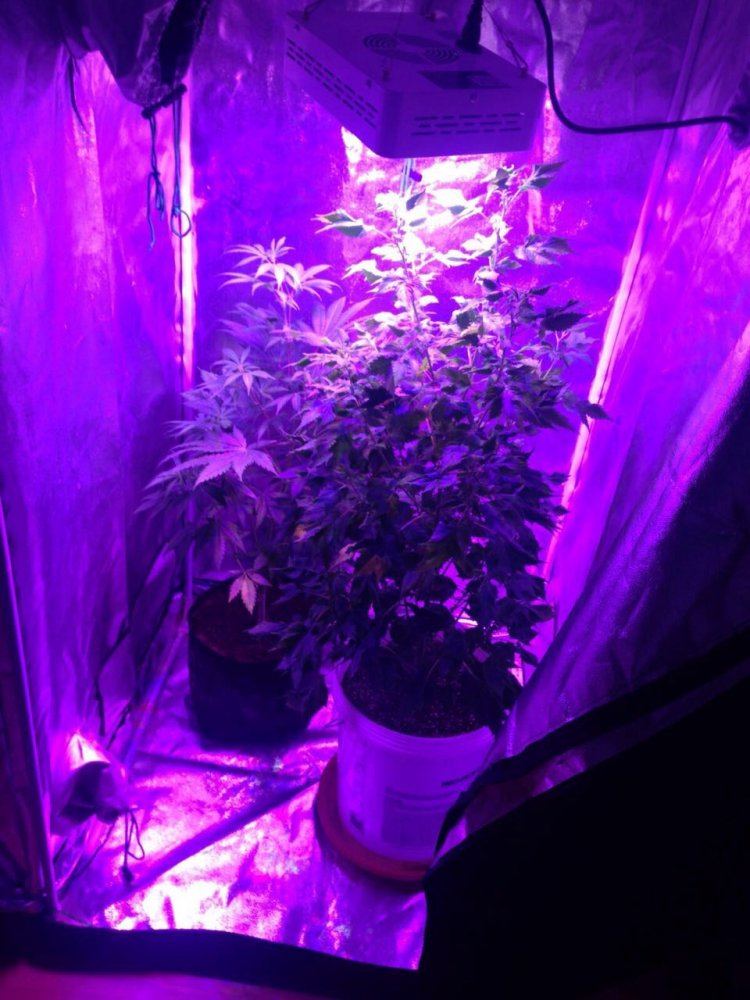
5W LEDs are intense enough that it is uncomfortable to look at them (and they may damage your eyes!), more like the sun, MH or HPS lights. They have the power to penetrate the plant canopy and keep lower leaves healthy and contributing to the plants' growth. The more leaves a plant can have contributing to its' growth, the better the plant will grow. Many growers are familiar with the concept of "pruning up" lower leaves under artificial lights; with 5W LEDs the need to do this is dramatically reduced or entirely eliminated.
Other LED grow lights are still using 1W and 3W LEDs because they are much less expensive and much easier to cool. 5W LEDs require specialized thermal management to keep the LEDs from burning out quickly. It is cheaper and easier to design and manufacture a grow light with 1W or 3W LEDs.
If 5W LEDs are great for growing plants, it seems as though 10W LEDs would be even better, but this is not (yet) the case. 10W LEDs are not available yet in all the colors we need . The 10W LEDs that are available are primarily "white" LEDs, which are great for creating lights for humans, but aren't very efficient for growing plants. They actually put out less light that is
usable to the plants than our existing 5W LEDs, while taking twice the power!
Efficiency is incredibly important, but it doesn't matter if your LED grow light is the most efficient if it won't grow plants well. "
:):):smoking::smoking:
All we want is for giving growers better result, because that's the most important thing if a company wants to continue developing in the market. It's suicidal to make a big decision without all the investigations, experiments. :) :) So DrFever, please feel cool to use our lights with 5W, I believe it can work well for your beautiful plants!