Log In Register

Tea Recipe

  • Thread starter Thread starter Capulator
  • Start date Start date
  • Tagged users Tagged users None

Tea Recipe

Capulator 1,732 Replies 370,216 Views
Page 67 of 87 · Replies 1,321–1,340 of 1,733
With cannabis does it matter? Cooking edibles properly or BHO handles e-coli unless I am mistaken. What numbers did you show?

I have links that I will post later that have shown the opposite. I have to go snowblow my 1/4 mile driveway (sigh) first.

I don't have any of the info in front of me, we were playing around with this over the summer. But you're correct- it really doesn't matter unless you're doing solvent-less extractions or spending alot of time around your tea/plants.

and ouch snowblowing a 1/4 mile driveway?! It's all good I'm about to go on ride 18 miles on a singlespeed, and it's a cozy 25 degrees out
 
Here is another consideration in making tea. I add in my molasses incrementally.
I too find molasses to have a powerful impact on diversity.
I think It's the yeasts.
They take advantage of the free sugar and bloom. In beer, this acidifies the environment and suppresses bacteria.
I like the idea of adding fuel to a tea, but I'm thinking a drip applicator might limit yeast bloom impacts.

This is a two min video taken by my point and shoot set up over a 400X microscope.
https://plus.google.com/photos/1127...5949895089189938754&oid=112792718700638015785
 
Cap, I noticed another change for the tea recipe. You don't recommend adding any Alfalfa Meal any longer? Is there a specific reason? I am getting ready to make a tea now.
 
Btw. Anyone that uses Insect Frass. The On Frass brand. I got a five pound bag and was getting ready to make a foliar and noticed some bugs crawling around. Got in touch with the owner, i think, anyone whoever it was says that they are "pest beetles" and are attracted to the food they feed the "other insects". He got me to send a picture, it's just a small reddish beetle looking thing, and he wrote back telling me that it was a pest beetle and to just put the bag of insect frass in the freezer for a couple hours. It worked.
 
I am still trying to wrap my mind around ACT's. What difference would you see between a short brew of 2-4 hours compared to 24-36 hours?
 
Yes. I should have mentioned that. I think that it would just put them in stasis. Well, I hope. I didn't have time to do a back and forth with this guy and waiting on a remail of the product so I am going with the stasis belief for now. I mean soil microorganisms survive winter so I think I got a little logic on my side.


http://www.bountea.com/articles/lifeinwintersoil.html
 
Last edited:
Cap, I noticed another change for the tea recipe. You don't recommend adding any Alfalfa Meal any longer? Is there a specific reason? I am getting ready to make a tea now.

You can still add alfalfa for sure. I am just continually simplifying the tea recipe so that it's dummy proof. Feel free to add in anything you like.
 
I used alfalfa tea up until about week 3 1/2 with great results. No foxtailing or any other problems I have heard others warning about.
 
I have been brewing one gallon alfalfa tea back to back for over a year to water my super soil grow.
It brews 3-4 days between waterings.
I strip solids after day one thinking that the piles of wet alfalfa in the bottom are a micro environment I don't want as the air stone is not strong enough to stir it up.
I use it on everything, every time diluted to 6-9 gallons.
For the last few months I have been adding a small scoop of caps foliar inoculation at the start.
This has improved the smell greatly and I like the bacterial populations I see.
I also inoculate with runoff from the worm bin and throw solids from tea to the worms.
I'm expecting caps contribution to change the worm bin micro populations over time.
If I have an inclination to add anything, I add it to the tea.
Perhaps I will do a side by side water vs tea.
It would be a pain, but might be informative.
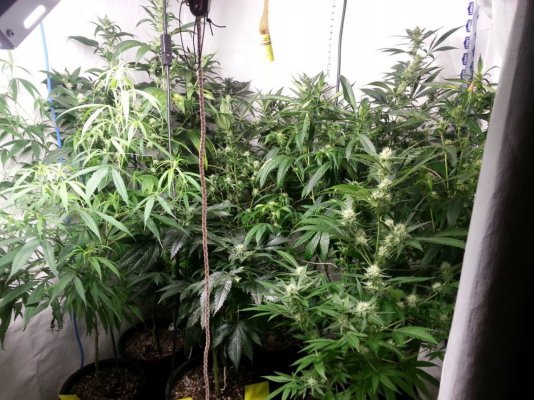
I'm presently testing some Lithonia High Bay 150W lamps.
Off the shelf at Home Depot for $219.
No fans and easy to hang.
20131125 171909
 
Yeah, Alfalfa Tea is like a no brainer to me. I have done side by sides. The only reason I think some people get airy buds and/or foxtailing from this tea is not enough light or having lights too high maybe....whatever. In other words it's not the tea, its another externality.

I am also finding that I can pump the nitrogen up very safely during flower. I know that many are now finding out that low N during flower is inhibitory, but I am surprised at how much I can pump it up.

As for A. Tea. This time I am going to go to somewhere around four weeks into flower with it, maybe longer, and see what happens. My yields increase every grow so I will keep with the program.

Btw. I got my first serious job offer from a dispensary. I am so fucking humbled.

HAPPY THANKSGIVING EVERYBODY :)

tell the corporations to kiss your ass, boycott Black Friday. (every year I try to spread that message, sorry for off topic)
 
Yeah, Alfalfa Tea is like a no brainer to me. I have done side by sides. The only reason I think some people get airy buds and/or foxtailing from this tea is not enough light or having lights too high maybe....whatever. In other words it's not the tea, its another externality.

That doesn't line up with knowledge about the effects of triacontanol on plant growth. These types of buds are expected for plants which are treated with too much triacontanol after a particular point in their life cycle. The difference may be in dosage, or it may simply be that one strain responds more to the chemical than another. Either way, these types of report are likely to be linked to the alfalfa, even if they don't occur for everyone.
 
Yes, my wording could have been better. Genetics is always a consideration, as are many external stimuli. I just go by what I see in my garden. The knowledge base on TRIA is somewhat flawed anyway in my opinion. Many sites do not distinguish that TRIA works independent of light cycle which when first discovered, and to this day, made it so interesting.

I am sure that some strains would larf out past a certain point. Hasn't happened to me though and that's all I was reporting.
 
In my experience genetics and environmental conditions make quite a bit of difference ......all the Indica dominant strains I've used triacontanol on have stayed nice and dense,as well as most hybrids,Sativa dominants that tend to
have looser colas have foxtailed on me when using triacontanol past week 4 of flower.... in my environment, cooler flower room temps helped curtail the foxtailing somewhat.

I do not use triacontanol on Sativa dominant strains past week 2 now
and have tight,dense colas on them again.....

I have ran triacontanol on White Bubba and Sledgehammer Bubba til week 6 with no ill effects

Hopefully some real research will be done in this area,as some of us are having very good results on some strains with triacontanol in flower
 
That explains my results for sure. I have one strain that's supposed to be NYC Diesel but it doesn't look anything like it, growing or harvested, but whatever it is, is the only strain I have whose characteristics are sativa dominant and I used A. Tea until about week 3 1/2 and the three plants set a record for me, I had three and harvested 28 ounces. Rock hard nugs.

Either way it's some good god given magic for gardeners. Plus, I don't think it stinks. Reminds me of my grandpa's farm. :)

You guys have a great Thanksgiving.
 
You would have to look up each species, get a graph on their lag time, exponential growth phase.....etc and compare. I am guessing that Cap is saying 2-4 as it's about a general time the root and foliar pack come out of dormancy (or stasis, whatever) and go active. I don't know what the activity looks like for molasses as a food source but the ones I have seen using standard lab culture broths are about 6-8 hours for the coming out of stasis phase, then they start their exponential growth up to about 12-18 hours and then level off as things stabilize, meaning the numbers reach a point where food source will start being depleted, O2 drops, plus different species do different things regarding PH and enzymes.

So all that you just read is my guess work from what I have read and I am way far from being an expert.
 
You would have to look up each species, get a graph on their lag time, exponential growth phase.....etc and compare. I am guessing that Cap is saying 2-4 as it's about a general time the root and foliar pack come out of dormancy (or stasis, whatever) and go active. I don't know what the activity looks like for molasses as a food source but the ones I have seen using standard lab culture broths are about 6-8 hours for the coming out of stasis phase, then they start their exponential growth up to about 12-18 hours and then level off as things stabilize, meaning the numbers reach a point where food source will start being depleted, O2 drops, plus different species do different things regarding PH and enzymes.

So all that you just read is my guess work from what I have read and I am way far from being an expert.
lol, thanks click! Ill stick to my 24 hour brew!
 
I am sure Cap will explain at some point. It is a pretty big difference going down to 2-4 hours. I am curious myself.
 
Page 67 of 87 · Replies 1,321–1,340 of 1,733
Back
Top Bottom